

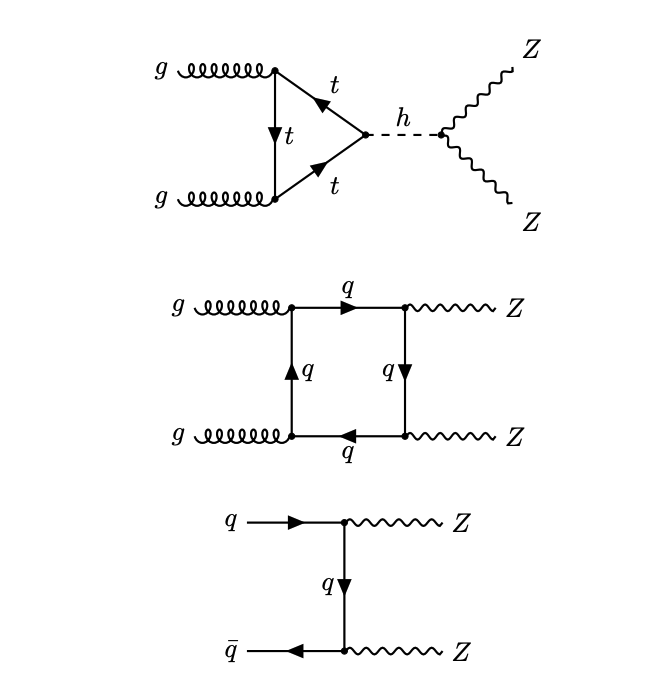
Understanding the fundamental properties of the Higgs boson remains a central goal in contemporary particle physics, with precise determination of its self-interactions being particularly elusive. This article details a novel approach to inferring the Higgs trilinear self-coupling, a measure of how the Higgs boson interacts with itself, utilising off-shell Higgs production – a process where the Higgs boson is not produced at its mass shell. Aishik Ghosh, from the University of California, Irvine and Lawrence Berkeley National Laboratory, alongside Maximilian Griese, Ulrich Haisch, Tae Hyoun Park and colleagues from the Max Planck Institute for Physics, present their work, titled ‘Neural simulation-based inference of the Higgs trilinear self-coupling via off-shell Higgs production’. Their research employs a hybrid neural network technique to improve the sensitivity of measurements at the Large Hadron Collider, potentially offering enhanced constraints on the Standard Model effective field theory (SMEFT) – a framework extending the Standard Model of particle physics to incorporate potential new physics.
Researchers are actively developing complementary methods to traditional analyses of particle interactions, with a particular focus on off-shell Higgs boson production as a sensitive probe of the Higgs trilinear self-coupling. This coupling, a fundamental parameter within the Standard Model of particle physics, describes how the Higgs boson interacts with itself, and precise measurement is vital for testing the model’s internal consistency and searching for new physics. A recent study details a novel hybrid neural-based inference (NSBI) approach, designed to construct a robust likelihood function for Higgs signals.
The NSBI method strategically combines the computational efficiency of matrix element techniques with the practical advantages of classification-based methods for background estimation. Matrix element techniques directly calculate the probability of a specific particle interaction occurring, thereby improving the accuracy of signal modelling. Classification methods, conversely, effectively distinguish genuine signal events from the overwhelming background noise produced by other particle interactions. This combination achieves a sensitivity approaching the theoretical optimum, maximising the potential for precise measurements.
Scientists construct a comprehensive likelihood function, a statistical tool used to assess the probability of observing particular data given a specific theoretical model. This function incorporates modifications predicted by the Standard Model Effective Field Theory (SMEFT), a framework extending the Standard Model by introducing additional parameters that account for potential new physics. Alongside these modifications, the likelihood function also includes accurate modelling of relevant background processes and their interference with signal events. Interference occurs when multiple processes contribute to the same final state, and accurately modelling this is crucial for precise measurements.
The study demonstrates the potential of NSBI to
The study demonstrates the potential of NSBI to constrain the Higgs trilinear self-coupling with increased precision at the High-Luminosity Large Hadron Collider (HL-LHC), a future upgrade to the existing Large Hadron Collider. The analysis extends to consider constraints on other SMEFT operators influencing off-shell Higgs production, providing a more comprehensive exploration of potential new physics signals. Off-shell production refers to Higgs bosons created with energies different from the mass predicted by the Standard Model, offering a unique window into potential deviations from established theory.
Researchers plan to refine the NSBI technique and apply it to larger datasets from the HL-LHC, aiming to further improve the precision of Higgs measurements and search for subtle deviations from Standard Model predictions. They also intend to explore the use of machine learning algorithms to optimise the analysis process and automate the identification of potential new physics signals. Future research will focus on combining the NSBI technique with other advanced analysis methods, creating a comprehensive framework for detailed Higgs physics studies.
🗞 Neural simulation-based inference of the Higgs trilinear self-coupling via off-shell Higgs production
🧠 DOI: https://doi.org/10.48550/arXiv.2507.02032


