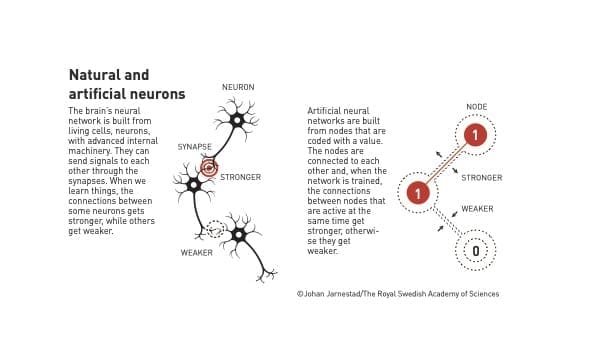
Artificial neural networks, inspired by the human brain, have revolutionized machine learning. Pioneers like John Hopfield and Geoffrey Hinton laid the foundation for this technology in the 1980s and are now rewarded with the 2024 Nobel Prize for Physics. Hinton’s work on Boltzmann machines enabled them to recognize patterns and learn from data. Later developments, such as pretraining networks with layers of Boltzmann machines, optimized their performance.
Today, these networks are used in applications like film recommendation systems. The machine learning revolution, which began around 2010, was made possible by access to vast amounts of data and increased computing power. Modern deep neural networks contain millions of parameters, a far cry from Hopfield’s 1982 network with just 30 nodes. Researchers are now exploring new areas of application, while also discussing ethical issues surrounding this technology. Physics has contributed tools for machine learning development, and in turn, is benefiting from artificial neural networks in areas like particle physics and materials science.
The Boltzmann machine, an early example of a generative model, is particularly intriguing. This type of network can learn from examples, updating its connection values to maximize the probability of generating familiar patterns. The training process allows it to recognize new, unseen data that belongs to a category found in the training material, much like recognizing a friend’s sibling based on shared traits.
The original Boltzmann machine was inefficient and slow, but subsequent developments have improved its performance. For instance, removing connections between units (a process called “thinning out”) can make it more efficient.
Geoffrey Hinton’s work in the 1990s and 2000s played a significant role in revitalizing interest in artificial neural networks. His method of pretraining a network with a series of Boltzmann machines in layers has been instrumental in optimizing image recognition tasks.
Today, machine learning is a rapidly growing field, driven by access to vast amounts of data and enormous increases in computing power. Deep neural networks, constructed from many layers, are capable of remarkable feats, such as recommending films or TV shows based on viewer preferences.
It’s striking to compare the early work of John Hopfield, who used networks with 30-100 nodes, to the massive language models of today, which can contain over one trillion parameters. The development of machine learning has been nothing short of revolutionary.
As physics has contributed tools for machine learning, it’s fascinating to see how artificial neural networks are now being applied in various areas of physics research. From sifting through data to discover the Higgs particle to predicting molecular properties and identifying exoplanets, machine learning is transforming the field.
The potential applications of machine learning are vast and varied, but so too are the ethical concerns surrounding its development and use. As researchers continue to push the boundaries of this technology, it’s essential to consider the implications and ensure that these powerful tools are used responsibly.
In conclusion, the story of artificial neural networks is a testament to human ingenuity and the power of interdisciplinary collaboration. As we look to the future, it will be exciting to see how machine learning continues to evolve and shape our understanding of the world around us.
External Link: Click Here For More