The neural basis of conscious experience remains one of the most challenging questions in neuroscience, and identifying the specific brain activity that accompanies awareness proves remarkably difficult. Francois Stockart of Yale University, Alexis Robin from CHU Grenoble Alpes, and Hal Blumenfeld, also at Yale University, alongside Milan Brazdil of Masaryk University, Philippe Kahane from CHU Grenoble Alpes, and Liad Mudrik of Tel Aviv University, address this problem by examining research utilising direct recordings from within the human brain. This review demonstrates how intracranial recordings, offering significantly improved spatial and temporal resolution compared to typical brain scanning techniques, provide unique insights into the neural correlates of perceptual consciousness. By analysing studies that examine brain activity at the level of individual neurons, the team evaluates current theories of consciousness and proposes new avenues for future research, ultimately aiming to pinpoint the brain mechanisms that give rise to subjective experience.
Neural Correlates and Theories of Consciousness
Research into consciousness currently focuses on identifying brain activity corresponding to conscious experience, exploring theoretical frameworks and employing advanced methodologies. A dominant theme is the search for neural correlates of consciousness, pinpointing brain regions and activity patterns that reliably predict awareness. Several theoretical perspectives guide this research, including Global Workspace Theory, Integrated Information Theory, and predictive processing. A major methodological approach involves intracranial electroencephalography, or iEEG, where electrodes are implanted directly into the brain to record activity with high spatial and temporal resolution, complementing electroencephalography and functional magnetic resonance imaging.
Researchers utilize paradigms like binocular rivalry and masking to manipulate awareness, and employ no-report paradigms to study unconscious processing. Specific brain regions frequently implicated in conscious awareness include the frontal and parietal cortex, involved in attention and decision-making, and the occipital cortex, extensively studied in relation to visual consciousness. Research focuses on the ventral stream, involved in object recognition, and the lateral occipital complex, specifically linked to conscious visual perception. The fronto-insular cortex, thalamus, ventral striatum, and sensory thalamocortical circuit also play crucial roles.
Emerging trends include decoding neural activity using machine learning and investigating the brain states that support conscious experience. Open science practices, such as data sharing, are increasingly emphasized to promote reproducibility and collaboration. Researchers are also exploring the relationship between oculomotor control and conscious detection, and investigating how the brain integrates information from different senses. This vibrant field relies on identifying neural correlates of consciousness using advanced neuroimaging techniques, with a growing emphasis on understanding the interplay between conscious and unconscious processing.
Intracranial Recordings Reveal Conscious Perception Mechanisms
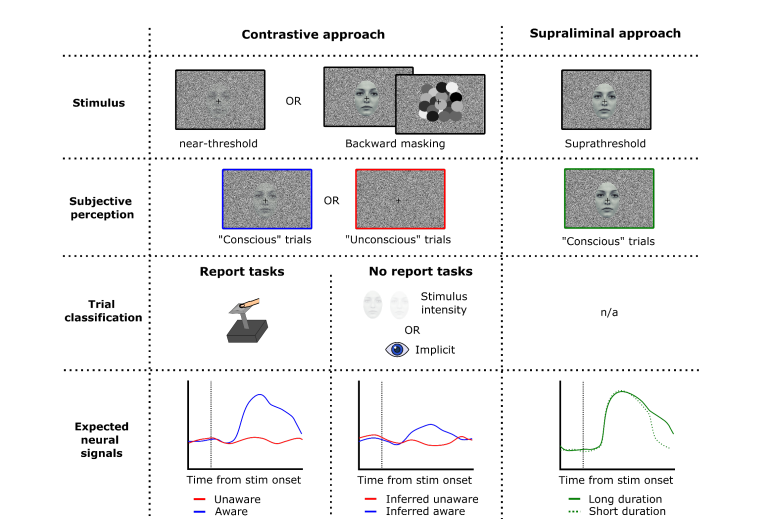
Researchers are actively investigating the neural correlates of perceptual consciousness, recognizing limitations in traditional non-invasive methods due to their restricted spatial and temporal resolution. This work addresses the challenge of disentangling genuine neural correlates from concurrent cognitive processes. The study champions human intracranial recordings as a powerful technique, offering high spatiotemporal resolution and improved signal sensitivity. A primary approach involves contrasting neural activity between trials where a stimulus is consciously perceived and those where it is not.
Researchers employ techniques like backward masking and binocular rivalry to manipulate stimulus visibility, creating conditions where the same stimulus is either consciously registered or remains unseen, while maintaining minimal differences in stimulus presentation parameters. Participants provide subjective reports of consciousness, allowing researchers to categorize trials based on conscious perception. This allows for investigation of neural activity associated with conscious experience without relying solely on manipulations of stimulus visibility. Researchers utilize report tasks, where participants use button presses or saccadic eye movements to indicate stimulus perception, and no-report tasks, employing attentional manipulations to infer conscious perception. This multifaceted approach allows for a comprehensive investigation of the neural mechanisms underlying perceptual consciousness.
Intracranial Recordings Reveal Conscious Neural Correlates
Human intracranial electrophysiology offers a powerful approach to identifying the neural correlates of perceptual consciousness, overcoming limitations inherent in non-invasive techniques like scalp EEG and MEG. This method, typically conducted on patients undergoing pre-surgical evaluation for drug-resistant epilepsy, utilizes implanted electrodes to directly record brain activity with significantly improved spatial resolution and signal-to-noise ratio. Two primary types of implants are employed: electrocorticography, or ECoG, which places electrodes on the cortical surface, and stereo-encephalography, or sEEG, utilizing depth electrodes. Both ECoG and sEEG capture local field potentials reflecting the activity of neuronal populations.
Single-neuron recordings are also possible, allowing for investigations at a finer granularity. Researchers can rereference neighboring contacts on an electrode to isolate local activity, ensuring precise signal capture. Recordings demonstrate the ability to capture brain oscillations in the high gamma range, frequencies often associated with local neuronal firing, a capability limited by signal scattering in scalp recordings. Furthermore, the implanted electrodes allow for direct brain stimulation, enabling researchers to modulate brain activity and study its effect on conscious experience. Despite challenges such as individualized implantation schemes and potential contamination from pathological brain activity, researchers are developing methods to address these issues and enhance the interpretability of intracranial data.
Intracranial Recordings Reveal Consciousness Correlates
This review demonstrates the potential of human intracranial recordings to advance the search for the neural correlates of consciousness, a long-standing challenge in neuroscience. By utilizing high spatiotemporal resolution and improved signal sensitivity, researchers can investigate brain activity with greater precision than previously possible using non-invasive techniques. Studies employing both electrocorticography and stereoelectroencephalography capture local field potentials, offering detailed insights into neural processes linked to perceptual awareness. The authors acknowledge inherent limitations within this approach, primarily stemming from the clinical context of intracranial recordings, conducted on patients undergoing pre-surgical evaluation for epilepsy.
This restricts the range of applicable behavioural paradigms and the number of participants available for study. Furthermore, the team notes the challenges of extrapolating findings from animal studies, given differences in experimental design and the inability of non-human animals to provide subjective reports. Despite these constraints, the review highlights the value of intracranial human electrophysiology as a particularly promising avenue for consciousness research, offering a complementary approach to existing methods.
🗞 Neural correlates of perceptual consciousness from within: a narrative review of human intracranial research
🧠 ArXiv: https://arxiv.org/abs/2510.08736