Designing precise control pulses for quantum computers presents a significant challenge, as even slight inaccuracies diminish performance. Sofiia Lauten and Matthew Otten, from the University of Wisconsin, Madison, address this problem by pioneering a new approach using physics-informed neural networks. Their work demonstrates that these networks effectively predict the complex pulses needed to implement quantum gates, offering a powerful alternative to traditional methods. By incorporating the fundamental laws governing quantum mechanics directly into the network’s design, they achieve high-fidelity control over quantum operations, and their flexible architecture proves robust across a variety of gate designs. This advancement promises to streamline the development of more reliable and efficient quantum computers.
PINNs Optimise Quantum Pulse Sequence Design
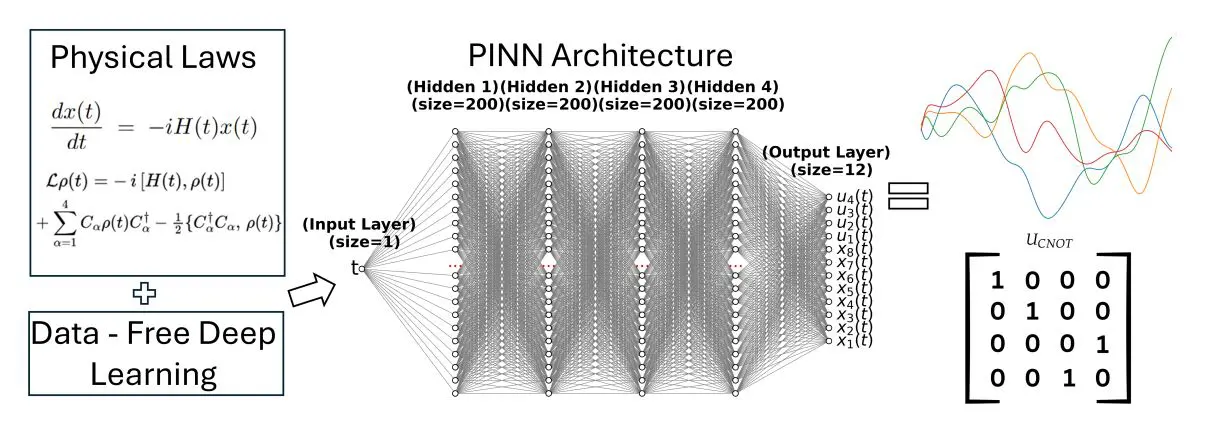
Scientists have developed a new approach to quantum control using physics-informed neural networks (PINNs) to design high-fidelity pulses for manipulating qubits. This work addresses the challenge of generating precisely shaped pulses needed for accurate quantum gate operations, moving beyond traditional optimization methods. The team engineered a feedforward neural network with an unsupervised learning framework, integrating the fundamental laws governing quantum systems directly into the training process. The network accepts a time vector as input and outputs a tensor representing the real and imaginary components of the quantum state, alongside control amplitudes.
The PINN architecture comprises an input layer, four fully connected hidden layers each containing 200 neurons, and a linear output layer. Researchers employed a sinusoidal activation function after the input and each hidden layer, tailoring the choice to the specific problem. The network processes time steps, utilizing 200 steps over a total time period, with units normalized for simplicity. Optimization was achieved using the Adaptive Moment Estimation (Adam) algorithm with a specific learning rate, trained over thousands of iterations. To model quantum dynamics, the team constructed two distinct PINNs, one based on the Schrödinger equation for closed quantum systems and another based on the Lindblad equation for open quantum systems.
The system models two qubits with a constant interaction, alongside independently tunable control fields on each qubit. The loss function enforces physical laws, ensuring the network predicts solutions consistent with quantum mechanics. This innovative approach successfully discovers high-fidelity two-qubit gate pulses for a variety of operations, demonstrating the flexibility and robustness of the method and offering a powerful new tool for quantum information processing.
Sinusoidal Activation Optimizes Quantum Control Pulses
Experiments reveal that the choice of activation function is critical for PINN performance. By comparing sinusoidal, tanh, and ReLU activation functions, researchers demonstrate that the sinusoidal function consistently outperforms the others during training, aligning with previous studies that highlight its suitability for solving complex equations and learning periodic behaviors. The team observed that ReLU’s performance suffered due to its mathematical properties, hindering its ability to satisfy the requirements of the governing equations. To optimize the PINN’s weight initialization, scientists tested various values and discovered that a specific value consistently produced smoother, more sinusoidal pulses. Increasing this value sometimes reduced pulse amplitudes, but the chosen value yielded the most desirable pulse shapes, particularly in models with low noise. In contrast, a higher value generated sharper, more oscillatory pulses containing high-frequency content, which are difficult to realize experimentally due to limitations in control electronics.
Physics-Informed Networks Control Quantum Gate Fidelity
This work demonstrates the successful application of physics-informed neural networks to the problem of optimal control for quantum gates, achieving performance comparable to existing algorithms. The team designed a specific network architecture, incorporating a sinusoidal activation function and a custom weight initialization strategy, which proved beneficial for learning these complex pulse shapes. The developed networks, based on both the Schrödinger and Lindblad equations, demonstrate flexibility and robustness in discovering pulses for a variety of quantum operations. While both network types showed similar limitations when tested in noisy environments, suggesting a need for more detailed noise information during training, the simpler Schrödinger-based model offers a computationally efficient alternative without sacrificing performance.
The researchers hypothesize that further development, potentially through advanced techniques, could lead to full transferability of learning, significantly reducing computational costs compared to current methods. Acknowledging the current limitations in creating pulses robust to noise, the team plans to investigate strategies for improving resilience. Future work includes testing the model on superconducting qubit architectures and scaling the system to larger numbers of qubits, with the ultimate goal of creating a low-cost, flexible, and generalizable model that automatically adapts to different quantum systems and surpasses the performance of existing algorithms.
🗞 Physics-Informed Neural Networks for Gate Design using Quantum Optimal Control
🧠 ArXiv: https://arxiv.org/abs/2511.09463