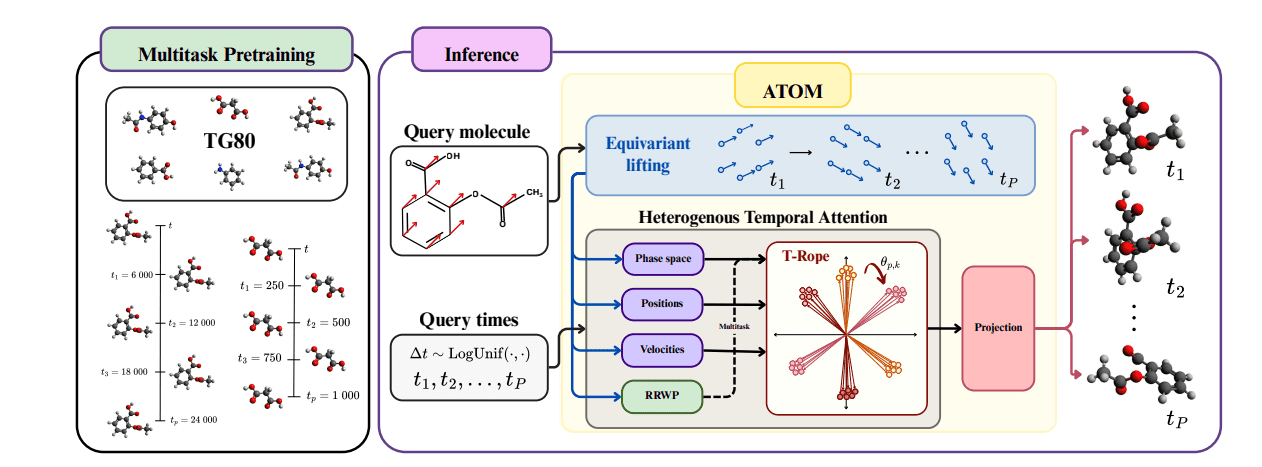
Molecular dynamics simulations are fundamental to advances in drug discovery, materials science, and biochemistry, yet conventional methods can be computationally demanding. Luke Thompson, Davy Guan, and Dai Shi, alongside colleagues from the University of Sydney and Data61, CSIRO, present a new approach with ATOM, a pretrained neural operator that significantly accelerates these simulations. ATOM overcomes limitations of existing models by employing a flexible, quasi-equivariant design and a temporal attention mechanism, allowing it to predict molecular behaviour in parallel and generalise to previously unseen compounds. The team also curated TG80, a large and diverse molecular dynamics dataset, to support the operator’s pretraining, and demonstrate that ATOM achieves state-of-the-art performance and exceptional zero-shot generalisation, representing a substantial step towards accurate, efficient and transferable molecular dynamics modelling.
Molecular Dynamics Datasets for Machine Learning
Scientists are utilizing molecular dynamics simulations to understand how molecules move and interact over time, a crucial process for fields like drug discovery and materials science. These simulations generate datasets now used to train machine learning models capable of predicting molecular behavior. Researchers created three datasets for this purpose: MD17, a standard benchmark; TG80, a collection of 80 different molecules; and an expanded version of TG80, providing more diverse training data. The expanded dataset builds upon the original molecules, allowing models to learn from a wider range of chemical structures, ultimately accelerating scientific discovery.
Transformer Operator Predicts Molecular Dynamics Trajectories
Scientists have developed Atomistic Transformer Operator for Molecules, or ATOM, a novel approach to molecular dynamics simulations that overcomes limitations in existing methods regarding accuracy, computational efficiency, and generalization to new compounds. ATOM employs a transformer neural operator, pre-trained across diverse chemical compounds and timescales, to predict molecular movement with improved speed and precision. This innovative design allows for parallel processing of molecular states, significantly accelerating simulations. A key advancement lies in ATOM’s balance of physical symmetry and model flexibility, allowing it to accurately represent complex molecular interactions.
Researchers implemented a specialized layer to generate symmetry-aware features, while allowing subsequent processing blocks to operate without strict symmetry constraints, enhancing expressiveness and simplifying optimization. To further enhance performance, scientists introduced a novel method for encoding time lags, improving the prediction of molecular behavior over varying time horizons. To support the development and benchmarking of ATOM, the team curated TG80, a large and diverse molecular dynamics dataset comprising over 2. 5 million femtoseconds of trajectories across 80 different compounds.
This dataset is specifically designed for training models to learn transferable representations of molecular dynamics. Unlike existing methods trained on individual molecules, ATOM demonstrates exceptional ability to accurately simulate the behavior of previously unseen molecules and predict their behavior over extended time horizons. The system operates directly on point cloud data, streamlining the simulation process. The research team achieved significant improvements in both accuracy and efficiency, demonstrating the potential of ATOM to accelerate molecular dynamics simulations and facilitate advancements in drug discovery and materials science.
ATOM Predicts Molecular Dynamics with High Accuracy
Researchers have achieved a significant breakthrough in molecular dynamics simulations with the development of Atomistic Transformer Operator for Molecules, or ATOM, a novel approach to predicting the behavior of molecules over time. This work addresses limitations in existing methods by creating a model capable of accurately and efficiently simulating complex molecular interactions across diverse chemical compounds and timescales. The team curated TG80, a large and stable molecular dynamics dataset comprising over 2. 5 million femtoseconds of trajectories across 80 different compounds, to support the training and validation of ATOM.
Experiments demonstrate that ATOM achieves state-of-the-art performance on established benchmarks, including MD17, RMD17, and MD22. Specifically, on the MD17 dataset, ATOM yielded significant reductions in prediction error compared to existing methods. On the MD22 dataset, which includes larger molecules, ATOM maintained competitive performance while other models struggled. This success is attributed to ATOM’s ability to accurately represent both local and long-range interactions within molecules, a challenge for many existing approaches. The team further demonstrated ATOM’s capabilities through training on the TG80 dataset, consistently outperforming existing models with a robust validation approach. These results highlight ATOM’s potential to accelerate materials discovery and drug design by providing a more accurate and efficient means of simulating molecular behavior.
ATOM Predicts Molecular Dynamics with Zero-Shot Accuracy
Researchers have developed a new approach to molecular dynamics simulations, introducing the Atomistic Transformer Operator for Molecules, or ATOM. This method utilizes a transformer neural operator, enabling accurate and efficient prediction of how molecules change over time. ATOM demonstrates a capacity for zero-shot generalization, meaning it can accurately simulate the dynamics of previously unseen molecules without requiring retraining. Experiments show strong performance on established benchmarks and, crucially, the ability to model larger molecules than previously possible with this type of approach.
This work is supported by the creation of TG80, a large and diverse dataset of molecular trajectories, which serves as a valuable resource for evaluating and advancing future models in the field. The researchers acknowledge limitations in the current dataset, specifically a lack of trajectories for very large molecules, and plan to expand TG80 to include these in future work. They also note that ATOM currently lacks an explicit energy-based component, which could improve long-term simulation stability, and suggest incorporating physics-informed features as a promising avenue for future research. The team intends to release both the TG80 dataset and experimental details to promote reproducibility and further investigation within the scientific community.
👉 More information
🗞 ATOM: A Pretrained Neural Operator for Multitask Molecular Dynamics
🧠 ArXiv: https://arxiv.org/abs/2510.05482