Photoacoustic computed tomography (PACT) offers the potential for deep-tissue imaging with both high contrast and ultrasonic resolution, but current systems often require extensive hardware and lengthy scan times that hinder widespread clinical use. Jiayun Wang, Yousuf Aborahama, Arya Khokhar, and colleagues address this challenge by developing a novel approach, Pano, which learns to reconstruct 3D images directly from sensor data using a physics-aware neural network. This innovative method bypasses traditional reconstruction algorithms, achieving high-quality volumetric imaging with significantly fewer sensors and faster acquisition speeds. By incorporating the fundamental principles of wave propagation into the learning process, Pano not only preserves image fidelity but also operates effectively with varying sensor configurations, paving the way for more practical and accessible 3D PACT systems for both research and clinical applications.
Pano Algorithm Validates Ultrasound Reconstruction Accuracy
This research details Pano, a new method for image reconstruction in ultrasound Computed Tomography (USCT), and provides extensive results validating its performance. Scientists conducted thorough numerical tests and studies to confirm Pano’s accuracy and efficiency, focusing on reconstructing images from limited data, a significant challenge in medical imaging. Experiments utilized both simulated and real phantom data to assess reconstruction quality using cosine similarity, peak signal-to-noise ratio, and normalized mean squared error. Researchers systematically varied the number of sensors and sampling patterns to assess robustness, comparing Pano with and without a physics loss to determine its impact on reconstruction quality.
Results demonstrate that Pano consistently outperforms existing methods, achieving higher cosine similarity and peak signal-to-noise ratio, and lower normalized mean squared error, across various sparsity levels and data types. Pano exhibits a more graceful degradation in performance as data becomes sparser, maintaining higher reconstruction quality even with significantly reduced sensor data. The inclusion of the physics loss consistently improves reconstruction quality, particularly when data is limited, suggesting it effectively regularizes the reconstruction process. Pano also demonstrates resilience to limited-angle sampling, maintaining good performance even when data is acquired from a restricted range of angles, suggesting potential for significantly improved USCT imaging, reduced data acquisition costs, and more accurate diagnoses.
Physics-Aware Neural Network for PACT Imaging
Scientists developed Pano, a novel deep learning framework for three-dimensional photoacoustic tomography (PACT) image reconstruction, addressing limitations in current systems that require dense transducer arrays and prolonged acquisition times. This new approach directly learns the relationship between sensor measurements and reconstructed images, bypassing the need for traditional physics-based solvers. Unlike methods that treat image reconstruction as a post-processing task, Pano jointly learns both the physics of wave propagation and data characteristics, enabling greater flexibility and generalizability. Pano is resolution-agnostic, substantially reducing reliance on extensive transducer arrays.
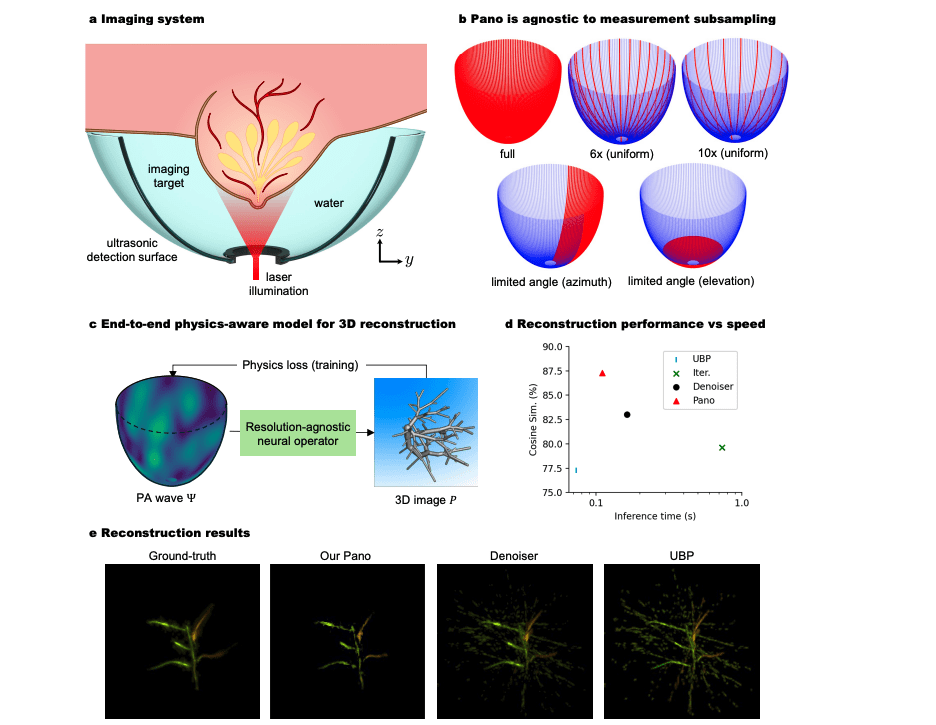
The system employs spherical discrete-continuous convolutions to accurately represent the hemispherical geometry of the sensor arrangement, ensuring physical consistency within the reconstruction process. Researchers incorporated constraints based on the Helmholtz equation into the framework, further reinforcing the physical plausibility of the reconstructed images. Experiments utilized a hemispherical ultrasound transducer array to detect photoacoustic waves. The team implemented a sampling-based strategy to balance computational efficiency and gradient stability, enabling scalable implementation for large-scale datasets. Pano achieves over 30% improvement in reconstruction metrics compared to a widely-adapted solver and a 6% improvement over an existing deep learning method, successfully reconstructing high-quality images using only 33% scan angle coverage, establishing a practical pathway for more accessible and feasible 3D PACT imaging for preclinical research and clinical applications.
Pano Reconstructs 3D Images From Sparse Data
Scientists developed Pano, a novel deep learning framework that reconstructs three-dimensional images from photoacoustic tomography (PACT) data, achieving significant advancements in imaging speed and reduced hardware requirements. The research team demonstrated that Pano accurately transforms photoacoustic waves into detailed volumetric images, operating effectively even with substantially fewer sensor elements and accelerated data acquisition. Experiments revealed that Pano maintains high reconstruction fidelity across diverse sparse sampling patterns, enabling real-time volumetric imaging capabilities. The system utilizes a hemispherical ultrasonic detection surface to capture photoacoustic signals generated by illuminating a target object.
Data shows that Pano achieves a 10% improvement in reconstruction performance compared to the state-of-the-art universal back-projection algorithm (UBP), while maintaining comparable inference time. Measurements confirm that Pano achieves consistently high cosine similarity scores, demonstrating its ability to accurately reconstruct images from limited and accelerated data. The framework operates as a neural operator, a deep learning architecture designed to learn mappings between function spaces, and is agnostic to the sensor array’s sampling pattern, allowing Pano to accelerate imaging and reduce system complexity without compromising image quality. A cycle consistency check, incorporating a physics loss, further ensures the reconstructed images adhere to physical principles, validating the accuracy and reliability of the framework.
Physics-Aware Reconstruction for Real-Time Imaging
This research presents Pano, a novel physics-aware model for photoacoustic tomography (PACT) that directly learns how to reconstruct images from sensor measurements. By recasting the reconstruction process as an operator-learning problem, the team has achieved high-quality, real-time 3D imaging even with significantly reduced transducer counts and sparse data acquisition. This advancement overcomes limitations of existing methods, which typically require dense transducer arrays and prolonged acquisition times, hindering clinical translation. Pano distinguishes itself through its ability to learn both the underlying physics and data characteristics of the imaging process, while remaining independent of input data resolution.
The model employs spherical discrete-continuous convolutions to accurately represent sensor geometry and incorporates constraints based on the Helmholtz equation to ensure physical consistency in the reconstructed images. Demonstrations using both simulated and experimental data confirm Pano’s robustness and efficiency, establishing a practical pathway toward more accessible and cost-effective 3D PACT systems for preclinical and clinical applications. The authors acknowledge that extending Pano to heterogeneous media will be crucial for imaging deeper tissues and future work will focus on addressing these limitations and further refining the model to expand its capabilities and broaden its applicability in diverse imaging scenarios.
👉 More information
🗞 Accelerating 3D Photoacoustic Computed Tomography with End-to-End Physics-Aware Neural Operators
🧠 ArXiv: https://arxiv.org/abs/2509.09894