

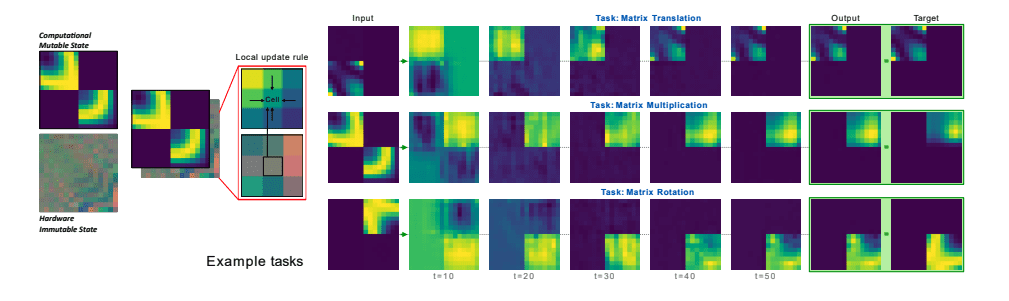
Researchers successfully trained a neural cellular automaton to perform computations within its state, achieving universal computation in a continuous domain. The system learned to emulate a neural network solving the MNIST digit classification task, demonstrating a pathway towards discovering complex behaviours via machine learning and advancing understanding of universality.
The capacity for simple systems to exhibit complex behaviour remains a central question in both physics and computation. Researchers are now investigating whether this principle extends to cellular automata – discrete models evolving in space and time according to local rules – when combined with the learning capabilities of artificial neural networks. A team led by Gabriel Béna, Dan Goodman, Maxence Faldor and Antoine Cully from Imperial College London detail their work in ‘A Path to Universal Neural Cellular Automata’, demonstrating the training of a continuous neural cellular automaton capable of performing complex computations, including the classification of handwritten digits, entirely within its internal state. This work establishes a pathway towards realising general-purpose computation using a self-learning, spatially distributed system.
Neural Cellular Automata Achieve Functional Universality
A recently published study details the successful training of a neural cellular automaton (NCA) to perform complex computations directly within its evolving state. This establishes a functional, continuous, universal cellular automaton – a system capable, in principle, of performing any computation.
Cellular automata (CA) are discrete dynamical systems where space and time are discretised. The state of each cell evolves according to a fixed rule based on the states of its neighbours. This research moves beyond pre-defined rules, utilising gradient descent optimisation – a machine learning technique – to learn the rules governing the NCA’s evolution. The trained NCA demonstrates the ability to perform fundamental linear algebra operations, including matrix multiplication and transposition, and subsequently, to classify handwritten digits from the MNIST dataset – a standard benchmark in machine learning.
The success hinges on carefully constructed objective functions. These functions reward the NCA for exhibiting desired computational behaviours and penalise undesirable ones, effectively guiding the learning process. This approach contrasts with traditional CA research, which typically focuses on analysing the emergent behaviour of fixed rule sets.
Previous work, notably explorations of Langton’s ant – a simple CA exhibiting complex behaviour – and investigations into the computational beauty of natural phenomena, established the potential for complexity within simple rule-based systems. This study extends this by demonstrating that learned rules, implemented via neural networks, can unlock significantly greater computational power than pre-defined rulesets.
The research offers insights into universality within continuous dynamical systems. Researchers demonstrated that a relatively simple system, governed by a limited set of learned rules, can exhibit complex behaviour and perform sophisticated computations. This challenges conventional computational paradigms and suggests alternative approaches to information processing.
Furthermore, the study advances automated discovery of complex behaviours within CA using machine learning. This opens avenues for novel artificial intelligence and machine learning techniques, moving beyond explicitly programmed algorithms. The researchers introduce a specific NCA model, alongside the objective functions and training strategies employed, providing a replicable blueprint for future investigations. Recent computational tools, such as CAX – an implementation utilising the JAX library – facilitate efficient exploration of these systems, accelerating the pace of discovery.
This work draws inspiration from biological self-organisation and emergent behaviour, seeking to replicate the efficiency and adaptability of natural systems in computational models. The successful implementation demonstrates the potential of bio-inspired computing to address complex challenges in artificial intelligence and machine learning. The research builds upon foundational work in both CA and neuromorphic computing – the design of computer chips that mimic the structure and function of the brain. By leveraging principles of brain-inspired organisation, the researchers created a system capable of complex information processing.
Ultimately, this study demonstrates the power of machine learning to explore the vast space of possible behaviours in complex systems, potentially leading to the discovery of new algorithms and solutions. This has implications for our understanding of computation and information processing, and may pave the way for more intelligent and sustainable technologies.
👉 More information
🗞 A Path to Universal Neural Cellular Automata
🧠 DOI: https://doi.org/10.48550/arXiv.2505.13058


