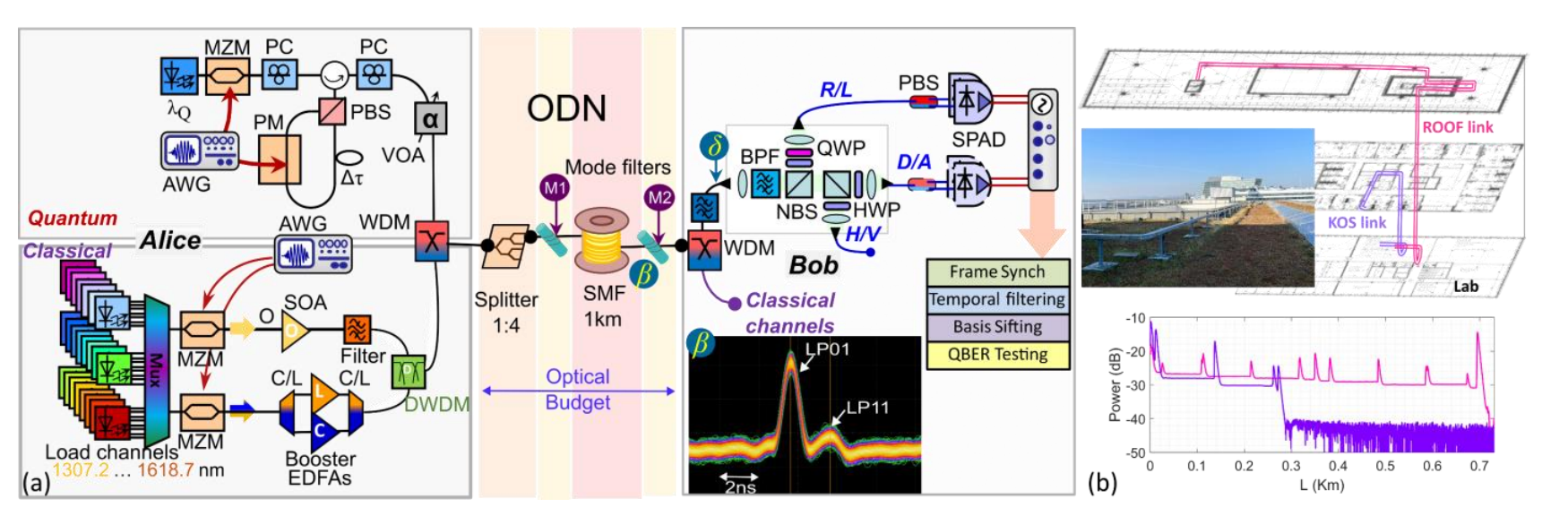
Quantum key distribution (QKD) promises unconditionally secure communication, but current systems typically rely on dedicated fibre infrastructure, limiting their widespread adoption. Mariana F. Ramos, Costin Luchian, and Michael Hentschel, along with colleagues at the AIT Austrian Institute of Technology, demonstrate a significant step towards integrating QKD into existing telecommunications networks. The team successfully implements shortwave-QKD over short-reach architectures, achieving a secure key generation rate of 12 kilobits per second even with 50 co-existing data channels. This achievement overcomes challenges posed by few-mode propagation and speckle-selective loss, paving the way for practical, cost-effective quantum-secured networks compatible with current telecom applications.
Secure Quantum Key Distribution in Data Centers
Scientists have demonstrated secure communication alongside standard data transmission using shortwave technology deployed in data center architectures. The research team successfully achieved a secure-key rate of 12 kb/s, even while simultaneously operating 50 co-existing classical data channels, confirming the potential for integrating quantum security with existing networks. Experiments revealed that few-mode propagation impacts performance in these short-reach systems, with speckle-selective loss and differential mode delay causing signal depolarization. To address this, the team measured a potential improvement of approximately 3% in the quantum bit error rate by implementing mode filtering at the final optical connection. Further optimization involved carefully tuning the launch conditions for the quantum key distribution modes, maximizing signal fidelity. This work demonstrates a viable path towards enhancing data center security through the integration of quantum technologies, paving the way for future advancements in secure network infrastructure.
Shortwave QKD in Existing Fibre Networks
This research demonstrates the feasibility of shortwave quantum key distribution (QKD) operating within existing telecommunications infrastructure. Scientists successfully implemented QKD using standard optical fibre and components, achieving a secure-key rate of 12 kb/s even alongside 50 co-existing classical data channels. The team investigated the impact of few-mode propagation, revealing that speckle-selective loss and differential mode delay within the fibre network can significantly affect performance by causing signal depolarization. Testing over an installed indoor fibre loop demonstrated high stability, with a peak-to-peak quantum bit error rate (QBER) excursion of only 5.
7% and an average raw-key rate of 19. 2 kb/s. The authors acknowledge that performance is affected by the characteristics of the fibre and components used, and further research could focus on mitigating the effects of speckle and mode delay to enhance key rates and transmission distances. This work contributes to the development of practical, secure communication networks compatible with current data centre and local area network technologies.
Few-Mode QKD Over Telecom Infrastructure
Scientists have investigated the propagation of shortwave quantum key distribution signals over standard telecommunications infrastructure. The research team discovered that components like planar lightwave circuit splitters introduce variations in key rate and quantum bit error rate due to speckle-selective loss and differential mode delay, which causes signal depolarization. The team demonstrated that implementing mode filtering at the final optical connection improves the quantum bit error rate by approximately 3% and that optimizing the launch conditions for the quantum key distribution modes further enhances performance. Experiments conducted over installed fibre loops, including a 270-meter office loop and a 692-meter rooftop loop, demonstrated high stability and consistent performance. The team found that speckle patterns introduced by the splitters cause variations in transmission loss, impacting the overall key rate. Careful spectral tuning of the quantum signal minimizes these effects, ensuring reliable secure communication.
🗞 Enabling Shortwave-QKD in Short-Reach Networks: Impact of a Composite ODN Native to Telecom Applications
🧠 ArXiv: https://arxiv.org/abs/2510.22617