

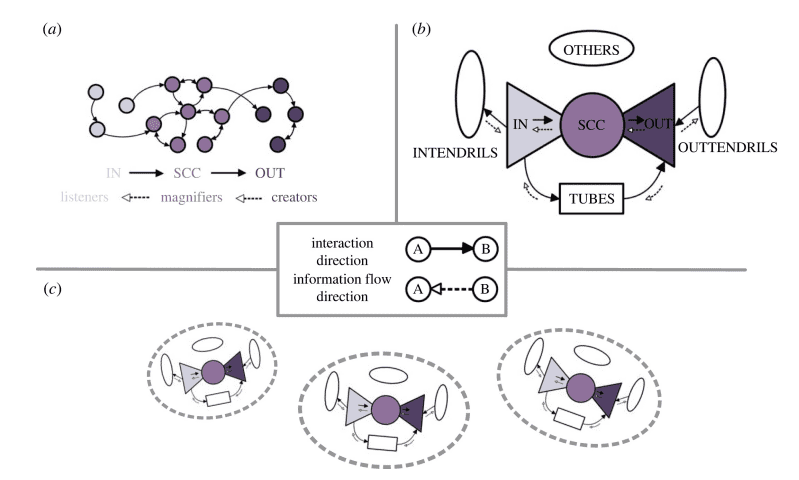
The spread of news, rumours and opinions increasingly resembles a physical process, driven by interactions within complex networks, and researchers are now applying the tools of statistical physics to understand these dynamics. Guido Caldarelli from Istituto dei Sistemi Complessi CNR-ISC, Oriol Artimed from Universitat de Barcelona, and Giulia Fischetti from Ca’Foscari University of Venice, alongside Stefano Guarino, Andrzej Nowak, and Fabio Saracco, and their colleagues, demonstrate how this framework illuminates the flow of information in modern media ecosystems. Their work systematically examines the underlying principles governing information spreading and opinion formation, moving beyond traditional social science approaches to reveal the physical mechanisms at play. By analysing both large-scale data and theoretical models, the team provides valuable insights into phenomena such as misinformation cascades and opinion polarisation, offering a new perspective on the challenges of information disorders in the digital age.
Temporal Networks and Non-Poissonian Activity
This body of work comprehensively investigates network science, opinion dynamics, and the impact of unpredictable activity on processes like information spreading and collective behaviour. Researchers focus on networks that evolve over time, where the timing of interactions is critical, moving beyond traditional static models. A central theme is the deviation from random events, exploring phenomena like burstiness, aging, and memory effects. Many studies examine how opinions form, spread, and change within networks, employing models such as the Voter, Deffuant, and Schelling segregation models. Researchers also investigate how information, or innovations, propagates through networks, with a particular emphasis on temporal patterns.
Studies explore how individual agents coordinate their behaviour to achieve collective outcomes, and how bursty arrivals impact queueing dynamics and priority systems. This research encompasses theoretical foundations of temporal networks, opinion dynamics with temporal effects, information spreading, queueing systems, and general temporal network analysis. By combining models and validating them with real-world data, scientists aim to understand adaptive networks and develop strategies for controlling information or opinion spread, promising a deeper understanding of complex social dynamics and opening avenues for future research in areas like higher-order interactions and multi-agent systems.
Social Networks Exhibit Power Law and Small-World Properties
This work demonstrates a powerful framework for understanding complex social dynamics by applying principles from statistical physics to the study of information flow and opinion formation. Researchers established that real-world networks, representing social and technological connections, exhibit recurring structural features crucial for understanding collective behaviours. Analysis of these networks revealed skewed degree distributions, where most nodes have few connections while a small number act as hubs. Detailed evaluations indicate that truncated power laws, log-normal distributions, or exponential cutoffs more accurately describe many networks.
The study further confirmed the “small-world” property of these networks, demonstrating that average path lengths scale logarithmically with the number of nodes, enabling efficient propagation of information. Simultaneously, researchers observed unusually high clustering coefficients, indicating a strong tendency for connections between neighbours, and a clustering spectrum that varies by degree, with high-degree nodes exhibiting lower clustering and low-degree nodes belonging to tightly knit communities. These findings suggest hierarchical or modular organization within social structures. Importantly, the research consistently identified the presence of community structure, where nodes cluster into groups with dense internal connections and sparse external links. These detailed network properties serve as benchmarks for generative models and provide crucial insights into processes like diffusion, contagion, and percolation, ultimately enhancing our ability to model and predict collective behaviours within complex social systems.
Social Systems Mirror Physical Phenomena
This research demonstrates the power of applying concepts from statistical physics to the study of social systems, revealing parallels between collective physical phenomena and large-scale human behaviours. By modelling individuals as interacting particles, scientists have begun to explain complex social dynamics such as opinion formation, the spread of misinformation, and sudden shifts in public sentiment. The work establishes a framework for understanding how macroscopic social patterns emerge from microscopic interactions, drawing on concepts like phase transitions and stochastic dynamics to illuminate previously unexplained behaviours. The team systematically reviewed both empirical findings derived from large-scale data analysis and theoretical advances in physics-based modelling, highlighting valuable insights into phenomena with significant societal impact. They acknowledge that directly applying statistical mechanics to social systems presents challenges, as individuals are more akin to active matter than inert particles, and social networks exhibit characteristics like fat-tail distributions and out-of-equilibrium dynamics. Future research will focus on uncovering the limited but crucial observational regularities within these complex structures, promising a more robust and predictive understanding of social behaviours, moving beyond traditional qualitative analyses to a more quantitative and physics-informed perspective.
👉 More information
🗞 The Physics of News, Rumors, and Opinions
🧠 ArXiv: https://arxiv.org/abs/2510.15053


