

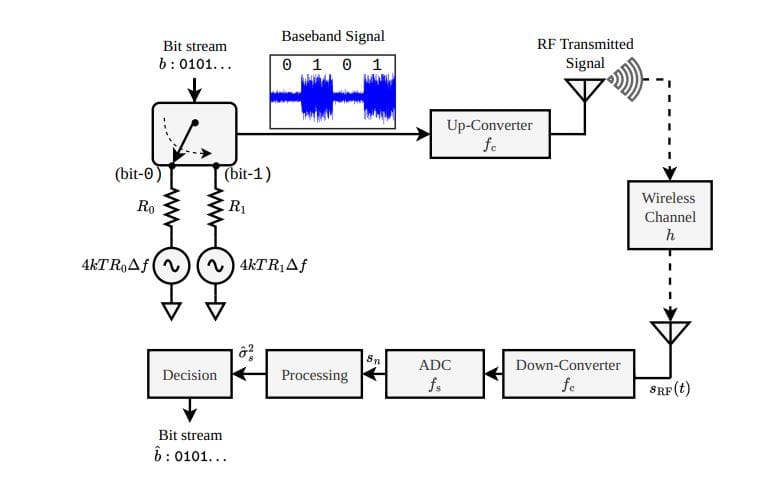
The relentless expansion of sixth-generation (6G) networks and the Internet of Things creates a pressing need for wireless communication systems that are both energy efficient and secure, while also remaining difficult to detect. Higo T. P. Da Silva, Hugerles S. Silva, and Felipe A. P. Figueiredo, alongside their colleagues, comprehensively survey the emerging field of noise-based communication, a transformative approach that encodes information within the inherent randomness of noise itself, rather than relying on conventional signal carriers. This work systematically explores the fundamental principles and key techniques within the field, including methods like thermal noise modulation and Kirchhoff-law-Johnson-noise secure key exchange, and addresses the practical hurdles of implementation and channel estimation. The team’s analysis demonstrates that these noise-based systems offer significant advantages in energy conservation and covertness, paving the way for the development of autonomous and secure wireless networks for the future.
This research investigates novel approaches to achieve these characteristics, focusing on the potential of noise-based communication. The team explores methods to embed information within noise signals, effectively concealing communication from unintended receivers. This technique leverages the inherent randomness of noise to mask the presence of a transmitted signal, enhancing security and enabling covert communication channels. The work details a system designed to transmit data using carefully modulated noise, achieving a balance between communication range, data rate, and the level of concealment. The central idea is to utilize naturally occurring thermal noise as a carrier for information, offering advantages in terms of energy efficiency, hardware simplicity, and inherent security. Noise-based systems can operate with extremely low power consumption, making them ideal for battery-constrained devices. The inherent randomness of noise provides a layer of security at the physical layer, making it difficult for eavesdroppers to intercept and decode the signal.
Researchers systematically investigated several key methodologies, including thermal noise modulation, noise modulation, and secure key exchange protocols, addressing practical challenges like accurately estimating the wireless channel and accounting for limitations in real-world hardware. The team explored various techniques to optimize performance, including adjusting detection thresholds and developing new modulation schemes. One approach, transmitting two-bit sequences per signaling interval, enhanced data rates. Another, eliminating the need for channel state information, improved robustness in practical scenarios. Time-domain noise modulation achieved diversity proportional to the number of temporal spreading slots, while On-Off Digital Noise Modulation consistently outperformed standard noise modulation in both clear and obstructed environments. Researchers systematically investigated several key methodologies, including thermal noise modulation, noise modulation, and secure key exchange, addressing practical challenges like channel estimation and hardware implementation. Thermal noise modulation, due to its passive nature, exhibits inherent energy efficiency, and optimization of the detection threshold significantly improved its performance. Noise modulation and a variant, NC-NoiseMod, achieved equivalent performance, with NC-NoiseMod demonstrating greater robustness by eliminating the need for channel state information for detection.
The team also explored time-domain noise modulation, achieving diversity proportional to the number of temporal spreading slots, though this required channel state information. Notably, On-Off Digital Noise Modulation consistently outperformed standard noise modulation in both line-of-sight and non-line-of-sight environments. Researchers developed Noise-Domain Non-Orthogonal Multiple Access, enabling multiple users to share resources simultaneously, and evaluated its performance under realistic fading conditions. Scientists systematically analyzed core principles, ranging from foundational thermal noise modulation to advanced artificial noise schemes and their application in secure key exchange protocols. The findings demonstrate that noise-based systems offer a unique combination of energy efficiency, hardware simplicity, and inherent physical-layer security, addressing critical demands for future networks supporting the Internet of Things and sixth-generation wireless technologies. Researchers acknowledge ongoing challenges in areas such as robust channel estimation, the impact of hardware imperfections, and achieving scalability for multiple users. Future work will focus on developing intelligent, low-complexity detection methods, exploring integration with concepts inspired by quantum mechanics and reconfigurable intelligent surfaces, and crucially, initiating standardization efforts. By directly addressing the fundamental trade-offs in next-generation wireless systems, noise-based communication is poised to become a cornerstone technology for enabling ubiquitous, secure, and sustainable connectivity.
👉 More information
🗞 A Survey on Noise-Based Communication
🧠 ArXiv: https://arxiv.org/abs/2511.04011


