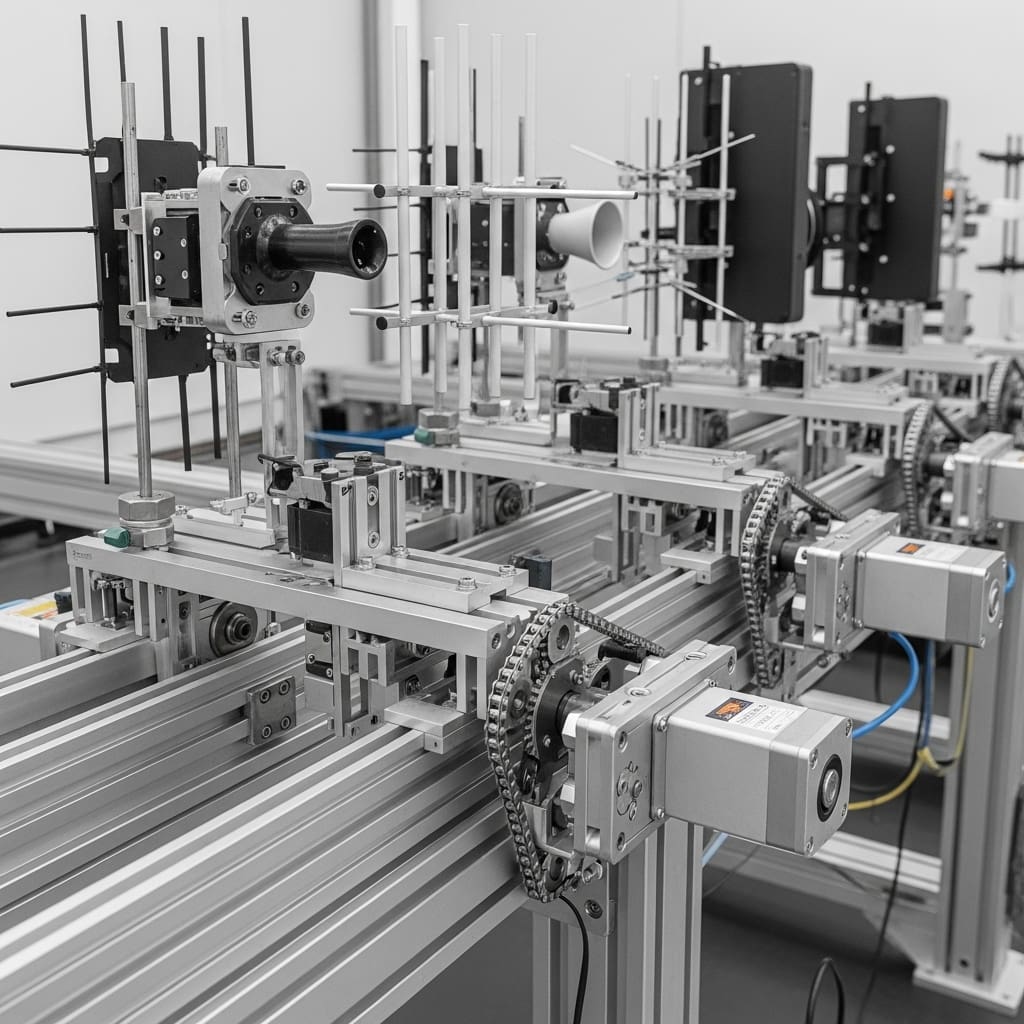
Wireless sensing stands to gain significant improvements through the dynamic adjustment of antenna positions, and a team led by Haobin Mao from Beihang University, Lipeng Zhu and Rui Zhang from the National University of Singapore, alongside Wenyan Ma, Zhenyu Xiao and Xiang-Gen Xia, now demonstrates a novel system exploiting movable antenna arrays to enhance multi-target detection. The researchers establish a theoretical framework by characterizing the fundamental limits of angle estimation accuracy, known as the Cramér-Rao bound, as it relates to antenna placement. By optimising antenna positions to minimise this bound, and employing innovative computational methods, they achieve superior sensing performance compared to traditional fixed antenna systems and those designed for single targets. This work fundamentally improves the ability to distinguish between multiple targets, reducing ambiguity and enhancing the precision of angle estimation, paving the way for more reliable and effective sensing technologies in future wireless networks.
Movable Antennas for Wireless Communication Systems
This collection of research explores the potential of movable antennas to revolutionize wireless communication and sensing technologies, particularly within the context of emerging sixth-generation (6G) networks. A central theme is the integration of communication and sensing capabilities, allowing systems to simultaneously transmit data and perceive their environment. The work also covers near-field communication, a short-range technology enabling high-data-rate communication, and reconfigurable intelligent surfaces, which enhance signal reflection and refraction. Many studies focus on optimizing antenna placement and signal processing techniques to improve channel estimation, direction-of-arrival (DOA) estimation, and overall system performance. Researchers are also investigating the use of machine learning and swarm intelligence algorithms to automate antenna configuration and enhance optimization processes, demonstrating a clear trend toward intelligent and adaptable wireless systems capable of meeting the demands of increasingly complex communication scenarios.
Antenna Positioning Optimizes Spatial Angle Estimation
Scientists have developed a novel wireless sensing system that significantly enhances multi-target spatial angle estimation for sixth-generation (6G) networks. The research establishes a theoretical foundation by characterizing the Cramér-Rao bound, a limit on estimation accuracy, as it relates to antenna positions within a movable antenna array. By carefully optimizing antenna placement, the team aimed to maximize sensing coverage and precision, formulating an optimization problem to minimize the expected trace of the Cramér-Rao bound across random target angles. To address the computational complexity of this optimization, scientists employed the Monte Carlo method to approximate the objective function and a swarm-based gradient descent algorithm to iteratively refine antenna positions. Experiments demonstrate that the proposed system outperforms conventional fixed-position antenna arrays and single-target oriented movable arrays, consistently reducing both the theoretical limit on accuracy and the actual estimation error. This research delivers a fundamentally new approach to wireless sensing, unlocking additional degrees of freedom through dynamic antenna positioning and enabling substantial gains in angle estimation resolution.
Movable Antennas Enhance Spatial Angle Estimation
This research presents a novel wireless sensing system that enhances multi-target spatial angle estimation through the use of movable antenna arrays. The team characterized the Cramér-Rao bound, a limit on estimation accuracy, as it relates to antenna positioning, allowing them to formulate an optimization problem designed to minimize estimation error by strategically configuring antenna positions within the array. To solve this complex problem, the researchers employed a combination of computational techniques, including the Monte Carlo method and a swarm-based gradient descent algorithm. Through simulations, they demonstrated that their movable antenna design significantly outperforms conventional systems using fixed-position antennas and single-target oriented movable arrays, achieving lower Cramér-Rao bounds and reduced mean square error in angle estimation. This improvement stems from the array’s ability to create low-correlation and high-power sensitivity vectors, which mitigate ambiguity and enhance accuracy in multi-target scenarios.
👉 More information
🗞 Movable-Antenna Array Enhanced Multi-Target Sensing: CRB Characterization and Optimization
🧠 ArXiv: https://arxiv.org/abs/2511.18907