Securely sharing confidential data with multiple users, known as multicast, presents a significant challenge in modern communications, and researchers are continually seeking ways to improve both capacity and long-term security. Masahide Sasaki, Te Sun Han, and Mikio Fujiwara, all from the National Institute of Information and Communications Technology, alongside Kai Li, Oliver Hambrey from Siglead Europe Ltd., and Atsushi Esumi from Siglead Inc., have developed a new system that addresses these limitations. Their work introduces path-controlled universal strongly ramp secure network coding, a method that efficiently finds optimal data paths and integrates with existing security technologies like quantum key distribution and physical layer security. This advancement overcomes the scalability issues of previous approaches, which often rely on trusted nodes or specific network conditions, and demonstrates the potential for achieving secure, reliable multicast communication across large, multi-hop networks, offering a practical path towards global-scale secure data sharing.
Rank-Metric Codes and Network Coding Security
This document provides a comprehensive overview of coding theory, network coding, and related mathematical concepts, serving as a valuable resource for researchers and students in the field. A significant emphasis lies on rank-metric codes, crucial for network coding error control and security, with Gabidulin codes receiving considerable attention due to their unique properties. The references detail error correction and decoding algorithms, including those for Gabidulin, BCH, and other codes, utilizing methods like Berlekamp-Massey and Welch-Berlekamp for efficient decoding. The mathematical foundation rests on finite field theory, covering finite field arithmetic and normal bases, with shift registers and linearized polynomials explored for code construction and decoding. The collection also covers security and cryptography, including secrecy functions and effective secrecy in network coding, extending to space networks with 3D visualizations and satellite mapping resources. The inclusion of recent research demonstrates the document’s currency and relevance to the latest advancements in the field.
Multicast Security via Path-Controlled Network Coding
Scientists have developed path-controlled universal strongly ramp secure network coding (PUSNEC) to overcome limitations in current multicast security methods, which often rely on vulnerable routing or cryptographic techniques. This innovative system integrates secure network coding with existing quantum key distribution (QKD) and physical layer security (PLS) networks, enabling both multicast capacity and information-theoretic security, even as networks expand. This approach eliminates the need for fully trusted nodes, a significant weakness in traditional QKD/PLS multicast implementations. The research team engineered a multi-tree multicast path-finding method to efficiently distribute confidential data, moving beyond simple distribution trees and creating multiple paths between source and destination for increased robustness.
Scientists then integrated this path-finding method with universal strongly ramp secure network coding, encoding data into packets and linearly combining them at intermediate nodes to enable multicast capacity while protecting against eavesdropping, employing maximum rank distance (MRD) codes at the source node to ensure both secrecy and error-control. To demonstrate PUSNEC’s effectiveness, the team conducted numerical simulations of multi-hop networks, analyzing the secrecy-reliability tradeoff under realistic conditions and validating the system’s ability to maintain secure multicast communication. The study highlights a practical approach to achieving secure, reliable multicast on a global scale, offering a significant advancement over existing methods that struggle to balance security, capacity, and scalability.
Secure Multicast Coding in Probabilistic Networks
Scientists have developed path-controlled universal strongly ramp secure network coding (PUSNEC) to address the challenges of secure multicast communication, particularly in large-scale networks. This work integrates a novel multi-tree multicast path-finding method with universal strongly ramp secure network coding, creating a system capable of overlaying onto existing quantum key distribution (QKD) or physical layer security (PLS) networks, delivering enhanced multicast capacity, information-theoretic security, and scalability. The team measured the maximum leakage of information to an eavesdropper within a probabilistic wiretap network, demonstrating secure multicast functionality in multi-hop networks through detailed numerical simulations. Quantitative analysis of the secrecy-reliability tradeoff highlights a practical approach to achieving secure and reliable multicast communication on a global scale.
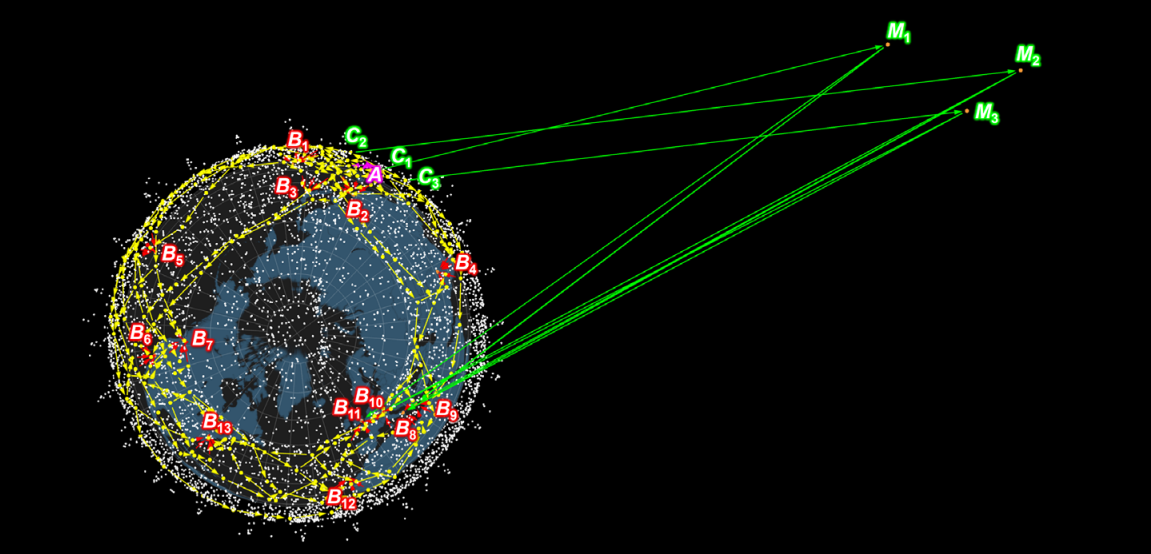
Experiments using a 5-degree PUSNEC over a global low Earth orbit (LEO) satellite network, connecting one satellite to 13 ground stations, demonstrate the system’s performance in a realistic scenario. Researchers implemented the Gabidulin code suite over finite fields, dividing incoming data into basic units and employing a ramp scheme to increase the message rate. Results show that the packet loss probability (PLP) decreases as the security parameter, k, increases, demonstrating stronger suppression with higher values of k. Analysis reveals a tradeoff between PLP and frame error rate (FER) in relation to k, providing a design guideline for selecting optimal coding specifications. Comparisons between the Gabidulin code and the Reed-Solomon (RS) code demonstrate the superior performance of the new coding scheme, achieving lower error rates under similar coding rates.
Ramp Secure Multicast Coding Achieves Scalability
This research presents path-controlled universal strongly ramp secure network coding (PUSNEC), a new system designed to address the challenges of secure and scalable multicast communication. The team successfully integrated an efficient multi-tree path-finding method with universal strongly ramp secure network coding, creating a system capable of achieving multicast capacity, information-theoretic security, and scalability. Demonstrations through numerical simulations confirm secure multicast functionality in multi-hop networks, highlighting a practical approach to achieving secure, reliable communication on a global scale. The system’s performance relies on a combination of techniques, including Gabidulin code and Fq-RLNC, which enhance reliability and minimize latency, and a robust path-finding algorithm that improves resilience against compromised nodes. Notably, the system can identify secure paths even when conventional routing methods fail, particularly in smaller networks.
👉 More information
🗞 Path-Controlled Secure Network Coding
🧠 ArXiv: https://arxiv.org/abs/2509.21115