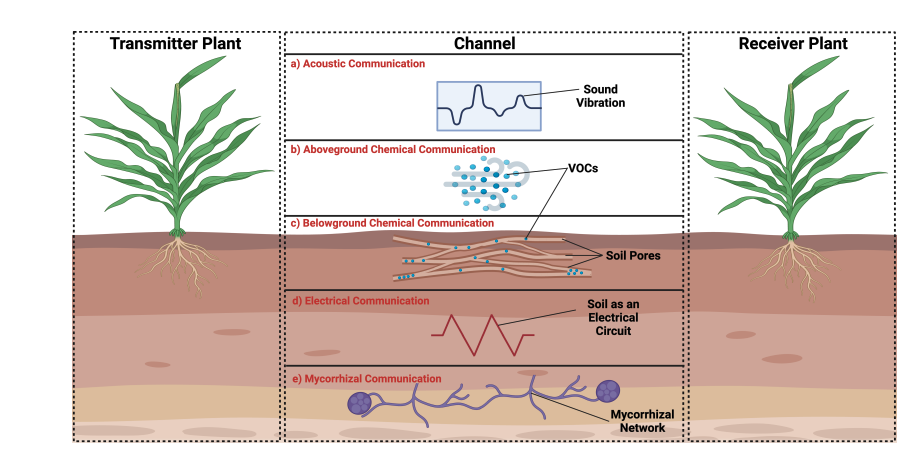
Plants actively communicate with each other using a surprising range of signals, including chemical, electrical, and even acoustic cues, all vital for their survival and adaptation, and Ahmet B. Kilic from Koç University, along with Ozgur B. Akan from Koç University and the University of Cambridge, are leading a new effort to understand this hidden world through the lens of information and communication theory. Their work systematically analyses these biological processes, reframing inter-plant signalling within established communication frameworks, and surveys existing research to chart a course for future investigation. This approach not only deepens our understanding of plant behaviour, but also lays the groundwork for a revolutionary concept, the Internet of Plants, where plants are viewed as interconnected nodes in vast ecological networks. This paradigm promises exciting applications in areas like precision agriculture, environmental monitoring, and the development of innovative, bio-inspired communication technologies, offering a compelling new direction for communications research.
Plant Electrical Signals and Long Distance Communication
This research explores how plants communicate with each other and respond to their environment, studying methods including electrical signals, sound vibrations, and interactions mediated by mycorrhizal fungi. These investigations aim to understand how plants detect stress, such as water deficiency or herbivore attacks, and coordinate defensive responses, potentially leading to new applications in agriculture and environmental monitoring. Understanding these communication methods could allow for early detection of stress, optimizing resource use, and improving overall plant health. Researchers are examining plant electrical signaling and acoustic emissions, such as those created by cavitation, to understand how these sounds can indicate stress or signal herbivore activity. Furthermore, the role of mycorrhizal fungi, which form underground networks connecting plant roots, is being explored to understand how these fungi facilitate communication and resource sharing between plants. This interdisciplinary approach combines biological observation with engineering principles to gain a deeper understanding of plant behavior.
Plant Signaling as an Information System
Scientists are systematically analyzing plant signaling within the frameworks of Information and Communication Technology (ICT), bridging biological observation with engineering principles to compare different communication methods and develop predictive models for plant interactions. The research details how plants emit signals, how those signals travel through the environment, and how neighboring plants detect and respond, including investigations into chemical communication, electrical signaling, and mycorrhizal networks. Researchers also highlight the need for improved sensing technologies to accurately capture the complexity of plant communication, paving the way for the emerging field of the Internet of Plants (IoP).
Plant Networks Transmit Signals Rapidly and Reliably
Plants communicate using complex networks involving chemical, electrical, and fungal connections, and scientists are analyzing these interactions through the lens of ICT. Researchers demonstrate that signals transmitted through common mycorrhizal networks (CMNs) behave similarly to data networks, with fluid flow within fungal hyphae reaching significant velocities, accelerating signal transmission beyond the rate achievable by simple diffusion. This rapid transmission is crucial for coordinating responses to environmental changes. Experiments reveal that signal transfer times within CMNs range from hours to days, depending on network topology; dense, well-connected networks facilitate rapid exchange, while sparse connections introduce delays. The team quantified this relationship using mathematical modeling, demonstrating that network structure dictates the speed of signal mixing and that bottlenecks or weak links dramatically increase delay, mirroring the performance of serial relays in data communication.
Plant Communication Reframed by Information Theory
Plants communicate through diverse signaling methods, including chemical, electrical, mycorrhizal networks, and acoustic pathways, and this research synthesizes existing knowledge of these biological mechanisms and reframes them within the context of ICT, offering a new perspective on plant interactions. The work proposes a framework for analyzing these signals using ICT principles, potentially leading to applications in precision agriculture, improved ecosystem monitoring, and the development of bio-inspired communication systems. Researchers acknowledge that further research is needed to fully realize the potential of this interdisciplinary field, particularly in developing a comprehensive understanding of the “Internet of Plants” concept and envisioning plants as interconnected nodes within ecological and technological networks.
🗞 Information and Communication Theoretical Foundations of the Internet of Plants, Principles, Challenges, and Future Directions
🧠 ArXiv: https://arxiv.org/abs/2509.08434