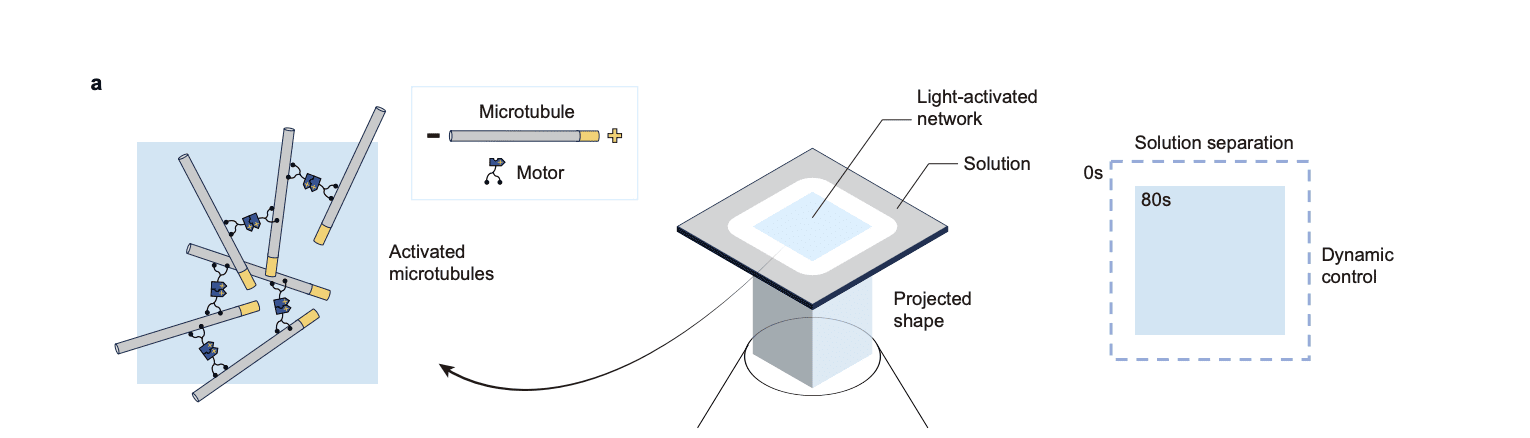
Cellular organisation relies on balancing internal activity with external physical limits, yet how cells actively control their shape remains a fundamental question. Zixiang Lin, Shichen Liu, and Shahriar Shadkhoo, along with colleagues, now demonstrate that the geometry of a network’s boundaries directly controls its deformation in systems built from microtubules and motor proteins. This research reveals a surprising interplay between internal stresses and boundary shape, establishing that boundaries aren’t simply passive constraints, but active regulators of network organisation. The team’s work, underpinned by a theoretical framework, identifies distinct modes of deformation achievable through controlled boundary manipulation, offering new insights into biological organisation and paving the way for the design of synthetic active materials with programmable shapes.
Active Network Boundary Deformation Investigated
Active networks, common in living systems, exhibit remarkable mechanical properties and dynamic behaviours. Understanding how these networks maintain their boundaries and respond to external stimuli remains a central challenge. Researchers constructed networks from actin filaments and myosin motors, creating isolated active regions to precisely control and observe boundary dynamics. The team used fluorescence microscopy to track the positions of filaments and motors, quantifying boundary deformation over time. They discovered that boundary deformation follows a characteristic pattern, dependent on the internal stress and network stiffness.
Specifically, the extent of deformation increases with higher stress and decreases with greater stiffness, revealing a fundamental relationship between these parameters. Furthermore, researchers found that network boundaries exhibit local fluctuations, which propagate along the boundary and contribute to overall deformation. These findings demonstrate that boundary deformation in active networks is a complex process governed by the interplay of internal stresses, network geometry, and local fluctuations. The results provide insights into the mechanical behaviour of living cells and tissues, where active networks play a crucial role in maintaining shape and responding to external forces.
This work establishes a framework for understanding the dynamics of active boundaries and offers a basis for designing materials with tailored mechanical properties. Cellular structures must organize themselves within strict physical constraints, operating with finite resources and well-defined boundaries. Active matter fundamentally alters the paradigm of passive response to boundaries, creating a bidirectional coupling between boundary geometry and mass conservation that enables dynamic control over network organization. Researchers demonstrate that boundary geometry actively directs network deformation in reconstituted systems.
Cytoskeletal Self-Organisation and Molecular Motor Dynamics
This text explores the dynamics of the cytoskeleton and the molecular motors that drive its organization, focusing on active matter and biological physics. The cytoskeleton, composed of microtubules and other filaments, generates forces and contributes to cellular processes. Molecular motors, such as kinesin and dynein, drive cytoskeletal dynamics and intracellular transport. These components create active fluids and gels, materials exhibiting non-equilibrium behaviour due to internal energy consumption. A key focus is on the emergent properties of these active systems, including spontaneous motion, pattern formation, and collective behaviour arising from the interactions of individual components.
Several key concepts underpin this research. Active stress, the generation of internal stresses by molecular motors, drives flow, deformation, and pattern formation. Topological defects, such as vortices, influence the flow and mechanical properties of active fluids and gels. Active matter systems are inherently non-equilibrium, requiring constant energy input to maintain structure and function, making understanding their thermodynamics crucial. Researchers also investigate pattern formation, the spontaneous emergence of spatial patterns, and phase separation, the tendency of active materials to separate into different phases.
Understanding fluid mechanics at small scales is also important, as many biological systems operate where viscous forces dominate. The research also focuses on force generation and transmission within cells, and how forces are transmitted through the cytoskeleton and other structures. Researchers employ a variety of experimental and theoretical techniques, including microscopy to visualize dynamics, particle image velocimetry to measure fluid flow, rheology to measure mechanical properties, and computational modelling to simulate system behaviour and test predictions. Mathematical techniques, such as singularity methods for solving Stokes flow equations, and concepts from network science are also applied.
This research has potential applications in a wide range of fields, including cell biology, where it can help understand cell motility, division, and morphogenesis. It also informs the design of new biomaterials with tunable mechanical properties and biological activity, and the creation of flexible, adaptable soft robots. The research can also contribute to the development of new microfluidic devices for manipulating cells and fluids, targeted drug delivery systems, and even the building of synthetic cells that mimic living cells. Furthermore, it could lead to the creation of programmable matter that changes shape and properties in response to external stimuli, and the use of light to control motor proteins and other cellular components.
Liquid crystal materials offer potential for creating responsive and adaptable materials. Emerging trends in this field include the study of topological active matter, controlling the behaviour of active matter by confining it within boundaries, developing methods for controlling active matter in a precise and predictable manner, and utilizing DNA as a building block for creating active materials. This text represents a snapshot of a vibrant and rapidly evolving field that is pushing the boundaries of our understanding of complex systems and paving the way for new technologies. It is a highly interdisciplinary area that draws on concepts from physics, biology, chemistry, and engineering.
Boundary Geometry Dictates Active Network Contraction
Researchers have demonstrated that the geometry of boundaries actively directs the deformation of networks composed of microtubules and motor proteins, revealing a new principle for controlling the organization of active materials. This work establishes that boundary geometry couples to internal stress fields through the conservation of mass, resulting in predictable dynamical modes and enabling engineered deformations of the network. Experiments with diverse geometries, including circles, triangles, squares, hexagons, hexagrams and cardioids, consistently show self-similar contractile behaviour, indicating spatially uniform and isotropic contraction. The team found that while network size and shape influence the overall domain of activity, they do not affect the strength of contraction, which remains consistent across different geometries. Quantitative analysis confirms a high degree of boundary geometry preservation throughout the contractile process, supporting the existence of a linear radial velocity field within the network. This research advances understanding of biological organization and provides a foundation for designing synthetic active devices capable of controlled deformation, opening avenues for future work in materials science and bioengineering.
👉 More information
🗞 Boundaries Program Deformation in Isolated Active Networks
🧠 ArXiv: https://arxiv.org/abs/2510.01713