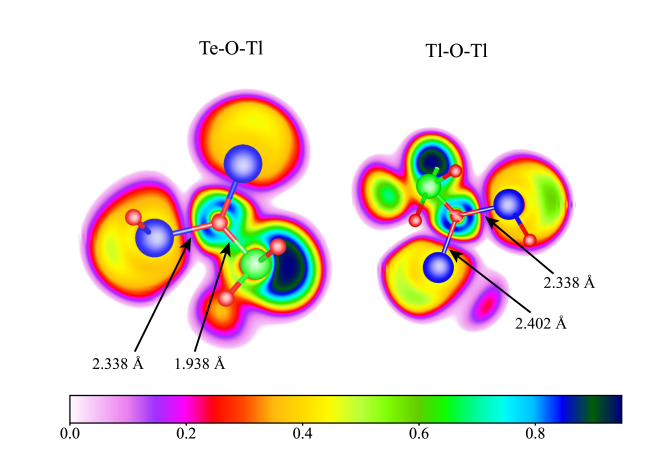
Tellurite glasses represent a promising material platform for integrated photonics, yet achieving precise control over their atomic structure and optical properties remains a significant challenge. Raghvender Raghvender, Assil Bouzid, and Evgenii M. Roginskii, alongside colleagues at the Institut de Recherche sur les Céramiques and the Ioffe Institute, present a detailed computational study that illuminates the relationship between composition, atomic arrangement, and nonlinear optical behaviour in these complex glasses. Their work employs advanced modelling techniques to reveal how the addition of titanium and thallium oxides influences the tellurium network, demonstrating that titanium acts to reinforce the network structure while thallium promotes depolymerization. This research not only reproduces experimental observations of Raman spectra and nonlinear optical responses, but also establishes a predictive capability for designing tellurite glasses with tailored properties for advanced photonic applications.
Tellurite Glass Structure and Optical Properties
This body of work comprehensively explores tellurite glasses, materials based on tellurium dioxide, and their potential for advanced optical technologies. Researchers focused on understanding the relationship between a glass’s atomic structure and its resulting properties, such as how it transmits light. The studies reveal that tellurite glasses are promising for applications like optical fibers and waveguides due to their unique ability to transmit infrared light and their high refractive index. A central challenge in this research is determining how atoms arrange themselves within these glasses, which lack the long-range order of crystals.
Scientists employed a combination of experimental techniques, including X-ray and neutron diffraction, and Raman spectroscopy, to probe the glass structure. These methods were complemented by computational modeling, using molecular dynamics and quantum mechanical calculations, to predict and refine structural models. Key areas of investigation included how adding different oxides, such as titanium dioxide, tungsten trioxide, and zinc oxide, alters the glass network and its connectivity. Developing accurate computational models required creating sophisticated mathematical descriptions of the interactions between atoms. The team focused on establishing reliable force fields for simulating the behavior of tellurite glasses. This research aims to connect the atomic-level structure of the glass to its physical and optical characteristics, including refractive index, infrared transmission, and thermal stability.
Tellurite Glass Structure From Molecular Dynamics Simulations
This study pioneers a computational approach to investigate the atomic structure of tellurite glasses. Researchers used first-principles molecular dynamics, a method based on quantum mechanics, to model binary glasses containing thallium oxide and tellurium oxide, and ternary glasses incorporating titanium dioxide. They generated eleven distinct models, varying the concentrations of thallium and titanium oxides to comprehensively map their effects on the glass structure compared to pure tellurium oxide. Each model contained hundreds of atoms, allowing for a detailed representation of the glass network.
To accurately describe the electronic structure of the glass, the team employed advanced computational techniques and a specific set of parameters. They used density functional theory, a powerful method for calculating the electronic properties of materials, and a sophisticated basis set to represent the electronic wavefunctions. Core-valence interactions were carefully managed, and a specific exchange-correlation functional was adopted to account for the complex interactions between electrons. The simulations were performed using a precise time step and periodic boundary conditions, ensuring accurate and reliable results. To create realistic glassy structures, the team employed a melt-quench protocol, gradually cooling the models from high temperatures to room temperature. Statistical averages of structural properties were then calculated from the final stages of the simulations.
Tellurite Glass Structure and Nonlinear Optics
This work presents a detailed investigation of tellurite glasses, specifically focusing on how thallium oxide and titanium dioxide impact their atomic structure and nonlinear optical properties. Researchers used first-principles molecular dynamics to model binary and ternary glasses, generating eleven distinct compositions to explore the interplay between modifier concentration and network connectivity. The resulting structural models were rigorously validated against experimental X-ray data, confirming their accuracy and reliability. Analysis reveals that increasing thallium oxide content induces network depolymerization, reducing the coordination of tellurium and substituting tellurium-oxygen-tellurium linkages with tellurium-oxygen-thallium units.
This process leads to a proliferation of non-bridging oxygens and a loss of network connectivity, evidenced by the opening of smaller rings within the glass structure. In contrast, the addition of titanium dioxide acts as a network former, preserving tellurium coordination and promoting a high fraction of bridging oxygens. Titanium atoms induce network repolymerization, forming smaller titanium-containing rings that counterbalance the depolymerizing effect of thallium oxide. Beyond structural analysis, the team computed Raman spectra and nonlinear optical properties from the generated models. Results accurately reproduce experimental trends in Raman band shifts with varying composition.
Nonlinear calculations demonstrate that the third-order nonlinear susceptibility remains stable with thallium oxide addition in binary glasses, consistent with experimental observations. Crucially, the inclusion of even a small fraction of titanium dioxide in ternary systems preserves the high nonlinearity of the tellurium dioxide network while simultaneously maintaining overall network connectivity. These findings establish a predictive framework for tailoring both the atomic structure and nonlinear optical response of tellurite glasses through controlled manipulation of modifier nature and concentration, paving the way for advanced optical materials with optimized properties.
Tellurite Glass Structure Modified by Additives
This research presents a detailed investigation into the atomic structure of tellurite glasses, specifically focusing on binary systems of tellurium and thallium oxides, and ternary systems incorporating titanium dioxide. Through first-principles molecular dynamics simulations, the team successfully modeled the structural characteristics of these glasses, validating their models against experimental X-ray data. The study reveals that increasing thallium oxide content leads to a breakdown of the tellurite network, reducing the coordination of tellurium and creating more open structures. Conversely, the addition of titanium dioxide acts to rebuild the network, preserving tellurium coordination and promoting stronger connections between atoms.
These findings demonstrate a clear relationship between the composition of tellurite glasses and their atomic arrangement. The researchers observed that titanium dioxide effectively counteracts the network-modifying effect of thallium oxide, maintaining both structural integrity and desirable nonlinear optical properties. Importantly, the simulations accurately reproduce experimental Raman spectral data, confirming the validity of the structural models. This research establishes a predictive framework for designing tellurite glasses with tailored structures and optical characteristics, paving the way for advanced materials with specific functionalities.
🗞 Ab-initio study of structural, vibrational and non-linear optical properties of (TiO2)-(Tl2O)-(TeO2) glasses
🧠 ArXiv: https://arxiv.org/abs/2510.15343