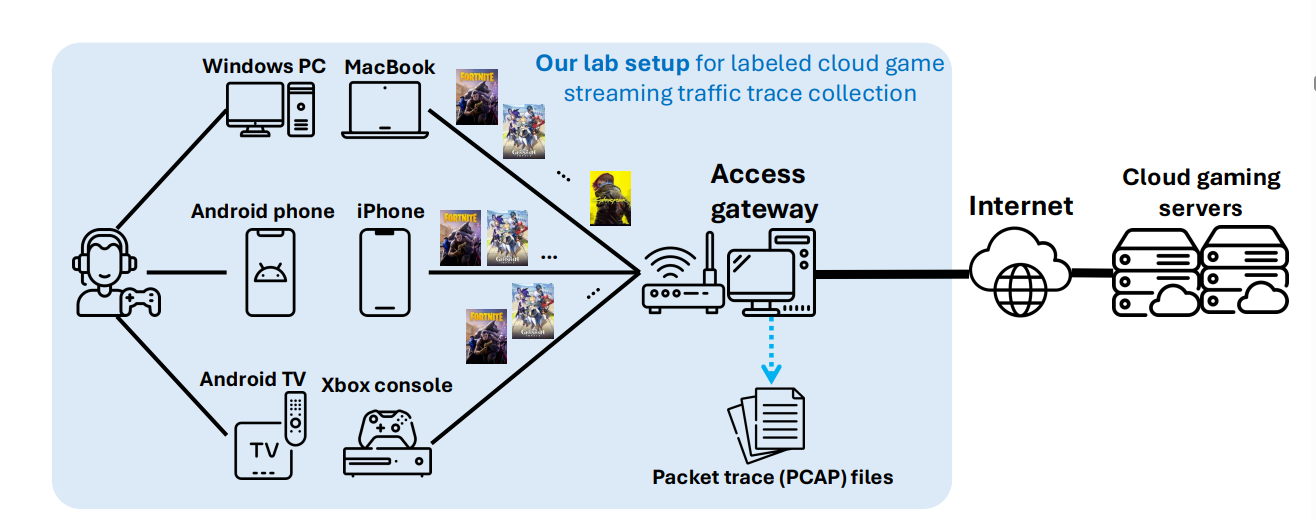
Cloud gaming represents a rapidly expanding entertainment market, yet accurately gauging user experience remains a significant challenge for network providers seeking to optimise their services. Yifan Wang, Minzhao Lyu, and Vijay Sivaraman, all from the University of New South Wales, address this problem by developing a method to classify cloud gaming contexts directly from network traffic. Their work moves beyond simple metrics like bandwidth and frame rate, instead identifying both the specific game being played and the player’s activity, whether actively engaged, passively observing, or idle, within the first few seconds of a session. This detailed analysis, deployed within a live internet service provider network over three months, provides crucial insights into how bandwidth consumption and user experience correlate with different gameplay scenarios, ultimately enabling more effective network resource allocation and improved service quality.
Cloud Gaming Traffic Characteristics and Identification
Scientists investigated the characteristics of network traffic generated during cloud gaming sessions, aiming to develop accurate methods for identifying and classifying this traffic and understanding how it differs based on game type, user activity, and platform. This research is important for improving quality of service, enhancing network security, and gaining insights into user behaviour. The team employed machine learning techniques, specifically Random Forest, Support Vector Machines, and K-Nearest Neighbors, to classify traffic based on features extracted from network packets, also analysing the types of games played and the activities within them. Results demonstrate that the Random Forest model consistently outperformed other methods in both game title and gameplay activity pattern classification, achieving up to 96.
5% accuracy. The research revealed that the transition from active gameplay to an idle state is a key indicator of user activity. This detailed characterization of cloud gaming traffic, along with the identified useful features, provides valuable data for network management and security.
Realtime Cloud Gaming Experience Measurement via Traffic Analysis
Scientists developed a novel method to accurately measure cloud gaming user experience by analysing network traffic and identifying contextual factors, specifically game title and player activity stage. This system can classify game titles within the first five seconds of game launch, enabling real-time assessment of player engagement. This innovative approach moves beyond traditional network metrics, recognising that bandwidth and frame rate must be interpreted within the context of the game and how the player is interacting with it. The team deployed this system within an Internet Service Provider hosting NVIDIA cloud gaming servers, collecting data from hundreds of thousands of streaming sessions over three months.
This large-scale deployment allowed for detailed analysis of bandwidth consumption and experience levels across diverse gameplay contexts. The method classifies player activity into three distinct stages, active, passive, and idle, providing a nuanced understanding of network demands. This approach accurately distinguishes between high-intensity actions and less demanding activities, enabling network operators to dynamically provision resources and offer monetizable assurance services.
Cloud Gaming Experience Measured From Network Data
Scientists developed a method to accurately measure cloud gaming user experience by analysing network traffic and contextual factors, including game title and player activity. The research team successfully classified game titles within the first five seconds of launch, demonstrating a rapid identification capability crucial for real-time network optimization. Furthermore, the method continuously assesses player activity, categorizing it as active, passive, or idle, providing a nuanced understanding of gameplay demands. Deploying this system within an internet service provider’s network, researchers analysed hundreds of thousands of cloud game streaming sessions over three months, revealing detailed insights into bandwidth consumption and experience levels.
The core of this achievement lies in classifying downstream packets into three groups, full, steady, and sparse, based on payload size and arrival time. By analysing these packet groups within one-second time slots, the team formulated 51 statistical attributes to characterize each game launch stage. Experiments revealed that analysing the first five seconds of packets, processed in one-second time slots, yielded optimal classification performance. A random-forest classifier accurately predicted game titles or identified sessions as “unknown” when a confident match could not be made. This research demonstrates the ability to correlate gameplay contexts with objective quality of experience metrics, enabling network operators to calibrate user experience measurements and identify network-related issues.
Gaming Experience Measured From Network Traffic
This research presents a method for network operators to accurately measure cloud gaming user experience by analysing network traffic and considering contextual factors such as game title and player activity. The team developed a system capable of classifying game titles within the initial seconds of launch and continuously assessing player activity as active, passive, or idle. This allows for a more nuanced understanding of network demands than traditional metrics like bandwidth and frame rate alone. Deployment of this method within a live internet service provider network hosting a cloud gaming platform generated insights from hundreds of thousands of gameplay sessions over three months. Validation against server logs confirmed the accuracy of game title classification, and analysis revealed how bandwidth consumption varies depending on both the game and the player’s current activity. Crucially, the research demonstrates the ability to distinguish between experience drops caused by network issues and those attributable to the game itself or the player’s activity stage, enabling more accurate network assurance.
🗞 Games Are Not Equal: Classifying Cloud Gaming Contexts for Effective User Experience Measurement
🧠 ArXiv: https://arxiv.org/abs/2509.19669