This research explores the intricate behaviour of complex systems, drawing on principles from theoretical physics and mathematical biology. The work investigates networks, stochastic processes, and ecological modelling to understand how interactions between components drive system dynamics, particularly within ecological contexts. Researchers examine the influence of randomness, or noise, on system behaviour, employing mathematical tools to analyse these effects. A central theme involves understanding how complex networks function, investigating cascading failures, robustness, and the structure of real-world networks like infrastructure and ecosystems.
The team applies concepts from statistical physics and field theory, seeking universal principles and identifying phase transitions within these systems, considering complex relationships between components and the probability of rare, extreme events. Researchers aim to simplify complex, high-dimensional systems into lower-dimensional representations that capture essential dynamics, allowing for more tractable modelling and prediction of system behaviour. The work explores how systems transition between different states and how these transitions are influenced by various factors, ultimately providing insights into emergent phenomena observed in complex networks.
Quantum Physics Simplifies Complex System Analysis
Researchers have developed a novel physics-based method to simplify the analysis of complex compartmental models, allowing for more accurate investigations of phase transitions in diverse systems, including epidemics, ecosystems, and infrastructure networks. The team leverages tools originating from quantum physics to systematically reduce multidimensional systems into an effective one-dimensional representation, overcoming limitations inherent in traditional approaches and enabling the study of both average system behaviour and random fluctuations. This innovative technique enables scientists to move beyond deterministic descriptions, which often require simplifying assumptions when dealing with systems possessing numerous interacting components. Scientists harness the power of this reduced system to investigate how concentrations within each compartment change over time, accounting for interactions and spontaneous transitions, particularly in systems where units can change categories, leading to complex reaction-diffusion behaviours. This method provides a powerful framework for analysing population dynamics across a range of complex systems, offering a potential alternative to current limitations and allowing for a more nuanced understanding of how systems transition between different states and how these transitions are influenced by various factors.
Mapping Complex Systems with Quantum Field Theory
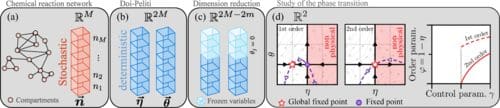
Researchers have developed a novel physics-based method to simplify the analysis of complex compartmental models, offering new insights into systems exhibiting phase transitions, such as epidemics, ecosystems, and infrastructure networks. The team successfully applied techniques from quantum field theory, specifically the path integral representation, to analyse stochastic classical systems, reducing multicompartment systems to a one-dimensional effective model and enabling characterization of critical behaviour through a geometrical interpretation. This breakthrough lies in mapping a chemical reaction network to a Hamiltonian problem using established mathematical tools, effectively translating the system’s dynamics into a form amenable to analysis. By strategically reducing the dimensionality of the problem through parametrization and constraint application, researchers can analyse the resulting phase portrait to identify critical points indicative of qualitative changes in system dynamics, allowing for high-accuracy approximations of steady states. Experiments revealed that the method accurately identifies phase transitions by locating intersections of zero-energy lines within the reduced Hamiltonian’s phase portrait, signalling shifts in the system’s behaviour. The order of these transitions, whether abrupt or continuous, can be determined by investigating these lines as a function of a control parameter, extending the boundaries of statistical physics and offering broad applications in population dynamics and critical behaviour studies.
Simplifying Complex Systems via Observable Focus
This research presents a unifying framework for analysing complex compartmental models, such as those used to study epidemics, ecosystems, and infrastructure networks. The team developed a method that simplifies these models by reducing their dimensionality, allowing for more effective analysis of phase transitions and stochastic dynamics, focusing on the observable of interest and effectively freezing other degrees of freedom to streamline calculations. The method successfully captures the critical properties of these systems and provides accurate approximations of stationary probability distributions, even for models with a large number of compartments. While traditional methods often rely on timescale separation, this new approach offers broader applicability, though it currently provides limited information about short-term behaviour. This work therefore provides a valuable tool for understanding complex systems, offering a balance between model generality and analytical tractability. By simplifying complex models while retaining essential features, researchers can gain deeper insights into the underlying mechanisms driving system behaviour and make more accurate predictions about future states.
👉 More information
🗞 Effective One-Dimensional Reduction of Multicompartment Complex Systems Dynamics
🧠 DOI: http://link.aps.org/doi/10.1103/whdb-2lgl