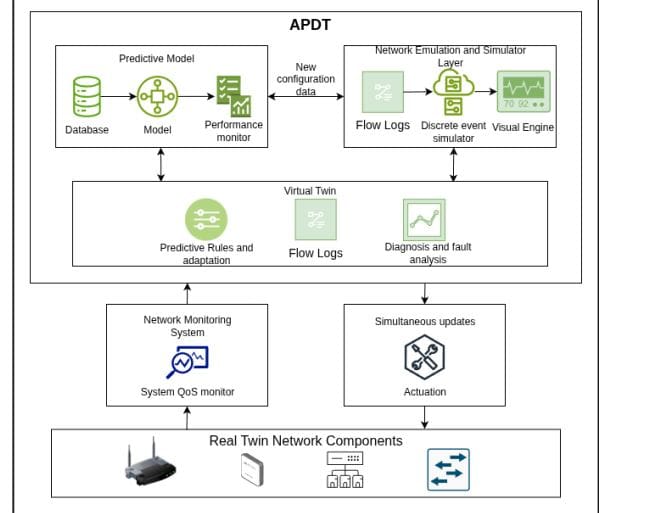
Increasing client density and network congestion present significant challenges for modern wireless networks, and researchers are now applying the concept of digital twins to address these issues. D. Sree Yashaswinee, Gargie Tambe, Y. Raghu Reddy, and Karthik Vaidhyanathan, all from IIIT Hyderabad, introduce a novel Access Point Digital Twin (APDT) that actively monitors network behaviour and predicts future demands. This digital twin captures real-time data from access points, enabling detailed simulations and predictive modelling of critical performance metrics like latency and jitter. By simulating various network scenarios and forecasting traffic surges, APDT offers a powerful tool for proactive network management, ultimately enhancing quality of service and reducing congestion for all users.
The core idea involves creating a real-time virtual replica of the network, leveraging predictive analytics to anticipate issues and automatically adjust configurations before they impact performance. Traditional reactive network management struggles with the dynamic nature of modern wireless environments, and APDT aims to overcome this by shifting to a proactive, predictive approach. APDT builds a virtual model mirroring the real-time telemetry of the wireless network, specifically focusing on individual Access Points (APs).
Machine learning algorithms are then used to forecast network behavior and potential issues, such as congestion. The system automatically adjusts network configurations based on these predictions, optimizing performance and preventing problems. Key features include a granular, AP-level focus for precise control, an automated feedback loop for self-optimization, and validation through testing on a small-scale campus network, demonstrating accurate predictions and alignment with simulations. The method involves collecting real-time telemetry data from the wireless network’s APs, using this data to create and maintain a virtual replica within the digital twin, and then employing machine learning models to predict future network behavior and potential issues.
Based on these predictions, the system automatically adjusts network configurations, such as channel allocation and power levels, to optimize performance. Results show the system achieved a latency prediction accuracy of 85. 03% using simulations, accurately predicted AP states, and validated the feasibility of the proposed architecture through testing. This work positions APDT within the broader context of digital twins, network virtualization, and predictive analytics, highlighting how it builds upon and differentiates itself from existing approaches. Future research will focus on expanding deployment to larger networks, refining predictive algorithms, evaluating the impact of automated adjustments in production settings, and assessing the robustness of the architecture. The system models critical metrics such as latency and inter-packet transfer time, enabling detailed analysis of network characteristics and proactive adjustments to network configurations. Experiments demonstrate APDT’s capability to forecast short-term traffic surges, facilitating improved Quality of Service (QoS) and reduced congestion.
The predictive model achieves an impressive simulation accuracy of 85. 03%, validating its ability to accurately replicate real-time network conditions. Researchers measured the system’s performance by simulating scenarios based on live network data, confirming its potential for robust network optimization and management. The APDT focuses on bridging the gap between monitoring models and system configurations, employing lightweight models for predictive analysis and QoS supervision. Scientists demonstrated the system’s ability to forecast average byte rates over a daily cycle, providing valuable insights into network traffic patterns. This proactive approach allows network administrators to anticipate future optimal configurations and simulate them for enhanced confidence and fine-tuning, moving beyond traditional reactive monitoring techniques. The team successfully developed a system that captures real-time network states using data from access points and incorporates simulation-based analysis with a predictive model. The APDT architecture effectively replicates network conditions and models key metrics such as latency and inter-packet transfer time, achieving a simulation accuracy of 85.
03%. This allows for the evaluation of “what-if” scenarios and the generation of recommendations, such as proactive client offloading and intelligent band steering, to mitigate congestion and enhance user experience. The authors acknowledge that the current implementation focuses on a specific network environment and further research is needed to assess its scalability and adaptability to diverse network topologies. Future work, as envisioned by the team, will likely explore broader applicability and refinement of the predictive capabilities of the APDT system. This research represents a significant step towards intelligent network management, offering a proactive and efficient solution for optimizing network performance and enhancing user experience in increasingly complex wireless environments.
👉 More information
🗞 APDT: A Digital Twin for Assessing Access Point Characteristics in a Network
🧠 ArXiv: https://arxiv.org/abs/2511.23009