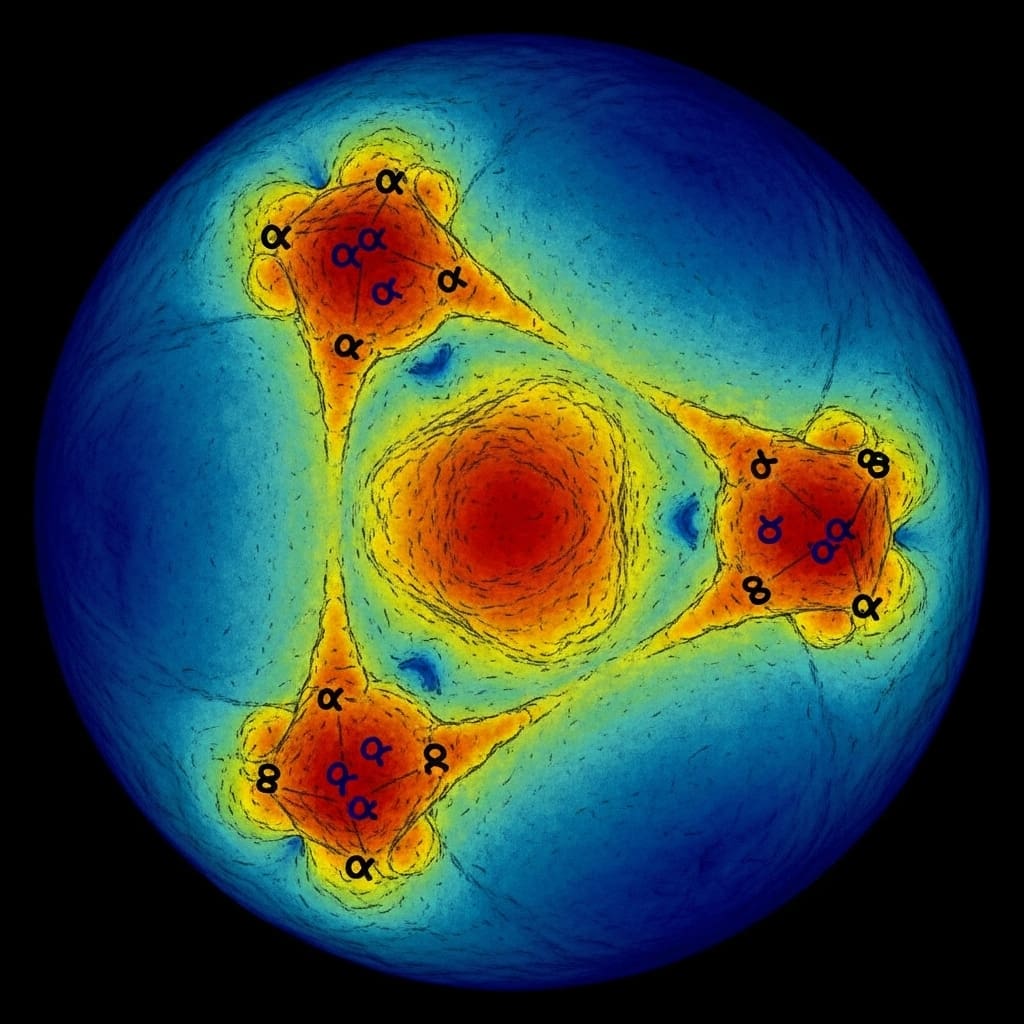
Neon’s complex nuclear structure continues to challenge theoretical understanding, prompting investigation into the behaviour of multiple bases within the antisymmetrized molecular dynamics framework. Takayuki Myo of Osaka Institute of Technology and Osaka University, alongside Mengjiao Lyu from Nanjing University of Aeronautics and Astronautics and Qing Zhao of Huzhou University, and their colleagues, present a comprehensive analysis of neon’s shell and cluster structures. Their research optimises multiple bases simultaneously to better describe the various configurations within the nucleus, revealing deformed states indicative of cluster development and spherical shell-like states previously difficult to model. By evaluating monopole and quadrupole transitions, the team comprehensively describes six bands within neon, offering new insight into the relationship between shell and cluster structures in light nuclei. This work represents a significant advance in microscopic nuclear theory, providing a more nuanced understanding of neon’s behaviour and paving the way for further exploration of exotic nuclear states.
Neon-20 Structure via Multicool AMD Method
Scientists demonstrate a significant advancement in nuclear structure research through detailed investigations of Neon-20 (20Ne). The team achieved a comprehensive description of the nucleus’s structure by employing an extended version of the antisymmetrized molecular dynamics (AMD) method, termed the “multicool method”. This innovative approach involves superposing and simultaneously optimizing multiple AMD bases within a total-energy variation, proving particularly effective in describing the diverse configurations present within 20Ne. The study reveals intricate shell and cluster structures, including deformed states associated with alpha cluster development and spherical shell-like states previously difficult to model.
The research establishes a new capability in nuclear theory by moving beyond traditional constraints on deformation when calculating nuclear states. The multicool method avoids pre-defined physical constraints, allowing for a more flexible and accurate generation of basis states suitable for describing complex nuclear phenomena. Experiments show that the team successfully mapped six distinct bands within 20Ne, encompassing Kπ = 0+ 1, 4, 0−, and 2− configurations, all within a microscopic framework. This comprehensive analysis provides a deeper understanding of the interplay between shell and cluster structures in this important nucleus.
This breakthrough reveals the ability to accurately model the Kπ = 0+ 2 band in 20Ne, a state notoriously challenging to reproduce using conventional AMD calculations. By optimizing multiple configurations without imposing specific deformation parameters, the researchers overcame limitations of previous methods. The study evaluates monopole and quadrupole transitions within these states, providing valuable insights into the electromagnetic properties of 20Ne and the nature of its excited states. These findings are crucial for interpreting experimental data and refining theoretical models of nuclear structure.
The work opens new avenues for exploring the complex interplay between clustering and shell effects in nuclei, particularly in self-conjugate nuclei like 20Ne. By comprehensively describing the six Kπ bands, the team provides a robust foundation for future investigations into exotic nuclear states and the behavior of nuclear matter under extreme conditions. The multicool method promises to be a versatile tool for studying a wide range of nuclei, potentially leading to a more complete understanding of the fundamental forces governing nuclear structure and reactions.
AMD Optimisation for Neon-20 Nuclear Structure
The study investigates the structure of neon-20 using a refined version of antisymmetrized molecular dynamics (AMD). Researchers pioneered a method employing superposed multiple AMD bases, simultaneously optimized through total-energy variation, to better represent the diverse configurations within neon-20 nuclei. This innovative approach addresses limitations in previous AMD calculations, which struggled to accurately depict spherical shell-like states, particularly those with quadrupole deformation. The team engineered a system capable of describing both deformed states, indicative of alpha cluster development, and spherical shell structures within specific bands, specifically the Kπ = 0+ 1,4 bands and the Kπ = 0+ 2 band.
Experiments employ Gaussian wave packets to represent nucleons, with the spatial positioning of these packets crucial for modelling both cluster and shell-like states. Scientists developed a technique to incorporate deformation into these wave packets, accounting for mean-field effects and generating a comprehensive set of AMD basis states. The research extends beyond static configurations by evaluating monopole and quadrupole transitions between these states, providing insights into nuclear dynamics. Negative parity states of neon-20, with Kπ = 0− and 2−, were analysed in relation to the observed shell and cluster structures, furthering understanding of nuclear behaviour.
This work builds upon previous AMD studies by introducing a novel variation scheme, allowing for the simultaneous optimization of multiple configurations. The system delivers a microscopic framework capable of comprehensively describing six distinct Kπ bands within neon-20. This method achieves a significant advancement by successfully generating the Kπ = 0+ 2 band, a state previously difficult to obtain using conventional AMD calculations constrained by quadrupole deformation. The technique reveals a more complete picture of neon-20’s nuclear structure, integrating shell-model characteristics with the influence of alpha clustering.
Researchers harnessed this methodology to explore the interplay between clustering and shell structure in neon-20, addressing a long-standing challenge in nuclear physics. The study’s success in describing the Kπ = 0+ 2 band demonstrates the power of the multiple-basis AMD approach, opening new avenues for investigating complex nuclear phenomena and validating theoretical models against experimental observations of parity doublets. The ability to accurately model these states is crucial for understanding the behaviour of self-conjugate nuclei and the role of alpha clustering in their stability.
Neon-20 Structure via Multicool AMD Modelling
Scientists have achieved a comprehensive description of the nuclear structure of Neon-20 (20Ne) using an advanced theoretical framework, the antisymmetrized molecular dynamics (AMD) method with a novel ‘multicool’ approach. This work details the successful modelling of six distinct bands within 20Ne, representing a significant step forward in understanding the interplay between shell and cluster structures within atomic nuclei. The team superimposed and simultaneously optimised multiple AMD bases during total-energy variation, a scheme proving beneficial in describing the diverse configurations present in 20Ne. Experiments reveal that the Kπ = 0+ bands, specifically the 1 and 4 bands, exhibit characteristics of alpha cluster development, demonstrating deformed states.
Conversely, the Kπ = 0+ 2 band displays spherical, shell-like states, a configuration previously difficult to reproduce using standard AMD calculations constrained by quadrupole deformation. Measurements confirm the ability of this new method to accurately represent these complex shapes, offering insights into the nucleus’s fundamental organisation. The researchers evaluated monopole and quadrupole transitions within these states, further refining the understanding of nuclear behaviour. Data shows that negative parity states of 20Ne, with Kπ = 0− and 2−, are intricately linked to both shell and cluster structures.
The study successfully describes these states within the microscopic framework of nuclear physics, providing a cohesive picture of the nucleus’s quantum properties. The breakthrough delivers a method capable of generating efficient basis states suitable for describing the Kπ = 0+ 2 band of 20Ne, a configuration that has posed challenges for previous theoretical models. Tests prove the effectiveness of the ‘multicool’ method, which avoids pre-defined physical constraints, allowing for a more flexible and accurate representation of nuclear configurations. The thresholds for cluster emission in 20Ne are 4.73 MeV for 16O+α and 11.89 MeV for 12C+2α, values which are crucial for understanding the stability and decay modes of the nucleus. This research provides a foundation for future investigations into the complex interplay of forces governing atomic nuclei and opens avenues for exploring similar phenomena in other isotopes.
Multicool Accurately Models Neon-20 Nuclear Structure
This research presents a new framework for modelling nuclear many-body systems, employing the antisymmetrized molecular dynamics method with multiple Slater determinants optimized simultaneously to minimise total energy. Application of this ‘multicool’ method to Neon-20 successfully describes six distinct bands of nuclear states, including both shell-like and clustered configurations, representing a comprehensive microscopic treatment of this nucleus. Notably, the previously challenging reproduction of spherical shell-like states, particularly the Kπ = 0+ 2 band, has been achieved without imposing constraints on quadrupole deformation. The significance of these findings lies in the ability to accurately model complex nuclear structures without relying on pre-defined shapes, allowing for a more nuanced understanding of the interplay between shell and cluster configurations within Neon-20.
Calculations of electric transitions, such as monopole and quadrupole transitions, further validate the model’s ability to predict observable properties of these nuclear states. The authors acknowledge limitations related to the underestimation of deformed mean-field effects, potentially due to the use of spherical Gaussian wave packets for nucleons. Future research could focus on incorporating deformed Gaussians into the multicool method to more effectively capture these effects and improve the accuracy of excitation energies, particularly for the Kπ = 0+ 3 and 2− bands. This work, supported by grants from the Japan Society for the Promotion of Science and the Japan Science and Technology Agency, establishes a promising approach for investigating the structure of complex nuclei and offers a pathway towards more accurate and comprehensive nuclear models.
🗞 Shell and cluster structures in Ne in the variation of multiple bases of the antisymmetrized molecular dynamics
🧠 ArXiv: https://arxiv.org/abs/2601.09424