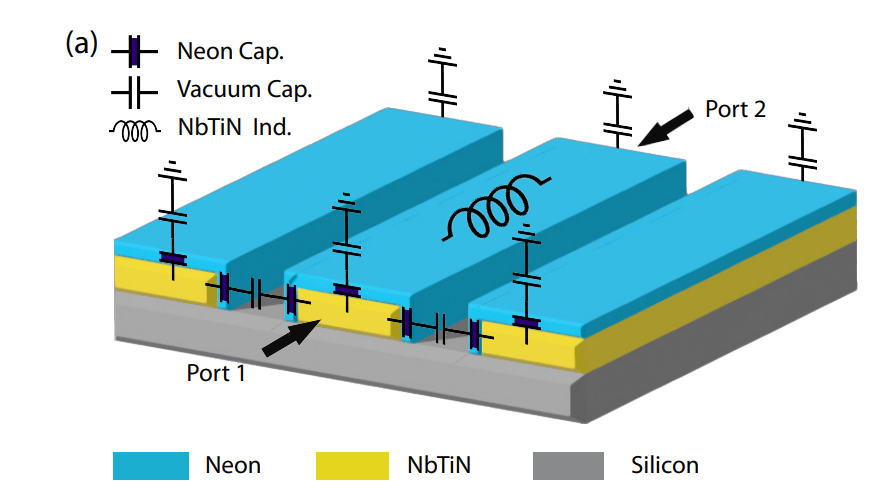
The quest to build stable and scalable quantum computers has led researchers to explore novel qubit platforms, including electrons levitating above solid neon, but achieving high performance relies critically on creating uniform and high-quality neon films. Kyle Matkovic, Patrick Russell, and Andrew Palmer, from UNSW Sydney, along with colleagues including Kun Zuo from the University of Sydney, now present a method for precisely characterising the growth of these films. Their work demonstrates the use of an array of superconducting microwave resonators to monitor film uniformity during deposition, revealing that a post-deposition cooling step significantly improves film homogeneity. This resonator-based metrology offers an in-situ technique for optimising neon film growth, directly advancing the development of robust and scalable electron-based quantum technologies.
Achieving consistent qubit performance requires precise control over the morphology and uniformity of solid neon films, and this work details a method for controlling and characterizing these films using an array of superconducting microwave resonators.
Single Electron Qubits on Solid Neon Films
Scientists are exploring the use of single electrons trapped on solid neon surfaces as a means of building qubits. Neon, when solidified, provides a clean, insulating surface that minimizes interference with electron manipulation, making it an attractive material for quantum computing. A key challenge lies in creating uniform, high-quality neon films, as variations in film thickness and defects can significantly degrade qubit performance and limit coherence. Researchers investigated the deposition and subsequent annealing of solid neon films. They discovered that annealing the films at 12 Kelvin dramatically improves film quality and homogeneity, leading to more uniform films that wet the chip surface more effectively and reduce defects.
Importantly, improved film quality translates to enhanced performance of superconducting resonators, as evidenced by higher internal quality factors and longer qubit coherence times. The research utilizes compact inductor-capacitor resonators operating at sub-gigahertz frequencies. Superconducting resonators are essential for detecting and manipulating electron qubits, and the Q-factor is critical for qubit coherence. The team employed microwave techniques to probe the resonators and control the qubits, and used specialized techniques to characterize the neon films. This work contributes to the broader field of quantum computing, specifically exploring solid-state qubit platforms, and offers potential advantages in scalability and control compared to other qubit technologies.
Annealing Improves Neon Film Homogeneity and Quality
Scientists have achieved a breakthrough in characterizing and improving the growth of solid neon films, a crucial step towards scalable quantum computing using electron qubits. The research team utilized high-quality superconducting microwave resonators as an in-situ diagnostic tool to probe the uniformity of neon film deposition with millimeter-scale spatial resolution. These resonators, exceptionally sensitive to local environmental changes, allowed for detailed mapping of film thickness and defect density across the chip area. Experiments revealed that a post-deposition anneal at 12 Kelvin significantly enhances the homogeneity of the neon films. Before annealing, variations in resonant frequency shifts across the resonator array were substantial; however, this process reduced the variance in relative frequency shifts by three orders of magnitude. This technique allows for precise characterization of neon film growth, directly supporting the development of electron-based qubits on inert solid substrates and paving the way for more stable and scalable quantum devices.
Neon Film Uniformity Impacts Qubit Performance
Researchers have demonstrated a new method for characterizing thin films of solid neon, a material increasingly important for building a novel type of qubit. By employing an array of highly sensitive superconducting microwave resonators, the team quantified the uniformity of neon films during their growth, revealing how variations in film thickness impact qubit performance. The method involves monitoring changes in the resonators’ resonant frequency and quality, providing a direct measure of film homogeneity as the neon is deposited. Notably, the researchers found that a brief post-deposition thermal treatment at a low temperature significantly improved film uniformity, reducing variations across the resonator array. This enhancement suggests improved wetting of the surface during neon deposition, leading to more consistent film growth. These findings establish resonator-based metrology as a valuable in-situ tool for characterizing neon film growth, directly supporting the development of electron-on-neon qubit platforms.
🗞 Characterizing Neon Thin Film Growth with an NbTiN Superconducting Resonator Array
🧠 ArXiv: https://arxiv.org/abs/2510.21029