

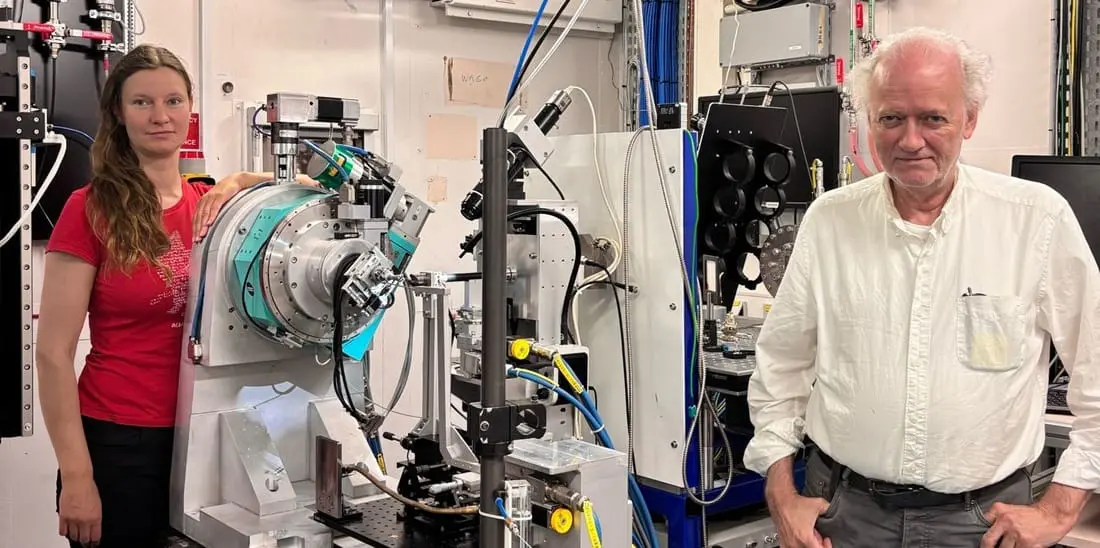
NTNU physicists have discovered a natural clay material with quantum properties that could be valuable for future quantum technologies. The clay is cheap, non-toxic, sustainable, and abundant, and exhibits two-dimensional semiconductor behavior and antiferromagnetic properties—key characteristics for advanced computing applications. Although it requires specialized laboratory processing to become technologically viable and currently does not function at room temperature, its potential in fields such as supercomputers, space technology, mineral exploration, and medicine is notable. The discovery resulted from an international collaboration involving researchers from NTNU, Brazil, France, and the Czech Republic.
Researchers at NTNU have discovered that a naturally occurring clay material has promising properties for use in quantum technology. This clay is cheap, non-toxic, sustainable, and available in large quantities, making it an environmentally friendly alternative to synthetic materials typically used in quantum technology.
The clay material possesses three valuable properties that make it particularly useful for future quantum technologies: it is two-dimensional (important at extremely small scales), functions as a semiconductor (conducts electricity under certain conditions), and is antiferromagnetic (has special magnetic properties useful in quantum applications).
While this discovery represents significant progress, the material still requires advanced laboratory methods to extract, examine, and prepare it for technological use. Additionally, the material is not antiferromagnetic at room temperature, which is a current limitation.
Despite these challenges, researchers believe the material could impact future technologies such as spintronics, photonics, magnetic sensors, and brain-mimicking computers. The research is the result of international collaboration between NTNU (Norway), Universidade de São Paulo (Brazil), the European Synchrotron Radiation Facility (France), and Univerzita Karlova (Czech Republic). The NTNU team includes six researchers, with four being women early in their careers, highlighting the importance of supporting emerging researchers.
More information
External Link: Click Here For More


