

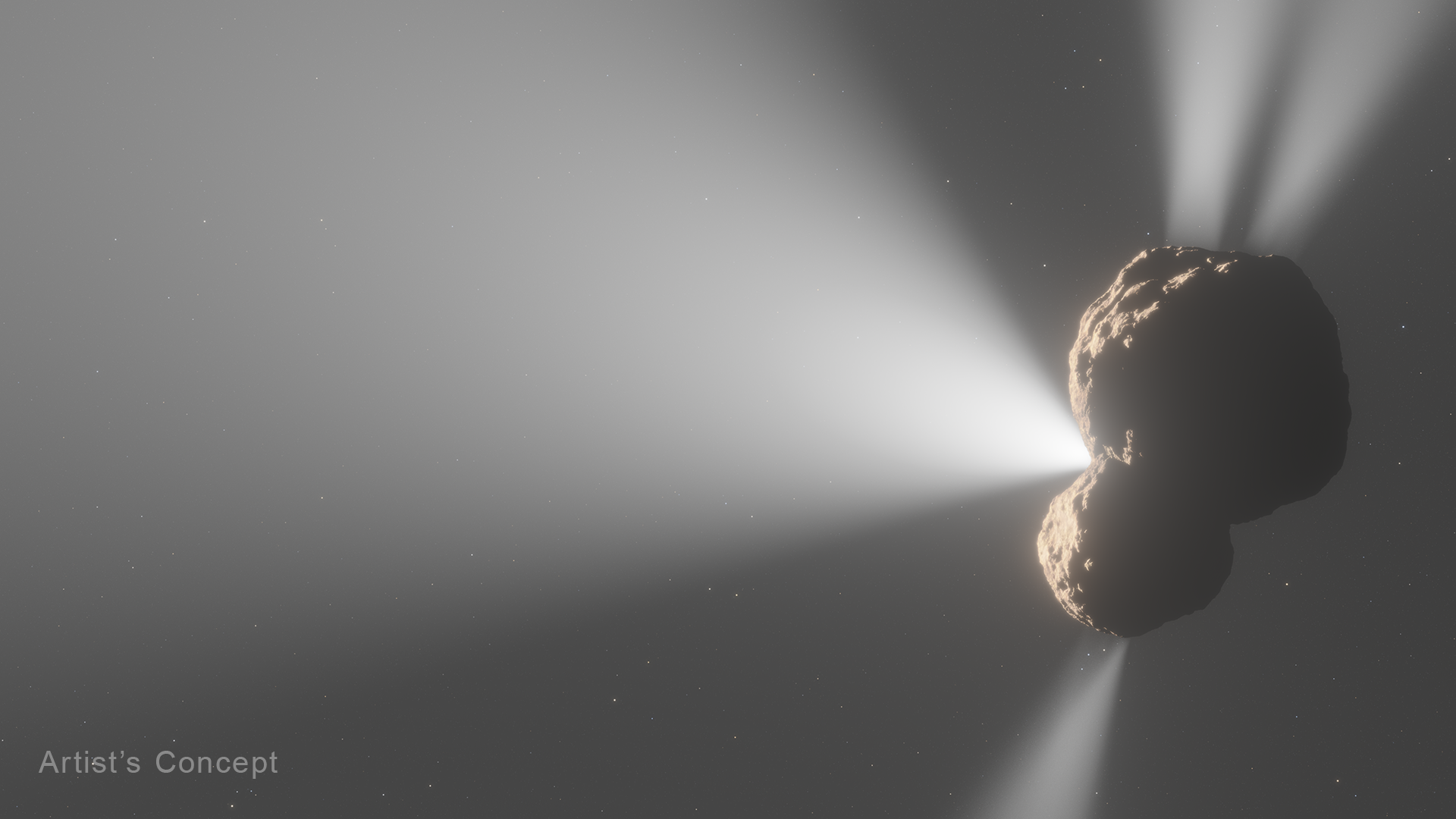
A team of scientists has made a groundbreaking discovery about Centaur 29P, one of the most active objects in our solar system’s outer reaches. Using NASA’s James Webb Space Telescope, they detected two jets of carbon dioxide and one jet of carbon monoxide emanating from the centaur’s surface. The findings, published in Nature, provide new insights into the composition and origin of Centaur 29P. Led by researchers at NASA Goddard and Appalachian State University, the team created a 3D model of the jets to understand their orientation and source.
They found that the jets originate from different regions on the centaur’s nucleus, suggesting it may be composed of distinct objects with varying compositions. Geronimo Villanueva, co-author of the study, notes that this challenges our understanding of how primordial objects are created and stored in the Kuiper Belt. The research has significant implications for our understanding of the formation and evolution of our solar system.
In a groundbreaking study published in Nature, a team of scientists has made the first definitive detection of carbon dioxide (CO2) in Centaur 29P/Schwassmann-Wachmann 1, one of the most active objects in the outer solar system. Using NASA’s James Webb Space Telescope, the researchers uncovered two jets of CO2 emanating from the centaur in the north and south directions, as well as a jet of carbon monoxide (CO) pointing towards the north.
This remarkable discovery has significant implications for our
This remarkable discovery has significant implications for our understanding of the formation and evolution of our solar system. The data gathered by Webb revealed never-before-seen features of Centaur 29P, including the orientation and origin of the jets. By creating a 3D model of the jets, the team found that they were emitted from different regions on the centaur’s nucleus, suggesting that the nucleus may be an aggregate of distinct objects with different compositions.
The study’s co-author, Geronimo Villanueva, notes that the dramatic differences in the abundance of CO and CO2 across Centaur 29P’s surface suggest that it may be composed of several pieces, potentially formed through separate pathways. This challenges our current understanding of how primordial objects are created and stored in the Kuiper Belt.
While this discovery sheds new light on Centaur 29P, many questions remain unanswered. The mechanisms behind its outgassing activity and bursts in brightness require further investigation. Unlike comets, where water ice sublimation drives jets, centaurs’ location makes them too cold for water ice to sublimate, implying a different nature of their outgassing activity.
The team hopes to return to Centaur 29P
The team hopes to return to Centaur 29P and observe it over a longer period, potentially uncovering additional carbon monoxide jets or changes in the orientation of the existing jets. By expanding our understanding of centaurs, we can gain insights into the formation and evolution of our solar system.
This study demonstrates the unparalleled capabilities of the James Webb Space Telescope, which is poised to revolutionize our understanding of the universe. As the premier space science observatory, Webb will continue to uncover hidden secrets of our cosmos, from the mysteries of our solar system to distant worlds around other stars.
External Link: Click Here For More


