

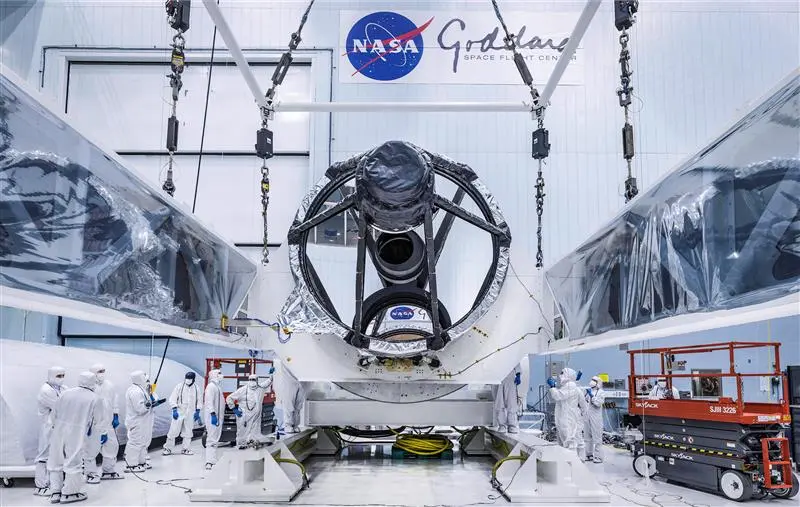
NASA’s Nancy Grace Roman Space Telescope has taken a significant step forward with delivering its Optical Telescope Assembly to the Goddard Space Flight Center in Maryland. The assembly, designed and built by L3Harris Technologies, includes a 7.9-foot primary mirror, nine additional mirrors, and supporting structures and electronics.
This critical component will focus cosmic light and send it to Roman’s instruments, revealing billions of objects throughout space and time. According to Bente Eegholm, optics lead for Roman’s Optical Telescope Assembly at NASA Goddard, the telescope has excellent optical performance at cold temperatures and is well aligned.
The team at L3Harris worked closely with NASA to ensure the assembly met stringent requirements for expansive, sensitive infrared observations. Josh Abel, lead Optical Telescope Assembly systems engineer at NASA Goddard, emphasized that the telescope’s design and performance are crucial factors in the mission’s survey capability. With this milestone, Roman remains on track for launch by May 2027.
The Optical Telescope Assembly: A Critical Component of NASA’s Roman Mission
The Nancy Grace Roman Space Telescope has taken a significant step forward with the delivery of its Optical Telescope Assembly (OTA) to NASA’s Goddard Space Flight Center in Greenbelt, Maryland. This critical component is designed to focus cosmic light and send it to Roman’s instruments, revealing billions of objects strewn throughout space and time.
The OTA includes a 7.9-foot (2.4-meter) primary mirror, nine additional mirrors, and supporting structures and electronics. The assembly was built by L3Harris Technologies in Rochester, New York, using key optics provided by the National Reconnaissance Office. The team at L3Harris reshaped the mirror and built upon the inherited hardware to ensure it would meet Roman’s specifications for expansive, sensitive infrared observations.
According to Bente Eegholm, optics lead for Roman’s OTA at NASA Goddard, “We have a top-notch telescope that’s well aligned and has great optical performance at the cold temperatures it will see in space.” The team worked closely with L3Harris to ensure the stringent requirements were met, and the telescope assembly will integrate smoothly into the rest of the Roman observatory.
Rigorous Testing Ensures Telescope Performance
The OTA’s manufacturing and testing processes were extremely rigorous. Each optical component was tested individually prior to being assembled and assessed together earlier this year. The tests helped ensure that the alignment of the telescope’s mirrors would change as expected when the telescope reached its operating temperature in space.
The telescope underwent a series of simulations, including extreme shaking and intense sound waves associated with launch. Engineers also tested the tiny components called actuators, which will adjust some of the mirrors in space, to ensure they move as predicted. Additionally, the team measured gases released from the assembly as it transitioned from normal air pressure to a vacuum, similar to the phenomenon that has led astronauts to report that space smells gunpowdery or metallic.
Finally, the telescope underwent a month-long thermal vacuum test to ensure it will withstand the temperature and pressure environment of space. The team closely monitored it during cold operating conditions to ensure the telescope’s temperature will remain constant to within a fraction of a degree. Holding the temperature constant allows the telescope to remain in stable focus, making Roman’s high-resolution images consistently sharp.
Installation and Integration
Now that the OTA has arrived at Goddard, it will be installed onto Roman’s Instrument Carrier, a structure that will keep the telescope and Roman’s two instruments optically aligned. The assembly’s electronics box – essentially the telescope’s brain – will be mounted within the spacecraft along with Roman’s other electronics.
With this milestone, Roman remains on track for launch by May 2027. According to J. Scott Smith, the assembly’s telescope manager at NASA Goddard, “Congratulations to the team on this stellar accomplishment! The completion of the telescope marks the end of an epoch and incredible journey for this team, and yet only a chapter in building Roman.”
The Nancy Grace Roman Space Telescope is managed at NASA’s Goddard Space Flight Center in Greenbelt, Maryland, with participation by NASA’s Jet Propulsion Laboratory and Caltech/IPAC in Southern California, the Space Telescope Science Institute in Baltimore, and a science team comprising scientists from various research institutions. The primary industrial partners are BAE Systems Inc. in Boulder, Colorado; L3Harris Technologies in Rochester, New York; and Teledyne Scientific & Imaging in Thousand Oaks, California.
External Link: Click Here For More


