

As NASA’s PUNCH mission prepares to launch in late February 2025, a constellation of four small spacecraft designed and built by Southwest Research Institute is poised to revolutionize our understanding of the Sun’s corona and its impact on the solar system.
By integrating observations of the outer atmosphere visible during total solar eclipses with measurements of the “solar wind” that fills and defines the solar system, PUNCH will provide an unprecedented 3D view of the corona and inner solar system, enabling scientists to track coronal mass ejections in real-time and better understand their effects on Earth.
PUNCH Spacecraft Prepare for Launch to Study the Sun’s Corona and Solar Wind
The Polarimeter to Unify the Corona and Heliosphere (PUNCH) mission, led by Southwest Research Institute (SwRI), has reached a critical milestone as its four small spacecraft make their final stop at Vandenberg Space Force Base in California before launch. The PUNCH mission aims to integrate our understanding of the Sun’s corona, visible during total solar eclipses, with the solar wind that fills and defines the solar system.
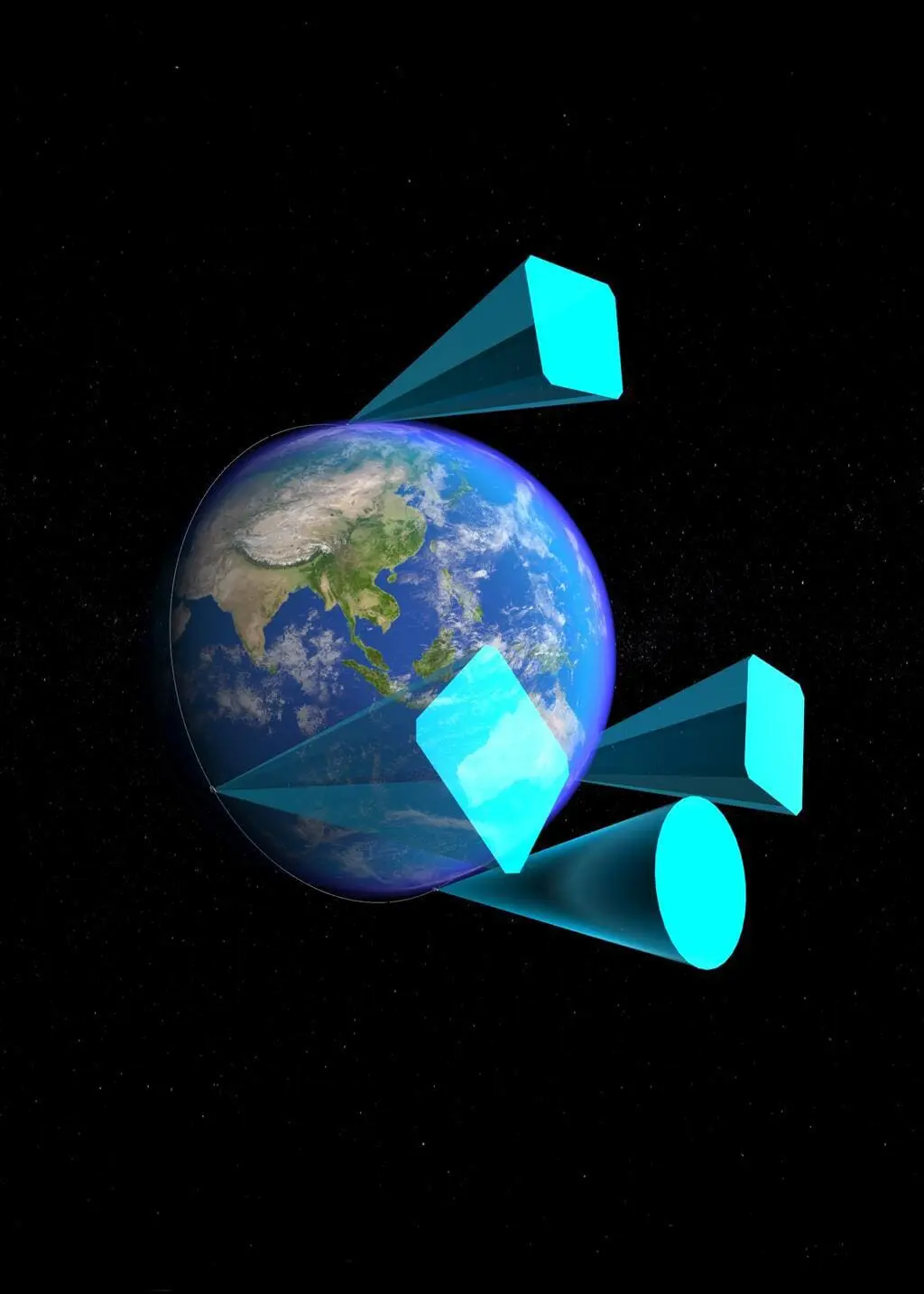
The PUNCH constellation of satellites will be launched into a polar orbit along the day-night line, allowing them to remain in sunlight with a clear view in all directions. This unique orbit will enable the spacecraft to capture roughly a quarter of the sky, centered on the Sun, and provide unprecedented insights into the solar wind and its interactions with the Earth’s magnetic field. The mission’s Principal Investigator, Dr. Craig DeForest, explained that once deployed, the constellation will allow scientists to “routinely see and understand the solar wind itself, as it streams out from our star and washes over Earth.”
The PUNCH spacecraft are equipped with advanced instruments designed to study the Sun’s corona and solar wind in unprecedented detail. Three satellites carry SwRI-developed Wide Field Imagers (WFI), which use an artificial “horizon” and deep baffles to view the very faint outermost portion of the solar corona and the solar wind itself. These instruments reduce direct sunlight by over 16 orders of magnitude, allowing scientists to observe the corona and solar wind with unprecedented clarity.
Advanced Instrumentation Enables Unprecedented Observations
The PUNCH spacecraft are equipped with advanced instruments designed to study the Sun’s corona and solar wind in unprecedented detail. The Wide Field Imagers (WFI) use an artificial “horizon” and deep baffles to view the very faint outermost portion of the solar corona and the solar wind itself. These instruments reduce direct sunlight by over 16 orders of magnitude, allowing scientists to observe the corona and solar wind with unprecedented clarity.
In addition to the WFI, one satellite carries a coronagraph, the Narrow Field Imager developed by the U.S. Naval Research Lab, which images the Sun’s corona continuously. Each spacecraft also includes a camera, developed by RAL Space, to collect three raw images through three different polarizing filters every four minutes. This allows scientists to make 3D maps of the features they see throughout the corona and inner solar system.
The PUNCH mission’s advanced instrumentation will enable scientists to discern the exact trajectory and speed of coronal mass ejections as they move through the inner solar system, improving on current instruments that only measure the corona itself and cannot measure motion in three dimensions. By measuring polarized light using polarizing filters similar to polarized sunglasses, PUNCH scientists can create detailed 3D maps of the features they observe throughout the corona and inner solar system.
Overcoming Challenges to Achieve Mission Success
The PUNCH team has demonstrated remarkable resilience in overcoming a number of late-breaking challenges over the last several months to complete integration and environmental testing of the four observatories. According to PUNCH Project Manager Ronnie Killough, “I look forward to a successful launch!” The Small Explorers (SMEX) program provides frequent flight opportunities for world-class scientific investigations from space using innovative, efficient approaches within the heliophysics and astrophysics science areas.
In addition to leading the PUNCH science mission, SwRI will operate the four spacecraft. The PUNCH team includes the U.S. Naval Research Laboratory, which is building the Narrow Field Imager, and RAL Space in Oxfordshire, England, which is providing detector systems for four visible-light cameras. With its advanced instrumentation and unique orbit, the PUNCH mission is poised to significantly contribute to our understanding of the Sun’s corona and solar wind.
The Importance of Understanding the Solar Wind
The PUNCH mission’s focus on studying the Sun’s corona and solar wind is critical to advancing our understanding of space weather and its impacts on Earth. The solar wind plays a crucial role in shaping the Earth’s magnetic field and can have significant effects on our planet’s climate and technological systems.
By providing unprecedented insights into the solar wind and its interactions with the Earth’s magnetic field, the PUNCH mission will help scientists better understand and predict space weather events. This knowledge will be essential for developing strategies to mitigate the impacts of space weather on our technological infrastructure and ensuring the continued reliability of our communication and navigation systems.
The successful launch and operation of the PUNCH spacecraft will mark a significant milestone in studying the Sun’s corona and solar wind, and will pave the way for future missions that will continue to advance our understanding of these complex phenomena.
External Link: Click Here For More


