NASA’s Hubble Space Telescope and MAVEN missions have helped unlock the mystery of Mars’ escaping water, a crucial step in understanding the Red Planet’s history. Scientists know that Mars was once a wet planet, but what happened to its water over the last 3 billion years? According to Dr. John T. Clarke, lead researcher from Boston University, Mars has an annual cycle that is much more dynamic than previously thought, with atmospheric conditions changing rapidly due to the planet’s proximity to the Sun.
The team discovered that escape rates of hydrogen and deuterium change rapidly when Mars is close to the Sun, requiring added energy to explain these changes. This research, published in Science Advances, has significant implications for understanding planetary evolution not only in our solar system but also for Earth-size planets around other stars. Key players involved in this work include NASA’s Goddard Space Flight Center, Lockheed Martin Space, and the University of Colorado Boulder.
The research team, led by John T. Clarke from Boston University, utilized the powerful combination of the Hubble Space Telescope and NASA’s Mars Atmosphere and Volatile Evolution (MAVEN) mission to study Mars’ atmosphere at different points in its orbit around the Sun.
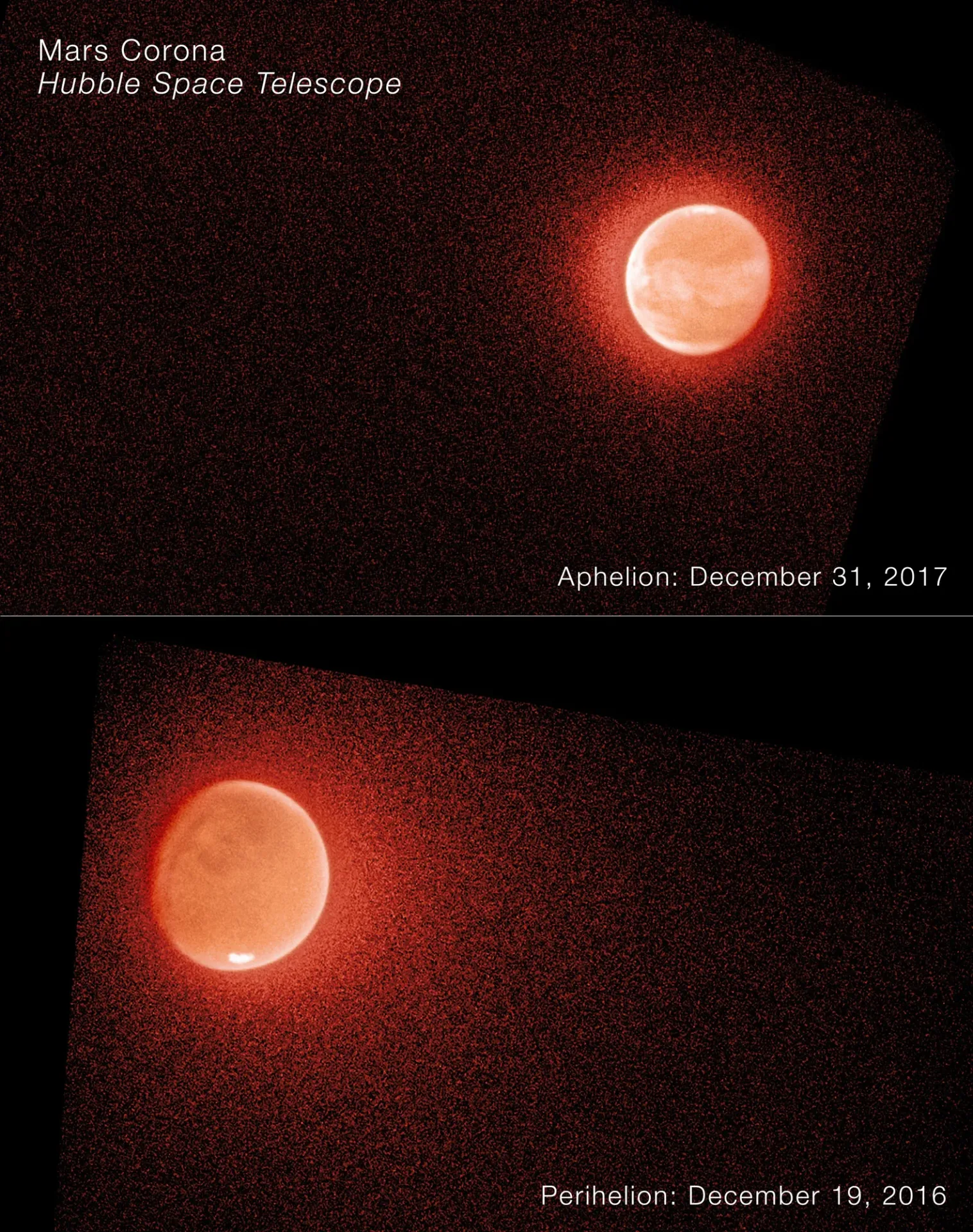
The Hubble images, taken on December 19, 2016,
The Hubble images, taken on December 19, 2016, and December 31, 2017, showcase a striking difference in Martian atmospheric conditions between perihelion (when Mars is closest to the Sun) and aphelion (when it’s farthest from the Sun). The atmosphere appears brighter and more extended when Mars is close to the Sun, indicating a significant increase in atmospheric molecules and haze.
The team discovered that Martian atmospheric conditions change rapidly, with water molecules rising quickly through the atmosphere when Mars is close to the Sun. This process releases atoms at high altitudes, contributing to the escape of hydrogen and deuterium from the planet’s atmosphere. The researchers also found that these changes occur on short timescales, even down to hours.
The study revealed that the rapid changes in hydrogen and deuterium require additional energy to explain their escape rates. This energy can come from collisions with solar wind protons or sunlight-driven chemical reactions in the upper atmosphere, producing faster (super-thermal) atoms capable of escaping Mars’ gravity.
Studying Mars’ atmospheric history is crucial not only for understanding our own solar system but also for grasping the evolution of Earth-sized planets around other stars. As we continue to discover more exoplanets, Mars serves as a valuable proxy for understanding the nature of these distant worlds.
The Hubble Space Telescope and MAVEN mission have
The Hubble Space Telescope and MAVEN mission have played instrumental roles in shaping our understanding of the universe. The continued operation of these missions will undoubtedly lead to further groundbreaking discoveries, helping us unravel the mysteries of our cosmos.
In conclusion, this study has significantly advanced our knowledge of Mars’ atmosphere, revealing a dynamic and turbulent system that’s far more complex than previously thought. As we continue to explore the Red Planet, we may uncover even more secrets about its past, present, and future – and perhaps, by extension, those of Earth-sized planets across the galaxy.
External Link: Click Here For More