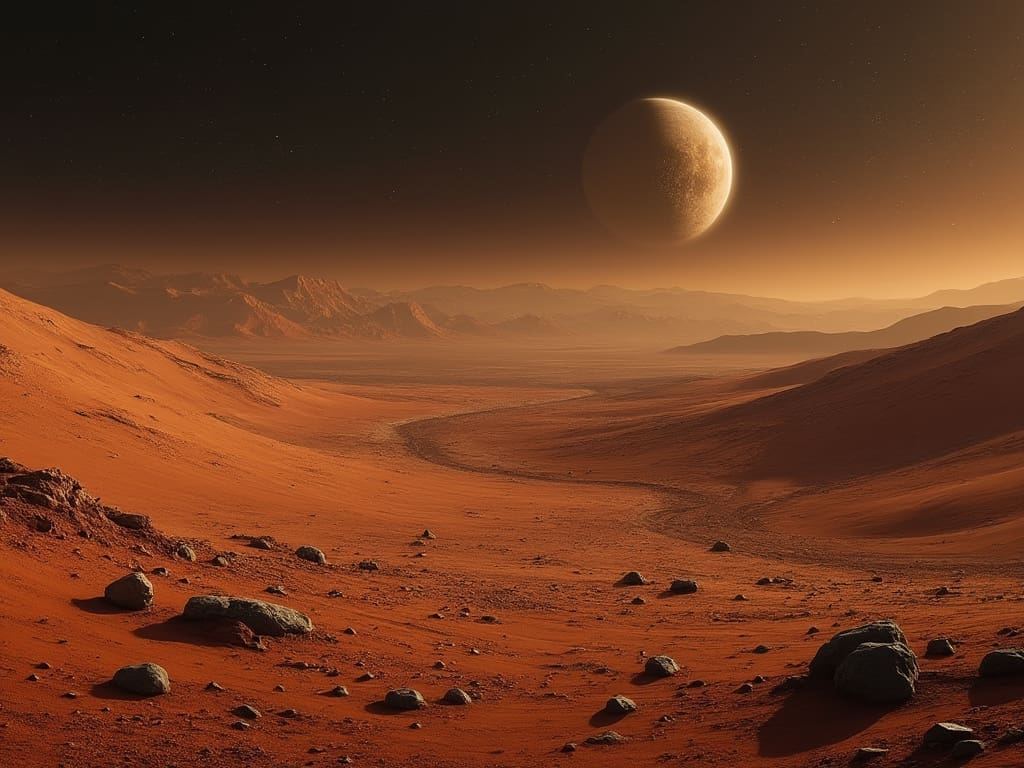
NASA’s Curiosity rover has uncovered new insights into how Mars transformed from a potentially habitable planet to its current inhospitable state. The rover, exploring Gale crater on Mars, found evidence of widespread liquid water on the surface billions of years ago, with features resembling valleys and deltas, and minerals that only form in the presence of liquid water. However, as the planet cooled and lost its global magnetic field, the solar wind and solar storms eroded away a significant amount of the atmosphere, turning Mars into the cold, arid desert we see today.
Researchers used instruments on board Curiosity to measure the isotopic composition of carbon-rich minerals found in Gale crater, led by David Burtt of NASA’s Goddard Space Flight Center. The findings suggest that these minerals formed in a climate with extreme evaporation, inconsistent with an ancient environment supporting life on the surface. However, this does not rule out the possibility of an underground biosphere or a surface biosphere that began and ended before these carbonates formed.
The study’s co-author, Jennifer Stern of NASA Goddard, notes that two formation mechanisms for carbonates found at Gale crater are proposed: wet-dry cycles within the crater or formation in very salty water under cold conditions. These scenarios represent different habitability possibilities, with implications for understanding Mars’ past and potential for life.
Unveiling Mars’ Transformation: From Habitable to Hostile
The Martian landscape, once thought to be potentially habitable with evidence of widespread liquid water on its surface, has undergone a drastic transformation over billions of years. NASA’s Curiosity rover, currently exploring Gale crater on Mars, has provided new insights into this transformation, shedding light on how the ancient Martian climate went from being suitable for life to becoming inhospitable.
The Red Planet’s atmosphere was once much denser and warm enough to form rivers, lakes, and perhaps even oceans of water. However, as the planet cooled and lost its global magnetic field, the solar wind and solar storms eroded away a significant amount of the planet’s atmosphere, turning Mars into the cold, arid desert we see today. This transformation is evident in the features resembling valleys and deltas, and minerals that only form in the presence of liquid water, found on ancient regions of Mars.
The Isotopic Clues: Uncovering Mars’ Ancient Climate
Researchers used instruments on board Curiosity to measure the isotopic composition of carbon-rich minerals (carbonates) found in Gale crater. These measurements revealed new insights into how the Red Planet’s ancient climate transformed. The isotope values of these carbonates point towards extreme amounts of evaporation, suggesting that these carbonates likely formed in a climate that could only support transient liquid water.
Isotopes are versions of an element with different masses. As water evaporated, light versions of carbon and oxygen were more likely to escape into the atmosphere, while the heavy versions were left behind more often, accumulating into higher abundances and eventually being incorporated into the carbonate rocks. The heavy isotope values in the Martian carbonates are significantly higher than what’s seen on Earth for carbonate minerals and are the heaviest carbon and oxygen isotope values recorded for any Mars materials.
Formation Mechanisms: Two Climate Regimes
The paper proposes two formation mechanisms for carbonates found at Gale. In the first scenario, carbonates are formed through a series of wet-dry cycles within Gale crater. In the second, carbonates are formed in very salty water under cold, ice-forming (cryogenic) conditions in Gale crater. These formation mechanisms represent two different climate regimes that may present different habitability scenarios.
Wet-dry cycling would indicate alternation between more-habitable and less-habitable environments, while cryogenic temperatures in the mid-latitudes of Mars would indicate a less-habitable environment where most water is locked up in ice and not available for chemistry or biology. The fact that these carbon and oxygen isotope values are higher than anything else measured on Earth or Mars points towards a process (or processes) being taken to an extreme.
Extreme Evaporation: A Key to Understanding Mars’ Transformation
The discovery was made using the Sample Analysis at Mars (SAM) and Tunable Laser Spectrometer (TLS) instruments aboard the Curiosity rover. The SAM heats samples up to nearly 1,652 degrees Fahrenheit (almost 900°C) and then the TLS is used to analyze the gases that are produced during that heating phase.
The extreme evaporation driving these isotope values to be so heavy suggests that any processes that would create lighter isotope values must have been significantly smaller in magnitude. This finding provides a crucial piece of evidence in understanding Mars’ transformation from a potentially habitable planet to a hostile environment.
The Quest for Understanding Mars: A Collaborative Effort
Funding for this work came from NASA’s Mars Exploration Program through the Mars Science Laboratory project. Curiosity was built by NASA’s Jet Propulsion Laboratory (JPL), which is managed by Caltech in Pasadena, California. JPL leads the mission on behalf of NASA’s Science Mission Directorate in Washington. NASA Goddard built the SAM instrument, which is a miniaturized scientific laboratory that includes three different instruments for analyzing chemistry, including the TLS, plus mechanisms for handling and processing samples.
This collaborative effort has led to a deeper understanding of Mars’ transformation, providing valuable insights into the planet’s ancient climate and its potential habitability. As we continue to explore the Red Planet, we may uncover more secrets about its past, ultimately helping us better understand our place in the universe.
External Link: Click Here For More