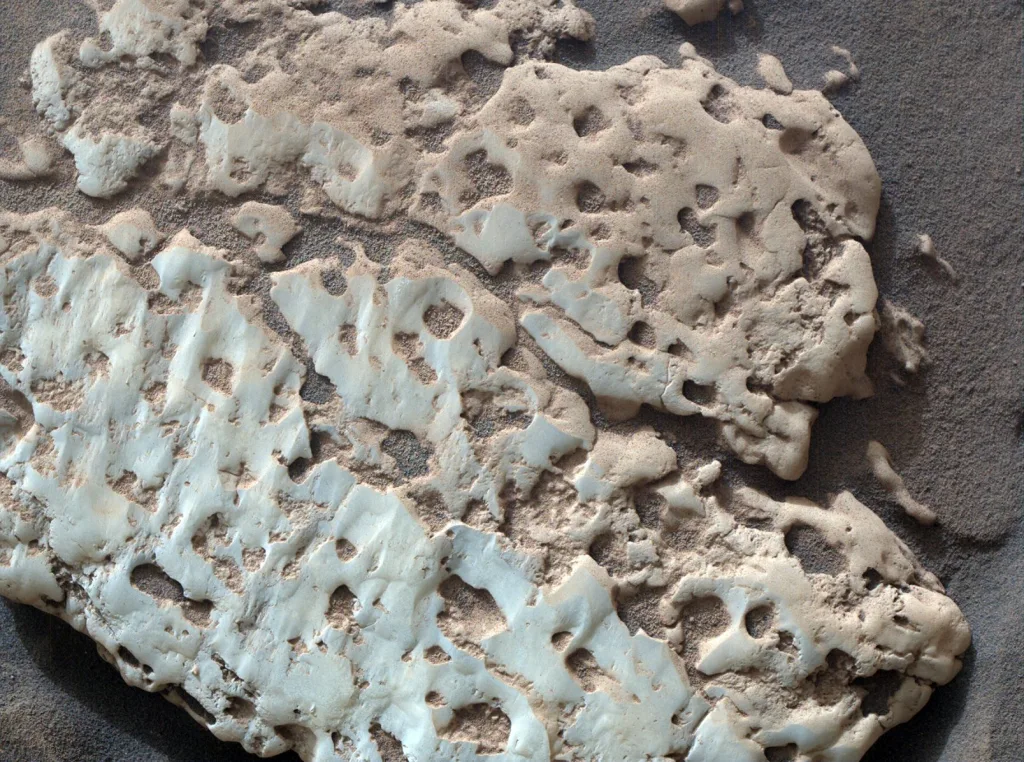
NASA’s Curiosity Mars rover has made a surprising discovery on the Red Planet, uncovering rocks made of pure sulfur, a first for the Martian terrain. On May 30, the rover drove over a rock and cracked it open, revealing yellow sulfur crystals. According to scientists, this finding is significant because elemental sulfur forms in only a narrow range of conditions that aren’t associated with the history of the location. The discovery was made in the Gediz Vallis channel, a region rich in sulfates, where Curiosity has been exploring since October 2023.
Ashwin Vasavada, Curiosity’s project scientist at NASA’s Jet Propulsion Laboratory, described the finding as an “oasis in the desert,” saying it shouldn’t exist and now requires explanation. The rover’s mission is to study the Martian terrain and determine if it could have supported microbial life. The discovery is one of several made by Curiosity while exploring the channel, including evidence of ancient floods and landslides that shaped the landscape.
NASA’s Curiosity Rover Makes Groundbreaking Discoveries
NASA’s Curiosity Mars rover has made several remarkable discoveries on the Red Planet, including detecting pure sulfur crystals and rocks in a region rich with sulfates. The rover’s findings have provided valuable insights into Mars’ geological history and potential habitability.
Sulfur Crystals: A First on Mars
On May 30, Curiosity drove over a rock nicknamed “Snow Lake” and cracked it open, revealing yellow sulfur crystals. This marked the first time elemental sulfur has been found on Mars. The discovery was unexpected, as scientists had previously detected only sulfur-based minerals, which are mixtures of sulfur with other elements. The presence of pure sulfur crystals suggests that Mars’ geological history is more complex than initially thought.
Floods and Avalanches: Shaping Martian Landscapes
Curiosity’s exploration of Gediz Vallis channel has provided evidence of ancient floods and landslides that shaped the Martian landscape. Scientists believe that the channel was carved by flows of liquid water and debris, which left a ridge of boulders and sediment extending 2 miles down the mountainside. The rover’s findings suggest that both violent flows of water and local landslides played a role in building up the large mounds of debris within the channel.
Water’s Impact on Martian Geology
Water has had a significant impact on Mars’ geology, as evidenced by the presence of “halo” shapes in rocks. These markings resemble those seen on Earth when groundwater leaks into rocks along fractures, causing chemical reactions that change the color. The discovery of halos suggests that water soaked into all the material that settled in Gediz Vallis channel, leading to chemical reactions that altered the rock’s composition.
Drilling into Martian History
On June 18, Curiosity drilled its 41st hole into a large rock nicknamed “Mammoth Lakes,” collecting a sample for further analysis. The rover’s drill can penetrate rocks and collect powderized samples, which are then analyzed by instruments inside the rover’s belly. This process allows scientists to determine the composition of Martian rocks and gain insights into the planet’s geological history.
Ongoing Exploration and Discovery
Curiosity’s ongoing exploration of the Gediz Vallis channel has provided new information about Mars’ geological history and potential habitability. As the rover continues its ascent up Mount Sharp, it is likely to uncover even more secrets about the Red Planet. The mission’s findings significantly impact our understanding of Mars and the search for life beyond Earth.
External Link: Click Here For More