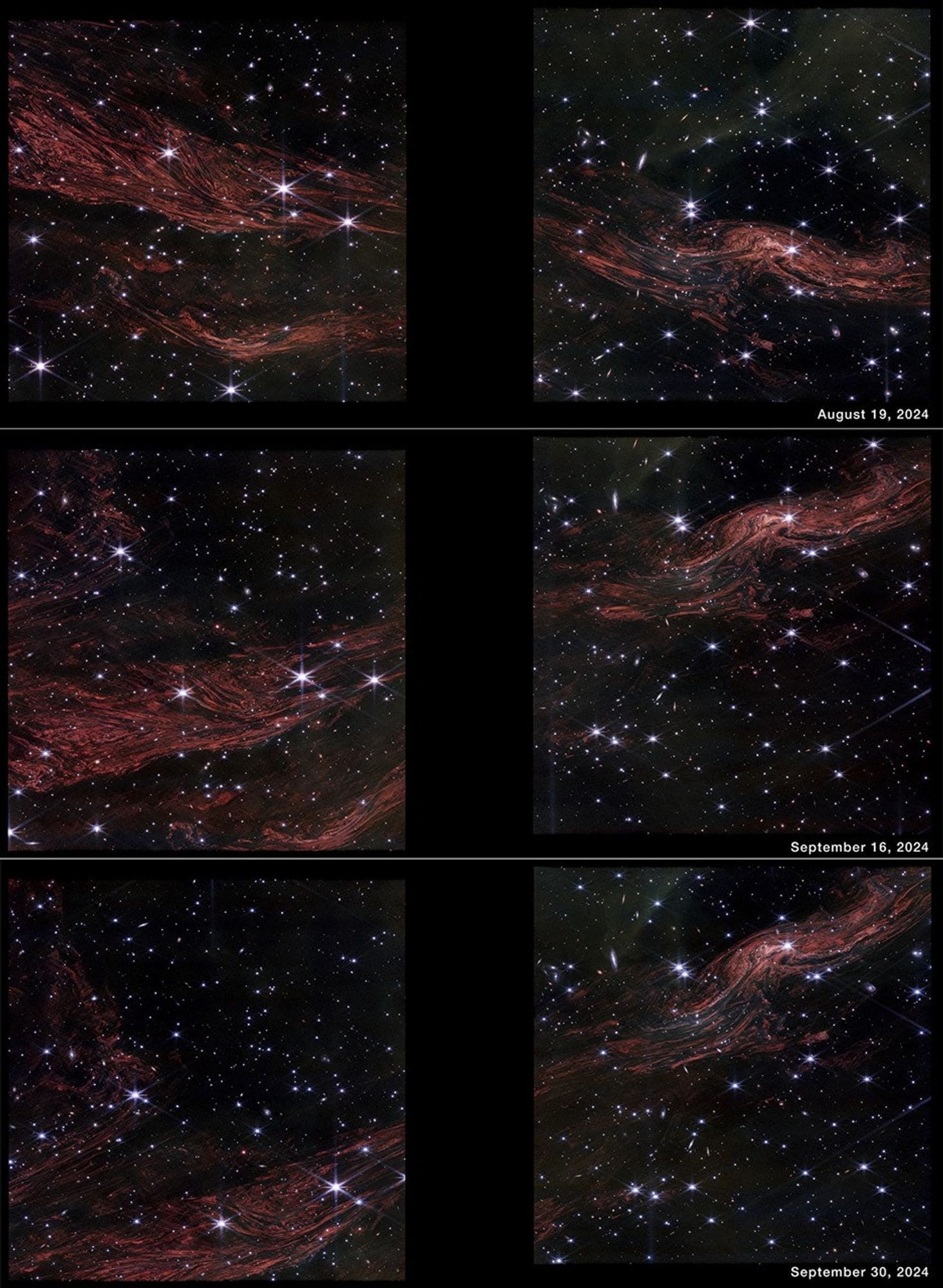
NASA’s James Webb Space Telescope has unveiled unprecedented details of the intricate layers of interstellar dust and gas, akin to the knots and whorls of wood grain, in the vicinity of the Cassiopeia A supernova remnant. By capturing the infrared glow of this interstellar material, illuminated by a brief pulse of X-rays and ultraviolet light from a massive star’s collapse, Webb has enabled astronomers to map the true 3D structure of this cosmic environment for the first time. The resulting images reveal fine details on remarkably small scales, including tightly packed sheets and dense, knotted regions that may be influenced by interstellar magnetic fields, offering a groundbreaking glimpse into the complex architecture of the interstellar medium.
Unveiling the Intricate Layers of Interstellar Dust and Gas
NASA‘s James Webb Space Telescope has made a groundbreaking observation, revealing the intricate layers of interstellar dust and gas in unprecedented detail. The telescope has captured the infrared glow of interstellar material illuminated by a brief, intense pulse of X-rays and ultraviolet light from a massive star that exploded 350 years ago. This phenomenon, known as a light echo, is allowing astronomers to map the true 3D structure of the interstellar medium for the first time.
The images taken by Webb’s Near-Infrared Camera (NIRCam) show tightly packed sheets of filaments with structures on remarkably small scales of about 400 astronomical units, or less than one-hundredth of a light-year. These sheet-like structures may be influenced by interstellar magnetic fields, and the dense, tightly wound regions resemble knots in wood grain, potentially representing magnetic “islands” embedded within the more streamlined magnetic fields.
A Cosmic CT Scan
The researchers targeted a light echo that had previously been observed by NASA’s retired Spitzer Space Telescope. By taking multiple observations at different times, they can study the true 3D structure of the interstellar medium, much like a medical CT scan. This will completely change the way scientists study the interstellar medium, allowing them to gain insights into its composition, density, and magnetic field structures.
Future Work and Implications
The team’s science program also includes spectroscopic observations using Webb’s Mid-Infrared Instrument (MIRI). They plan to target the light echo multiple times, weeks or months apart, to observe how it evolves as the light echo passes by. This will enable them to study changes in the compositions or states of molecules and even the smallest dust grains.
Infrared light echoes are extremely rare, requiring a specific type of supernova explosion with a short pulse of energetic radiation. However, NASA’s upcoming Nancy Grace Roman Space Telescope may find evidence of additional infrared light echoes for Webb to study in detail. The James Webb Space Telescope is poised to continue solving mysteries in our solar system, looking beyond to distant worlds around other stars, and probing the mysterious structures and origins of our universe.
The Significance of Light Echoes
Light echoes are created when a star explodes or erupts, flashing light into surrounding clumps of dust and causing them to shine in an ever-expanding pattern. While visible wavelength light echoes are due to light reflecting off interstellar material, infrared wavelength light echoes are caused by the dust being warmed by energetic radiation and then glowing.
The study of light echoes provides a unique opportunity to probe the interstellar medium, which plays a crucial role in the formation of stars and planets. By understanding the structure and composition of the interstellar medium, scientists can gain insights into the processes that shape our universe.
The James Webb Space Telescope
The James Webb Space Telescope is an international program led by NASA with its partners, ESA (European Space Agency) and CSA (Canadian Space Agency). As the world’s premier space science observatory, Webb is designed to solve mysteries in our solar system, look beyond to distant worlds around other stars, and probe the mysterious structures and origins of our universe and our place in it.
External Link: Click Here For More