
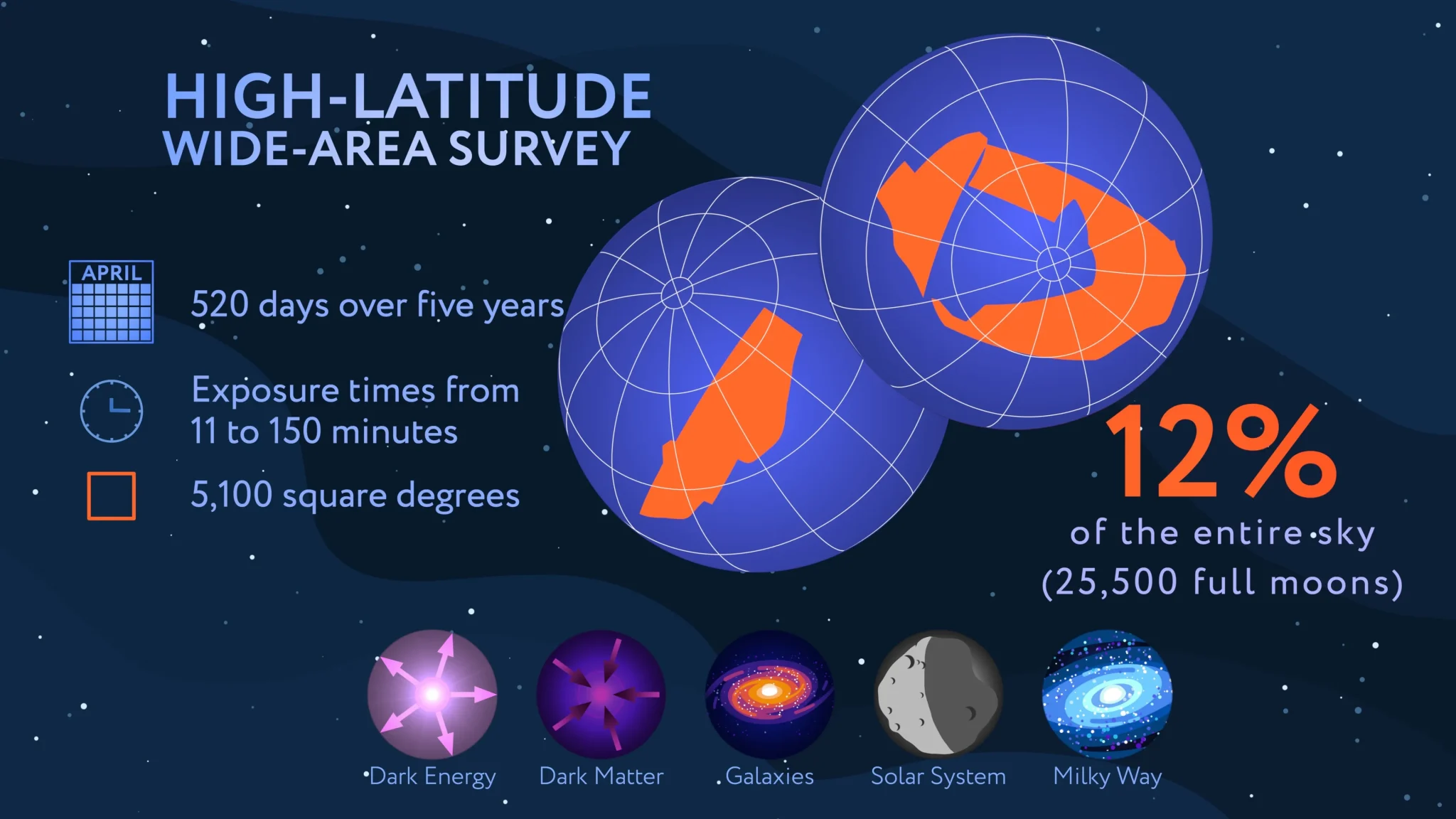
NASA’s upcoming Nancy Grace Roman Space Telescope will soon begin a groundbreaking survey poised to image hundreds of millions of galaxies, offering an unprecedented view of the universe’s hidden components. Launching as early as this fall, the mission’s High-Latitude Wide-Area Survey will cover more than 5,000 square degrees – roughly 12 percent of the sky – in under a year and a half. “We set out to build the ultimate wide-area infrared survey, and I think we accomplished that,” said Ryan Hickox, a professor at Dartmouth College and co-chair of the survey’s design team. This ambitious project will allow scientists to study elusive dark matter and dark energy, and ultimately, “explore the fundamental nature of the universe, including its dark side.”
Nancy Grace Roman Telescope’s 5,000 Square Degree High-Latitude Survey
This isn’t simply about cataloging celestial objects; it’s about probing the elusive nature of dark matter and dark energy, the mysterious forces dominating the cosmos. The survey’s strategic focus on “high-latitude” regions, away from the obscured plane of the Milky Way, is crucial for obtaining exceptionally clear views of distant galaxies. This allows astronomers to leverage the power of gravitational lensing, where the gravity of massive objects bends and distorts the light from galaxies behind them.
This distortion isn’t a hindrance, but a tool; by analyzing these warped images, scientists can indirectly map the distribution of dark matter, detectable only through its gravitational effects. Simulations demonstrate how intervening galaxy clusters and dark matter will distort the light from farther objects, enabling observations of extremely distant galaxies. The sheer scale of the data generated will be staggering. David Weinberg, an astronomy professor at Ohio State University, highlighted the resolution: “Even a single pointing with Roman needs a whole wall of 4K televisions to display at full resolution.
Displaying the whole high-latitude survey at once would take half a million 4K TVs, enough to cover 200 football fields or the cliff face of El Capitan.” Beyond imaging, the survey will also gather spectroscopic data from approximately 20 million galaxies, allowing astronomers to measure their redshifts – the stretching of light waves caused by the universe’s expansion. This will enable the creation of a detailed 3D map extending out to 11.5 billion light-years, revealing ancient sound waves frozen into the fabric of the cosmos.
These “baryon acoustic oscillations” – ripples from the early universe – act as a cosmic ruler, allowing scientists to trace the universe’s expansion history and refine measurements of dark energy. “Cosmic acceleration is the biggest mystery in cosmology and maybe in all of physics,” said Weinberg. “Somehow, when we get to scales of billions of light years, gravity pushes rather than pulls.” The Roman wide area survey will provide critical new clues to help us solve this mystery, because it allows us to measure the history of cosmic structure and the early expansion rate much more accurately than we can today.” Olivier Doré, a senior research scientist at NASA’s Jet Propulsion Laboratory, anticipates a wealth of unexpected discoveries, stating, “The data analysis standards required to measure weak gravitational lensing are such that the astronomy community as a whole will benefit from very high-quality data over the full survey area, which will undoubtedly lead to unexpected discoveries.”
Gravitational Lensing Maps Dark Matter Distribution
The quest to map the universe’s invisible scaffolding – dark matter – is entering a new era, moving beyond statistical inference toward direct visualization thanks to the upcoming Nancy Grace Roman Space Telescope. Current methods rely heavily on observing the effects of dark matter on visible matter, but Roman’s capabilities promise a leap in resolution and scope, allowing astronomers to trace its distribution with unprecedented precision. This isn’t merely about identifying where dark matter is, but understanding how it’s structured and how that structure has evolved over cosmic time.
This distortion isn’t a random effect; the degree and pattern of warping directly relate to the mass of the intervening object – including the elusive dark matter. Roman’s large field of view will be crucial, as “weak lensing distorts galaxy shapes too subtly to see in any single galaxy — it’s invisible until you do a statistical analysis.” The telescope is projected to analyze over 600 million galaxies, providing the statistical power needed to map dark matter’s influence.
The telescope’s ability to study lensing on a smaller scale will allow scientists to observe how clumps of dark matter warp distant galaxies in detail. By meticulously analyzing these warped images, astronomers will construct a comprehensive map of matter distribution, both visible and dark, throughout the universe. This detailed mapping will fill critical gaps in our understanding of dark matter’s role in cosmic structure formation and its interaction with ordinary matter. Furthermore, the survey will leverage the power of baryon acoustic oscillations – frozen sound waves from the early universe – as a “ruler” for measuring cosmic distances.
These ripples, imprinted in the distribution of galaxies, expand with the universe, and their size at different epochs can reveal the strength of dark energy. “Roman will be able to make high precision tests that should tell us whether these hints are real deviations from our current standard model or not,” said Risa Wechsler, director of Stanford University’s KIPAC (Kavli Institute for Particle Astrophysics and Cosmology) in California and co-chair of the committee that shaped the survey’s design. “Roman’s imaging survey combined with its redshift survey give us new information about the evolution of the universe — both how it expands and how structures grow with time — that will help us understand what dark energy and gravity are doing at unprecedented precision.” Ultimately, the mission aims to refine our understanding of dark energy’s influence by a factor of ten, potentially resolving long-standing mysteries about the universe’s accelerating expansion.
This survey is going to be a spectacular map of the cosmos, the first time we have Hubble-quality imaging over a large area of the sky.
David Weinberg, an astronomy professor at Ohio State University in Columbus
Spectroscopic Redshift Measures Cosmic Expansion History
Dartmouth College professor Ryan Hickox and his team are poised to unlock unprecedented insights into the universe’s expansion using data from NASA’s Nancy Grace Roman Space Telescope. The core of this investigation lies in spectroscopic redshift, a technique that analyzes the light from distant galaxies to determine their velocity and distance, effectively mapping the cosmos’s expansion history. Roman’s capabilities will allow astronomers to gather spectra from approximately 20 million galaxies, a monumental leap beyond current datasets.
Analyzing spectra helps show how the universe expanded during different cosmic eras because when an object recedes, all of the light waves we receive from it are stretched out and shifted toward redder wavelengths — a phenomenon called redshift. This isn’t merely a matter of cataloging galaxies; it’s about tracing the evolution of the universe from its earliest moments. By determining how quickly galaxies are receding from us, carried by the relentless expansion of space, astronomers can find out how far away they are — the more a galaxy’s spectrum is redshifted, the farther away it is.
These primordial sound waves, known as baryon acoustic oscillations, acted as ripples through the early plasma, creating slight density variations that eventually seeded galaxy formation. “These rings act like a ruler for the universe,” explains the team, as these structures expanded alongside the universe itself. The precision of Roman’s measurements will be crucial in understanding dark energy, the mysterious force driving the accelerating expansion. Current measurements are limited, but Roman promises to improve accuracy tenfold. Furthermore, the telescope’s ability to analyze weak gravitational lensing – the distortion of light from distant galaxies by intervening matter – complements the redshift analysis.
We set out to build the ultimate wide-area infrared survey, and I think we accomplished that.
Ryan Hickox, a professor at Dartmouth College in Hanover, New Hampshire, and co-chair of the committee that shaped the survey’s design
Baryon Acoustic Oscillations Reveal Ancient Sound Waves
These aren’t sounds we can hear, but rather frozen ripples in the distribution of matter, remnants of sound waves that propagated through the primordial plasma shortly after the Big Bang. Understanding these oscillations offers a unique yardstick for measuring cosmic distances and, crucially, the nature of dark energy. For the first half-million years of its existence, the universe was a superheated, dense soup of charged particles. Tiny density fluctuations within this plasma attracted more matter, but the intense heat prevented immediate collapse.
This resulted in a constant push and pull, generating pressure waves – sound – that travelled through the cosmos. As the universe cooled and expanded, these waves froze, leaving behind a characteristic pattern in the distribution of galaxies. These patterns, now approximately 500 million light-years wide, act as a “standard ruler” for cosmologists. By precisely measuring the size of these baryon acoustic oscillations at different points in cosmic history, astronomers can trace the universe’s expansion rate with unprecedented accuracy. The significance lies in unraveling the mystery of dark energy, the force driving the accelerating expansion of the universe.
Current measurements are imprecise, leaving multiple theoretical explanations viable. Roman’s observations promise to refine these measurements tenfold, potentially distinguishing between competing models. This detailed analysis, combined with the sheer volume of galaxies observed – an estimated 600 million detailed enough for study – will allow astronomers to trace the universe’s structural development from shortly after the Big Bang to the present day.