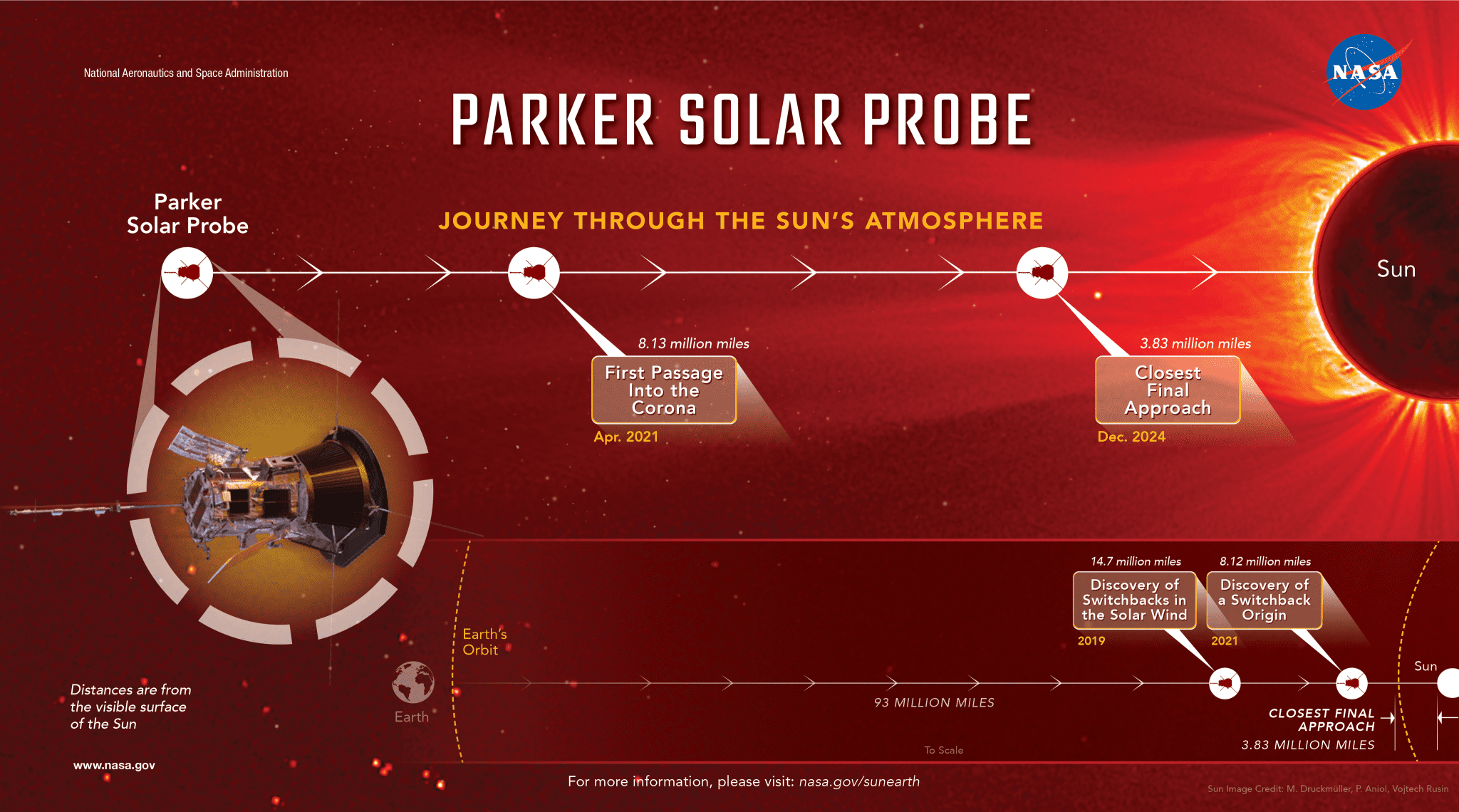
NASA’s Parker Solar Probe has made history by flying closer to the Sun than any human-made object, reaching a distance of 3.8 million miles above the solar surface on December 24, 2024. The spacecraft, designed and built by the Johns Hopkins Applied Physics Laboratory, hurtled through the solar atmosphere at a speed of 430,000 miles per hour.
According to Nicky Fox, NASA Associate Administrator for the Science Mission Directorate, this achievement is a historic moment in humanity’s first mission to a star. The probe’s close pass allows for unrivaled scientific measurements that can change our understanding of the Sun. Nour Rawafi, project scientist for Parker Solar Probe, notes that the spacecraft is revolutionizing our understanding of the Sun, while Kelly Korreck, a program scientist at NASA Headquarters, emphasizes the importance of the data collected by the probe. The mission has already led to significant discoveries about the solar wind and coronal mass ejections, with more data expected to be transmitted soon.
This proximity allows the spacecraft to collect valuable data about the Sun’s corona, solar wind, and energetic particles. The probe’s heat shield is designed to withstand temperatures of up to 2,600 degrees Fahrenheit while keeping the instruments behind it at a comfortable room temperature.
External Link: Click Here For More