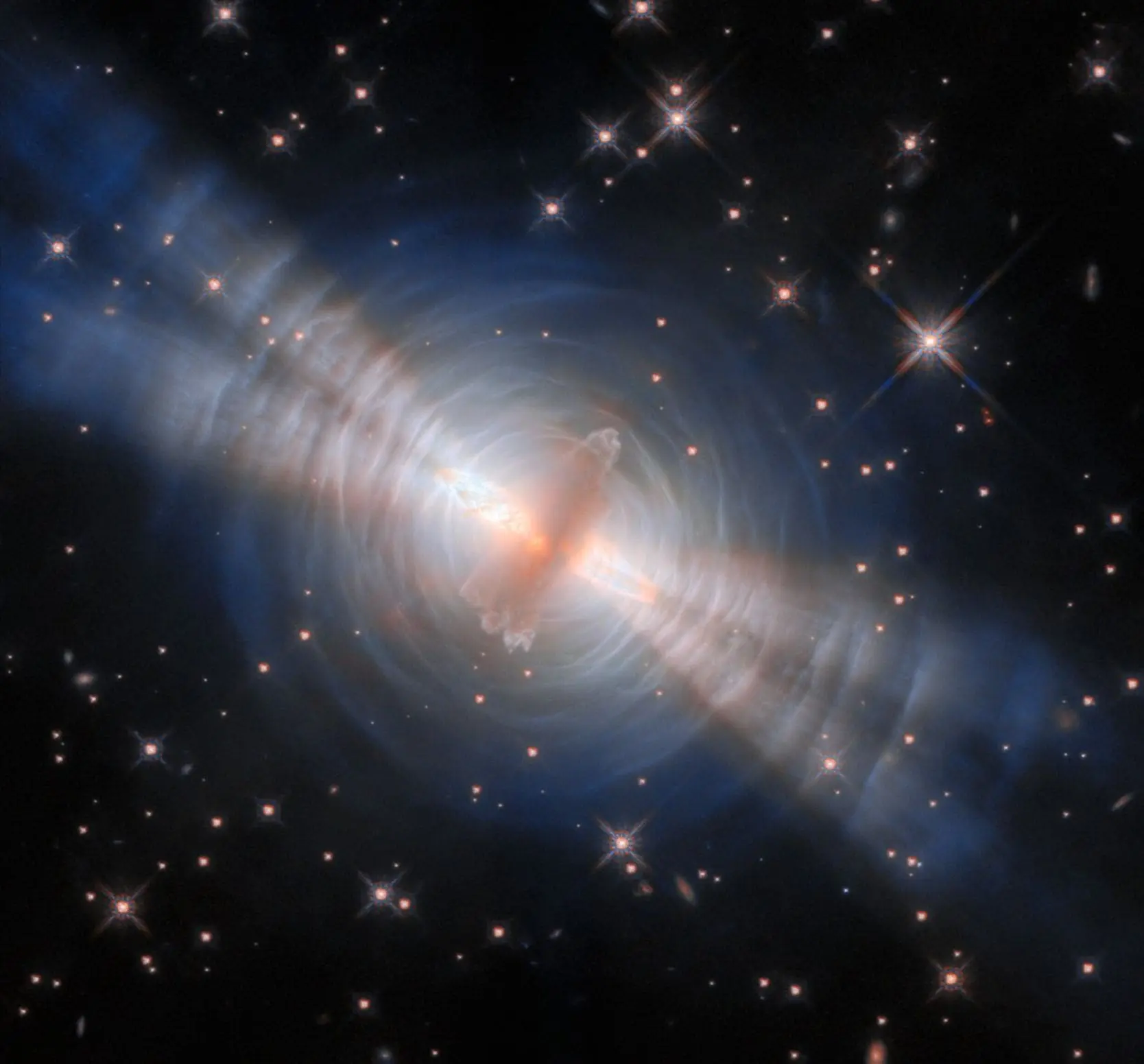
NASA’s Hubble Space Telescope has delivered the clearest view yet of the Egg Nebula, a structure of gas and dust created by a rapidly dying, Sun-like star. Located 1,000 light-years away in Cygnus, this nebula is unique as the first, youngest, and closest pre-planetary nebula ever discovered – a crucial stage before a star becomes a planetary nebula. Hubble’s sharpness unveils intricate details hinting at the processes shaping this enigmatic structure, revealing a central “yolk” obscured by a dense “egg white” of dust. “At this early phase, the nebula shines by reflecting light from its central star, which escapes through a polar ‘eye’ in the surrounding dust,” offering a rare opportunity to test theories of late-stage stellar evolution and understand how stars like our Sun eventually seed new planetary systems.
Egg Nebula Reveals Pre-Planetary Stage Stellar Evolution
The Egg Nebula presents a fleeting glimpse into the immediate precursor phase to planetary nebulae, a stage lasting only a few thousand years. Unlike the well-known, glowing shells of planetary nebulae like the Helix, Stingray, and Butterfly, the Egg Nebula is still shrouded in darkness, its central star obscured by a dense cloud of dust resembling an “egg white” around a “yolk.”
Recent observations captured with Hubble’s Wide Field Camera 3 reveal a complex interplay of light and shadow, sculpted by freshly ejected stardust. This light originates from a disk of material expelled from the star’s surface just a few hundred years ago, illuminating fast-moving polar lobes that pierce older, concentric arcs. “The symmetrical patterns captured by Hubble are too orderly to result from a violent explosion like a supernova,” indicating a more coordinated ejection process. Scientists believe these arcs and lobes stem from “poorly understood sputtering events in the carbon-enriched core of the dying star.”
Hubble’s ongoing observations, building on data from WFPC2 in 1997, NICMOS, ACS in 2003, and WFC3 in 2012, are crucial for understanding how stars like our Sun shed their outer layers as they exhaust their fuel. These aged stars are responsible for seeding the universe with the dust that eventually forms new star systems, including our own, which coalesced 4.5 billion years ago.
Hubble’s Wide Field Camera 3 Captures Nebula Details
The Egg Nebula currently presents a unique snapshot of stellar evolution, a fleeting moment in the life of a dying star. Rather than witnessing a catastrophic explosion, Hubble’s latest observations reveal a delicate structure of gas and dust, sculpted by processes occurring over just a few thousand years. The combined data delivers an unprecedented level of detail, allowing scientists to probe the mechanisms driving the nebula’s formation. This makes the Egg Nebula an ideal laboratory for understanding the origins of future star systems.
Hubble’s Three-Decade Legacy of Astrophysical Discovery
The NASA Goddard Space Flight Center continues to analyze data from the Hubble Space Telescope, building on a legacy of over three decades of groundbreaking astronomical observation. Recent investigations have focused on the Egg Nebula, a pre-planetary nebula located 1,000 light-years away in Cygnus, utilizing the Wide Field Camera 3 to capture unprecedented detail. This nebula represents a crucial transitional phase in stellar evolution, lasting only a few thousand years, making it an ideal subject for studying the processes of stellar death. Prior to these latest observations, Hubble examined the nebula in 1997 with the Near Infrared Camera and Multi-Object Spectrometer, and again in 2003 with the Advanced Camera for Surveys, each time refining our understanding of its structure.
Dust Ejection Links Dying Stars to Solar System Origins
The intricate structures observed within nebulae like the Egg Nebula aren’t merely beautiful cosmic displays; they offer crucial insights into the origins of planetary systems, including our own. This process isn’t just about stellar death, but about stellar recycling. Aged stars like the one at the heart of the Egg Nebula are responsible for creating and dispersing the dust that ultimately forms new stars and planets.
Indeed, these stars “forged and released the dust that eventually seeded future star systems, such as our own solar system, which coalesced into Earth and other rocky planets 4.5 billion years ago.” Hubble’s ongoing observations, building on data collected since 1997 with instruments like WFPC2, NICMOS, ACS, and WFC3, provide a progressively clearer picture of this crucial dust ejection process. The telescope’s ability to observe this “forensic evidence” while it remains “fresh” is invaluable for refining theories of stellar evolution and planetary formation.
Only Hubble’s sharpness can unveil the intricate details that hint at the processes shaping this enigmatic structure.
NASA, ESA, Bruce Balick (UWashington)