
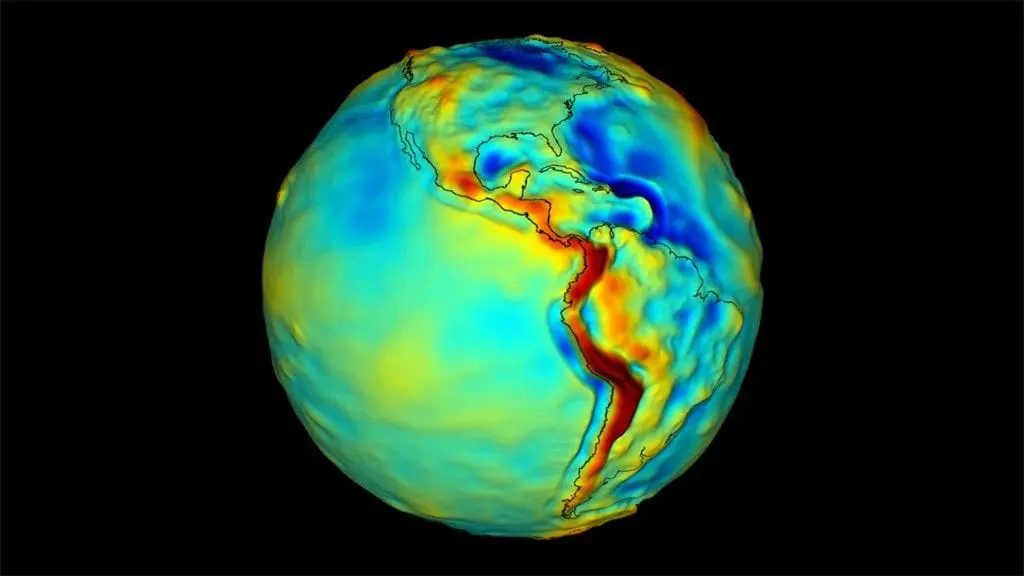
NASA’s Jet Propulsion Laboratory is developing the first space-based quantum sensor for gravity measurements in collaboration with private companies and academic institutions, supported by NASA’s Earth Science Technology Office (ESTO). This project aims to enhance the mapping of Earth’s gravitational field using ultra-cold rubidium atoms as test masses, improving applications in resource management, navigation, and national security. The Quantum Gravity Gradiometer Pathfinder (QGGPf) instrument is scheduled for launch near the end of the decade.
Earth’s gravitational field constantly changes as geological processes redistribute mass across our planet. The basic principle is simple: greater mass creates stronger gravitational pull.
While these subtle gravitational variations go unnoticed in daily life, scientists can map them using specialized instruments called gravity gradiometers. These detailed gravity maps provide critical data for navigation systems, resource management strategies, and national security applications.
“Using atoms, we could precisely determine the mass of mountain ranges like the Himalayas,” explained Jason Hyon, JPL’s Earth Science chief technologist and director of their Quantum Space Innovation Center. Hyon and his team recently published their concepts for the Quantum Gravity Gradiometer Pathfinder (QGGPf) instrument in EPJ Quantum Technology.
Gravity gradiometers function by comparing how quickly objects fall in different locations. They measure the acceleration difference between two “test masses” in free-fall, with faster acceleration indicating stronger gravitational force.
The QGGPf will employ an innovative approach, using two clouds of ultra-cold rubidium atoms as test masses. These atoms, cooled to near absolute zero, exhibit wave-like properties. The quantum gravity gradiometer will measure acceleration differences between these matter waves to detect gravitational anomalies.
“Using atomic clouds as test masses is ideal for long-term accuracy in space-based gravity measurements,” noted Sheng-wey Chiow, a JPL experimental physicist. “With atoms, every measurement remains consistent, and we’re less vulnerable to environmental interference.”
This atomic approach also enables a more compact instrument design for spacecraft integration. The QGGPf will occupy only about 0.3 cubic yards (0.25 cubic meters) and weigh approximately 275 pounds (125 kilograms)—significantly smaller and lighter than conventional space-based gravity instruments.
Quantum sensors also promise substantially improved sensitivity. Estimates suggest a science-grade quantum gravity gradiometer could measure gravitational forces up to ten times more precisely than classical sensors.
Scheduled for launch toward the end of this decade, this technology validation mission will primarily test novel techniques for manipulating light-matter interactions at the atomic level.
“This instrument represents uncharted territory for space applications,” said Ben Stray, a JPL postdoctoral researcher. “Flying it will help us understand its operational characteristics and advance not just quantum gravity measurement, but quantum technology broadly.”
The project involves significant public-private collaboration. JPL is partnering with AOSense and Infleqtion on sensor head technology, while NASA’s Goddard Space Flight Center in Greenbelt, Maryland, works with Vector Atomic to develop the laser optical system.
The innovations from this pathfinder mission could ultimately enhance our understanding of Earth, distant planets, and gravity’s role in shaping the universe. “The QGGPf instrument will drive advances in both planetary science and fundamental physics,” Hyon concluded.
More information
External Link: Click Here For More