

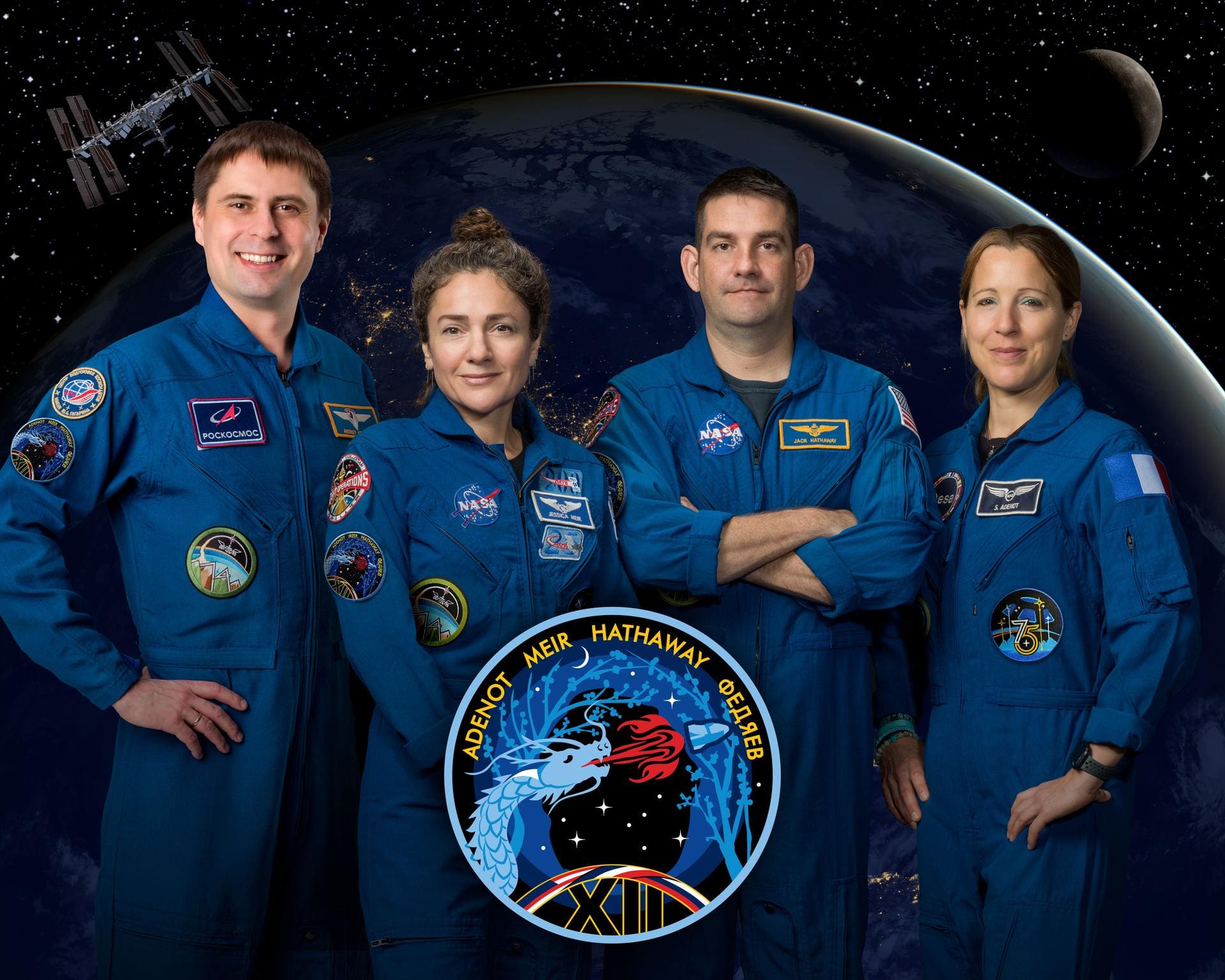
NASA has announced details of the eight-month Crew-12 mission, launching four astronauts to the International Space Station to spearhead critical research paving the way for lunar and Martian exploration. Commander Jessica Meir and Pilot Jack Hathaway of NASA will lead the team, alongside ESA astronaut Sophie Adenot and Roscosmos cosmonaut Andrey Fedyaev, aboard the SpaceX Dragon spacecraft Freedom. The crew will conduct vital science experiments, ranging from improving pneumonia treatments to enhancing space-based food production. This flight, the 12th crew rotation mission with SpaceX, builds upon NASA’s Commercial Crew Program and promises to “advance research and technology for future Moon and Mars missions and benefit humanity back on Earth.”
Crew-12: International Team Composition and Roles
The upcoming Crew-12 mission exemplifies the increasingly collaborative nature of orbital spaceflight, assembling a team representing three key space agencies. NASA astronauts Jessica Meir and Jack Hathaway will assume the roles of Commander and Pilot, respectively, steering the mission and spacecraft operations. This isn’t a repeat performance for everyone; this will be Hathaway’s first venture into space, while Adenot will also be experiencing spaceflight for the first time.
Meir, however, brings valuable experience, having previously spent 205 days as a flight engineer during Expedition 61/62 and notably completing “the first three all-woman spacewalks with fellow NASA astronaut Christina Koch,” totaling 21 hours and 44 minutes of extravehicular activity. Since then, she has held key positions within NASA, including assistant to the chief astronaut for commercial crew (SpaceX). Fedyaev also returns to the station, following a 186-day orbit as a flight engineer during NASA’s SpaceX Crew-6 mission in 2023, an achievement for which he was awarded the title Hero of the Russian Federation and the Yuri Gagarin Medal.
His background includes over 600 flight hours as a deputy commander of an Ilyushin-38 aircraft unit. Adenot’s path to space involved a distinguished career in aviation, beginning as a helicopter cockpit design engineer at Airbus Helicopters and progressing to roles as a search and rescue pilot and formation flight leader. She has amassed over 3,000 flight hours in 22 different helicopters. Hathaway, a commander in the United States Navy, is a graduate of the Empire Test Pilot’s School and has logged more than 2,500 flight hours in 30 aircraft, including over 500 carrier arrested landings and 39 combat missions. The team will launch aboard the SpaceX Dragon spacecraft Freedom, a vehicle previously utilized for Crew-4, Crew-9, Axiom Mission 2, and Axiom Mission 3, demonstrating the reliability of the Commercial Crew Program.
SpaceX Freedom Spacecraft Launch and Docking Procedures
The upcoming Crew-12 mission, utilizing the SpaceX Freedom spacecraft, represents a well-honed procedure refined through previous flights, including Crew-4 and Crew-9, as well as private Axiom missions. Launch will originate from Space Launch Complex 40 at Cape Canaveral Space Force Station in Florida, propelled by a SpaceX Falcon 9 rocket booster undergoing preparation for its second flight. Following liftoff, the Falcon 9 will accelerate the Dragon spacecraft to approximately 17,500 mph, initiating a carefully choreographed orbital insertion.
This isn’t simply a ballistic trajectory; a series of monitored maneuvers, overseen by both the crew and NASA/SpaceX mission control, will precisely guide Freedom towards the space station. The spacecraft is engineered for autonomous docking at the space-facing port of the Harmony module, though the crew retains the capability for manual control if required. This level of redundancy is crucial for ensuring a safe and successful rendezvous with the orbiting laboratory, already occupied by the Expedition 74 crew. Upon arrival, Crew-12 will join NASA astronaut Chris Williams and Roscosmos cosmonauts Sergey Kud-Sverchkov and Sergei Mikaev.
The integrated spacecraft and rocket will undergo a “dry dress rehearsal” with the crew and a static fire test prior to launch, confirming system integrity. Crew-12’s eight-month stay will coincide with a busy period of crew rotations and resupply missions, including the arrival of a Soyuz spacecraft in July carrying NASA astronaut Anil Menon and Roscosmos cosmonauts Pyotr Dubrov and Anna Kikina. The team will also witness the departure of Williams, Kud-Sverchkov, and Mikaev via Soyuz, alongside deliveries from Dragon, Roscosmos Progress, and Northrop Grumman’s Cygnus XL.
These routine, yet complex, operations are vital for maintaining the International Space Station’s continuous human presence – a feat achieved for over 25 years. NASA views the station as “a critical testbed” for long-duration spaceflight, paving the way for ambitious deep space missions under the Artemis campaign and, ultimately, human exploration of Mars.
Four crew members are set to launch to the International Space Station as part of NASA’s SpaceX Crew-12 mission, where they will conduct research, technology demonstrations, and maintenance aboard the orbiting laboratory.
NASA Communications
Crew-12 Mission: Scientific Research and Station Integration
The upcoming SpaceX Crew-12 mission represents a crucial continuation of scientific research aboard the International Space Station (ISS), with a planned eight-month tenure for the four-member team. This isn’t simply a personnel exchange; Crew-12’s research portfolio is designed to push the boundaries of knowledge relevant to both terrestrial and deep-space exploration. A key focus will be on understanding and combating threats to astronaut health, including studies of “pneumonia-causing bacteria to improve treatments,” according to NASA.
Beyond medical research, the mission will investigate innovative technologies for future missions, such as “on-demand intravenous fluid generation.” Researchers are also keen to explore sustainable food production in space, with investigations into “plant and nitrogen-fixing microbe interactions to enhance food production in space.” Furthermore, the crew will examine the effects of the space environment on the human body, specifically researching “how physical characteristics may affect blood flow during spaceflight.” The integrated spacecraft will accelerate to approximately 17,500 mph once in orbit, relying on autonomous docking procedures, though manual control remains an option.
The mission’s composition itself highlights the increasingly international nature of space exploration. Roscosmos cosmonaut Andrey Fedyaev, a veteran of 186 days in orbit during Expedition 69, returns to the ISS, bringing valuable experience. Sophie Adenot of the European Space Agency (ESA) will embark on her first spaceflight, following a career that included serving as a helicopter experimental test pilot.
This will be the second flight to the space station for Meir, who was selected as a NASA astronaut in 2013.
NASA
Astronaut Profiles: Hathaway, Meir, Adenot, and Fedyaev
The SpaceX Crew-12 mission assembling for an eight-month stay aboard the International Space Station represents a confluence of expertise, with each crew member bringing a unique skillset to the orbiting laboratory. Jessica Meir, a veteran of one previous spaceflight, returns with a robust background in biological sciences, having earned a doctorate from Scripps Institution of Oceanography. This mission marks his inaugural venture into space, though he arrives with considerable flight experience, having logged over 2,500 flight hours in 30 different aircraft. Hathaway’s training at the Empire Test Pilot’s School further underscores his preparation for the complexities of spaceflight.
The international composition of Crew-12 extends to ESA astronaut Sophie Adenot, also embarking on her first spaceflight. Adenot’s path to space included a specialization in spacecraft flight dynamics at ISAE-SUPAERO in Toulouse, France, followed by a master’s degree at MIT. Completing the quartet is Roscosmos cosmonaut Andrey Fedyaev, who brings prior long-duration spaceflight experience from his 186 days aboard the station during NASA’s SpaceX Crew-6 mission.


