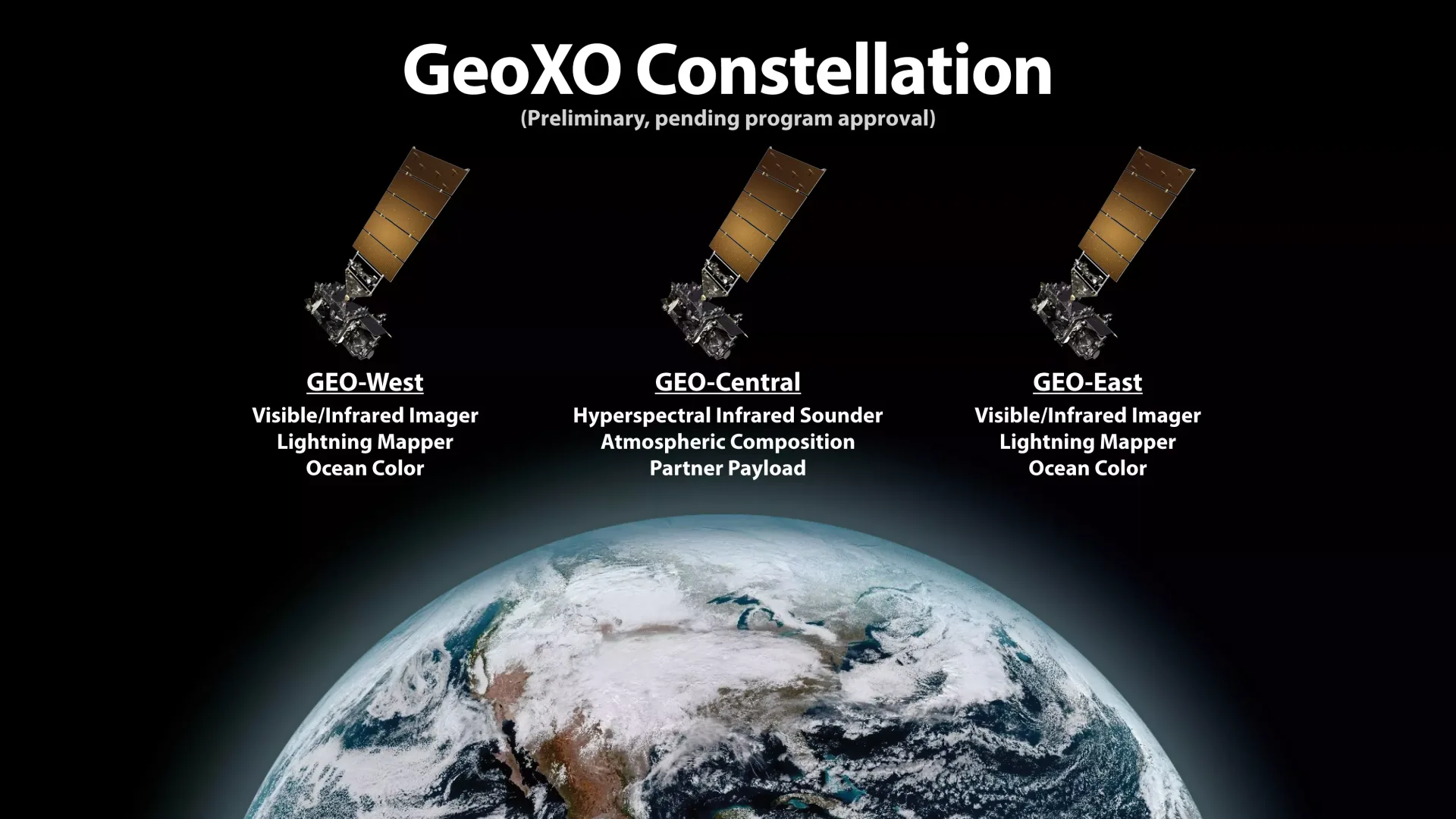
NASA, on behalf of the National Oceanic and Atmospheric Administration (NOAA), has chosen Lockheed Martin to construct the spacecraft for NOAA’s Geostationary Extended Observations (GeoXO) satellite program. The $2.27 billion contract includes the development of three spacecraft and options for four more. The GeoXO constellation will consist of three operational satellites, each carrying different instruments for earth observations. The project, which will take place at Lockheed Martin’s facility in Colorado and NASA’s Kennedy Space Center in Florida, is part of NOAA’s efforts to advance earth observations from geostationary orbit.
Lockheed Martin Selected for NOAA’s Next-Gen Spacecraft Construction
NASA, acting on behalf of the National Oceanic and Atmospheric Administration (NOAA), has chosen Lockheed Martin Corp., based in Littleton, Colorado, to construct the spacecraft for NOAA’s Geostationary Extended Observations (GeoXO) satellite program. The contract, which operates on a cost-plus-award-fee basis, is estimated to be worth around $2.27 billion. The contract encompasses the development of three spacecraft, with the option for four additional spacecraft.
The contract’s duration includes a 10-year period for on-orbit operations and a five-year period for on-orbit storage, totaling 15 years for each spacecraft. The work will be conducted at Lockheed Martin’s facility in Littleton and NASA’s Kennedy Space Center in Florida.
The GeoXO Constellation: A Trio of Operational Satellites
The GeoXO constellation will comprise three operational satellites, each occupying east, west, and central positions. Each of these geostationary, three-axis stabilized spacecraft is designed to host three instruments. The east and west spacecraft will carry an imager, a lightning mapper, and an ocean color instrument. The centrally-located spacecraft will carry an infrared sounder and an atmospheric composition instrument, with the capacity to accommodate a partner payload. Additionally, the east and west spacecraft will support an auxiliary communication payload for the NOAA Data Collection System relay, dissemination, and commanding.
Contract Scope and Responsibilities
The contract’s scope includes the tasks necessary to design, analyze, develop, fabricate, integrate, test, evaluate, and support the launch of the GeoXO satellites. It also includes the provision of engineering development units, the supply and maintenance of ground support equipment and simulators, and support for mission operations at the NOAA Satellite Operations Facility in Suitland, Maryland.
NOAA and NASA jointly oversee the development, launch, testing, and operation of all the satellites in the GeoXO program. NOAA is responsible for funding and managing the program, operations, and data products. NASA and commercial partners, acting on behalf of NOAA, are tasked with developing and building the instruments and spacecraft and launching the satellites.
GeoXO Program: The Successor to the GOES-R Series Program
The GeoXO program is the successor to the Geostationary Operational Environmental Satellites – R (GOES-R) Series Program. As part of NOAA’s constellation of geostationary environmental satellites, the GeoXO program aims to protect life and property across the Western Hemisphere.
The GeoXO satellite system will enhance Earth observations from geostationary orbit. The mission will provide crucial information to address significant environmental challenges of the future, supporting weather, ocean, and climate operations in the United States. The advanced capabilities from GeoXO will aid in assessing our changing planet and the evolving needs of the nation’s data users. The goal is to ensure GeoXO’s critical observations are in place by the early 2030s when the GOES-R Series nears the end of its operational lifetime.
External Link: Click Here For More