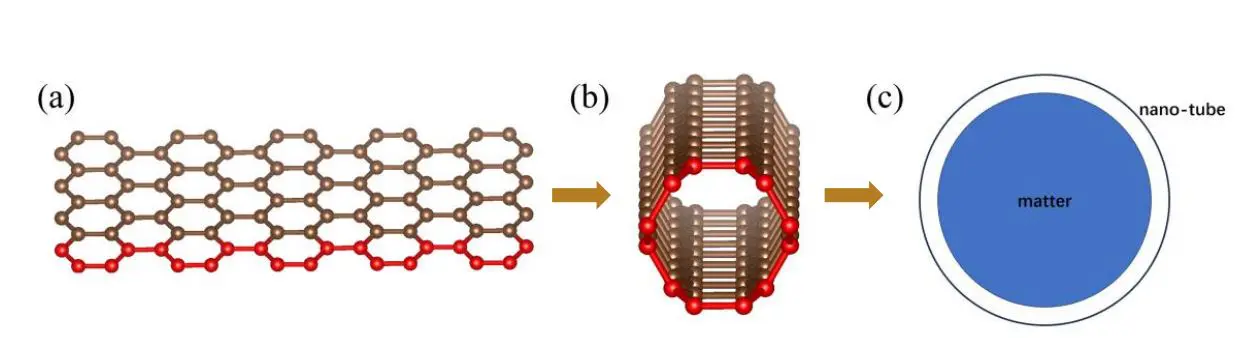
Scientists are continually seeking ways to preserve materials exhibiting unique properties under extreme pressure, properties often lost when returned to normal conditions. Yin L. Xu, Guang F. Yang, Yi Sun, Hong X. Song, Yu S. Huang, and Hao Wang, working at the National Key Laboratory of Shock Wave and Detonation Physics, have now developed a theoretical model to assess the absolute limits of nanoscale structures in maintaining high-pressure states. This research establishes a crucial link between nanostructure design and pressure preservation, demonstrating that certain nanotubes and nanospheres excel at containing materials at immense pressures. The team’s calculations reveal that structures with strong bonding and high density, such as those based on, exhibit the greatest capacity, potentially enabling the retrieval of compressed materials with unprecedented properties, including near room temperature superconductivity and metallic hydrogen phases.
Materials subjected to high pressure often gain desirable properties, but these are typically lost when the pressure is released. Researchers have long considered nanostructure engineering as a potential solution, as nanoscale materials possess exceptional mechanical strength. However, a comprehensive theoretical model to analyse this possibility has been lacking.
Graphene Best Preserves High Pressure Materials
This work presents a new physical model to determine the absolute theoretical limit of nanostructures in preserving high-pressure materials upon release to ambient conditions. Researchers systematically investigated the pressure-bearing capability of nanotubes and nanospheres constructed from graphene, hexagonal boron nitride (h-BN), biphenylene, and γ-graphyne using computational methods. Results demonstrate that graphene exhibits the highest pressure-bearing capability among the materials tested, followed by h-BN, biphenylene, and γ-graphyne, consistent with the principle that structures with larger average binding energy per bond and higher bond density are most effective at pressure preservation. These findings suggest that increasing the number of layers in nanotubes or nanospheres effectively enhances their ability to contain high-pressure materials. Investigations also show that chemical doping and interlayer interactions have minimal impact on pressure-bearing capability, indicating that structural properties are the primary determinants of performance. This research establishes a theoretical foundation for engineering nanostructures to retrieve and stabilize high-pressure phases, potentially unlocking applications in superconductivity and energy storage. The model provides a crucial framework for optimizing experimental designs and overcoming synthesis challenges in this emerging field.
Graphene Nanospheres Maximise High Pressure Preservation
This research establishes theoretical models to evaluate the ability of nanostructured cavities to preserve materials under high pressure, and determines the absolute limits for various nanotubes and nanospheres. The team’s model reveals that a material’s pressure-bearing capability is linked to the peak value in the rate of energy change during expansion, and can be understood by considering the average binding energy per bond and bond density. Through computational analysis and comparative study of graphene, hexagonal boron nitride, biphenylene, and γ-graphyne, the researchers found graphene nanospheres exhibit the greatest capacity to preserve high pressure. Retrieving materials from even higher pressures, like metallic hydrogen at 250 or 500 GPa, requires increasing the number of layers within the nanosphere. These findings establish the theoretical possibility of retrieving high-pressure materials to ambient conditions using nanospheres as confinement structures.
🗞 Appraising the absolute limits of nanotubes and nanospheres to preserve high-pressure materials
🧠 ArXiv: https://arxiv.org/abs/2511.17868