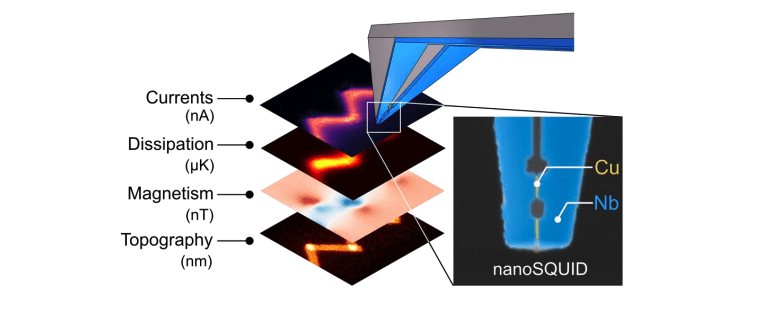
Understanding nanoscale dynamics represents a critical frontier in materials science and chip technology, yet measuring non-equilibrium properties like current and dissipation at this scale remains exceptionally difficult. Matthijs Rog, Tycho J. Blom, and colleagues at Leiden University and QuantaMap B. V. now present a significant advance in scanning probe microscopy, introducing tapping-mode SQUID-on-tip microscopy with proximity Josephson junctions. This innovative technique combines the high resolution of atomic force microscopy with the unparalleled sensitivity of nanoSQUIDs, allowing researchers to map currents, magnetism, dissipation, and topography simultaneously, and without the need for external radiation. The method achieves remarkable results, resolving nanoscale currents as small as 100 nanoamperes with a simple electronic readout, and promises a powerful, non-invasive pathway to investigate dynamic phenomena in both advanced materials and delicate electronic circuits.
Scanning nanoprobes utilizing superconducting quantum interference devices (SQUIDs) are uniquely suited to this task, due to their unparalleled sensitivity to magnetic fields and potential for high spatial resolution. These devices enable the investigation of fundamental physical properties at the nanoscale, offering insights into the behaviour of complex materials and the operation of emerging technologies. Therefore, developing techniques to overcome limitations in spatial resolution and sensitivity is crucial for advancing nanoscale science and technology.
SQUID-on-Tip Microscopy for Nanoscale Imaging
Researchers are pioneering advanced scanning probe microscopy techniques that utilize superconducting quantum interference devices (SQUIDs) as highly sensitive detectors, allowing them to image extremely weak magnetic fields, currents, and other physical properties at the nanoscale. A central focus is the creation of miniature SQUIDs integrated onto the tip of a scanning probe, enabling localized, high-resolution measurements. The team emphasizes the use of nano-SQUIDs to enhance sensitivity and spatial resolution, exploring different types of SQUIDs, including DC-SQUIDs and RF-SQUIDs, for various applications. This technique allows imaging of current flow in materials, such as graphene, and magnetic fields, domains, and textures at the nanoscale.
Researchers are improving SQUID-based SPM sensitivity through techniques like utilizing mechanical vibrations to improve signal-to-noise ratio, optimizing SQUID design, and implementing feedback loops to stabilize the probe. Combining SQUID detection with dynamic atomic force microscopy (DAFM) provides both topographic and magnetic/current information. This research has broad applications in materials science, allowing investigation of the magnetic and electronic properties of materials at the nanoscale, and advances studies of superconductivity, spintronics, and graphene devices. Furthermore, it holds potential for characterizing and manipulating quantum systems, contributing to the field of quantum computing. Ongoing research and development efforts focus on improving SQUID sensitivity and spatial resolution, developing new SQUID-on-tip designs, and integrating SQUIDs with other SPM techniques, promising unprecedented insights into the nanoscale world.
Simultaneous Nanoscale Imaging of Multiple Properties
Researchers have developed a groundbreaking scanning probe microscope that simultaneously images current, dissipation, magnetism, and topography at the nanoscale, offering unprecedented insight into quantum materials and devices. This new technique, termed tapping-mode SQUID-on-tip, overcomes limitations of existing methods by closing the gap between the sensor and the sample while providing robust topographic readout without relying on external radiation sources. The probes operate fully electronically, making them ideally suited for cryogenic operation and eliminating potential interference with sensitive quantum systems. The team’s innovative probe design integrates a superconducting quantum interference device (SQUID) with an atomic force microscope (AFM) cantilever, enabling stable topographic imaging even while scanning complex nanostructures.
Crucially, the probes demonstrate exceptional durability, maintaining performance after weeks of continuous scanning in tapping mode, a testament to their robust construction and design. The SQUID devices, fabricated with proximity Josephson junctions, deliver exceptionally large voltage output, simplifying the readout scheme to a straightforward four-wire measurement. This enhanced sensitivity allows the researchers to resolve nanoscale currents as small as 100 nanoamperes in densely packed nanostructures, a level of precision previously unattainable. The effective diameter of the thin-film SQUID is measured at 290 nanometers, demonstrating the potential for high spatial resolution. Furthermore, the microscope’s ability to simultaneously map multiple properties, magnetism, transport, dissipation, and topography, provides a comprehensive understanding of complex materials and opens new avenues for investigating fragile quantum systems, delivering a powerful, non-invasive tool for exploring quantum materials and devices.
Nanoscale Imaging of Magnetism and Transport
This research introduces a new microscopy technique, tapping-mode scanning SQUID-on-tip, which simultaneously images topography, magnetism, electrical transport, and dissipation at the nanoscale. The method utilizes a highly sensitive nanoSQUID probe to measure currents as small as 100 nanoamperes with a simple electronic readout, avoiding the need for cryogenic amplification. By combining atomic force microscopy with superconducting interference devices, the technique offers a non-invasive way to study dynamic phenomena in materials and devices without external radiation. The microscope was successfully tested on magnetic hybrids and superconducting devices, demonstrating its ability to resolve nanoscale currents and map magnetic, thermal, and transport properties, making it well-suited for investigating a broad range of quantum systems, including exotic materials and sensitive quantum circuits. Further development is needed to fully explore the technique’s potential and expand its applications, potentially contributing to advancements in fields like materials science and quantum computing.
👉 More information
🗞 Tapping-mode SQUID-on-tip Microscopy with Proximity Josephson Junctions
🧠 ArXiv: https://arxiv.org/abs/2508.21575