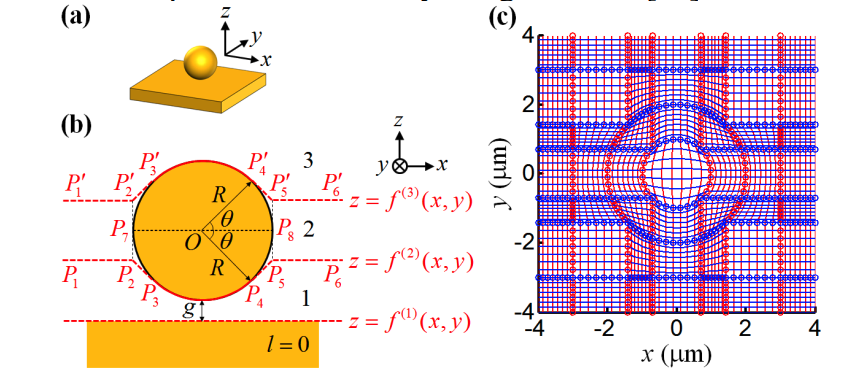
The behaviour of light interacting with metallic nanostructures at the nanoscale is profoundly influenced by quantum mechanical effects at the metal surface, necessitating electromagnetic boundary conditions that extend beyond classical descriptions. These ‘nonclassical’ effects become particularly significant for mesoscale metallic nanostructures (MMNSs), where dimensions fall between the fully quantum and purely classical regimes. Researchers at Nankai University, led by Haitao Liu from the Institute of Modern Optics and the Tianjin Key Laboratory of Micro-scale Optical Information Science and Technology, now present a refined computational approach to model these interactions. Their work, detailed in the article ‘Fourier modal method and coordinate transformation method under nonclassical electromagnetic boundary condition for the electromagnetism of mesoscale metallic nanostructures’, marries established numerical techniques – the Fourier modal method (FMM) and coordinate transformation method (C method) – with a recently developed three-dimensional modelling framework incorporating these advanced, nonclassical boundary conditions. This enables more accurate and efficient simulation of light-matter interactions at these critical dimensions, providing enhanced insight into the optical properties of these materials.
This work establishes a mathematical framework for modelling the optical response of mesoscale metallic nanostructures, explicitly incorporating non-classical electromagnetic boundary conditions (NEBC). Conventional modelling often assumes classical boundary conditions, which become inadequate at extreme nanometer scales where quantum mechanical effects significantly influence electromagnetic behaviour. NEBC account for these effects, providing a more accurate description of how light interacts with metallic nanostructures. Researchers derive Fourier representations for terms D3 and D14, crucial components in describing the electromagnetic field distribution within these structures, facilitating efficient numerical computation of wave propagation and moving beyond classical approaches.
The methodology marries the computational efficiency of the Fourier Modal Method (FMM) and the coordinate transformation method, known as the C method, with the rigorous treatment of surface properties afforded by the NEBC. FMM decomposes electromagnetic fields into a series of modes, simplifying calculations, while the C method simplifies complex geometries through coordinate transformations. By incorporating the Feibelman parameters, which quantify the surface response of the metal, the model accurately accounts for surface effects, critical for predicting optical characteristics. The resulting equations, expressed in matrix form, are directly applicable to numerical algorithms, streamlining the simulation process and enabling complex simulations.
Researchers build upon a previously published coordinate transformation
Researchers build upon a previously published coordinate transformation method, detailed in Liu (2021), to simplify the geometry of the structures before applying the Fourier analysis. They employ dyadic notation, as outlined by Tai (1997), to represent electromagnetic fields using tensors, a standard practice in advanced electromagnetic modelling. This approach allows for a more concise and efficient representation of the electromagnetic fields, simplifying subsequent calculations. Specifically, the derivation for both D13 and D14 involves expressing these terms as sums involving various matrices (Q14,1, Q14,2, Q14,3, and subsequently Q18,1, Q18,2, Q18,3, Q18,4). These matrices encapsulate the interaction of electromagnetic fields with the nanostructure’s components, providing a clear mathematical description of the physical processes. The resulting Fourier representations, such as equation S4.3, define the spatial distribution of D13 and D14 in Fourier space, represented by column vectors like 13D.
The relationships between the original matrices (Q1-Q4) and the transformed matrices (Q15-Q18) provide a clear notation for tracking the changes throughout the process, ensuring the accuracy and consistency of the calculations. Researchers incorporate surface-response Feibelman parameters, enabling a more accurate representation of the nanostructure’s optical properties. They validate their approach through numerical comparison with full-wave methods also incorporating the NEBC, confirming both the accuracy and efficiency of the derived Fourier representations. This validation demonstrates the viability of employing modal methods, such as FMM and the C method, for modelling non-classical effects in metallic nanostructures without sacrificing precision.
The established mathematical foundation and validated numerical implementation provide a robust tool for researchers investigating the optical behaviour of metallic nanostructures. This work not only advances the theoretical understanding of light-matter interactions at the nanoscale but also facilitates the development of novel photonic devices with tailored optical properties. The presented methodology is poised to become a valuable asset in the field of nanophotonics, offering a powerful means of designing and optimizing nanostructured materials for a wide range of applications.
Future work focuses on extending this framework to
Future work focuses on extending this framework to investigate more complex nanostructure geometries and material compositions. Researchers investigate the impact of varying Feibelman parameters on optical properties, identifying a promising avenue for tailoring nanostructure designs to specific applications. Furthermore, they integrate this methodology with optimisation algorithms, enabling the automated design of nanostructures with enhanced optical performance.
🗞 Fourier modal method and coordinate transformation method under nonclassical electromagnetic boundary condition for the electromagnetism of mesoscale metallic nanostructures
🧠 DOI: https://doi.org/10.48550/arXiv.2506.22838