

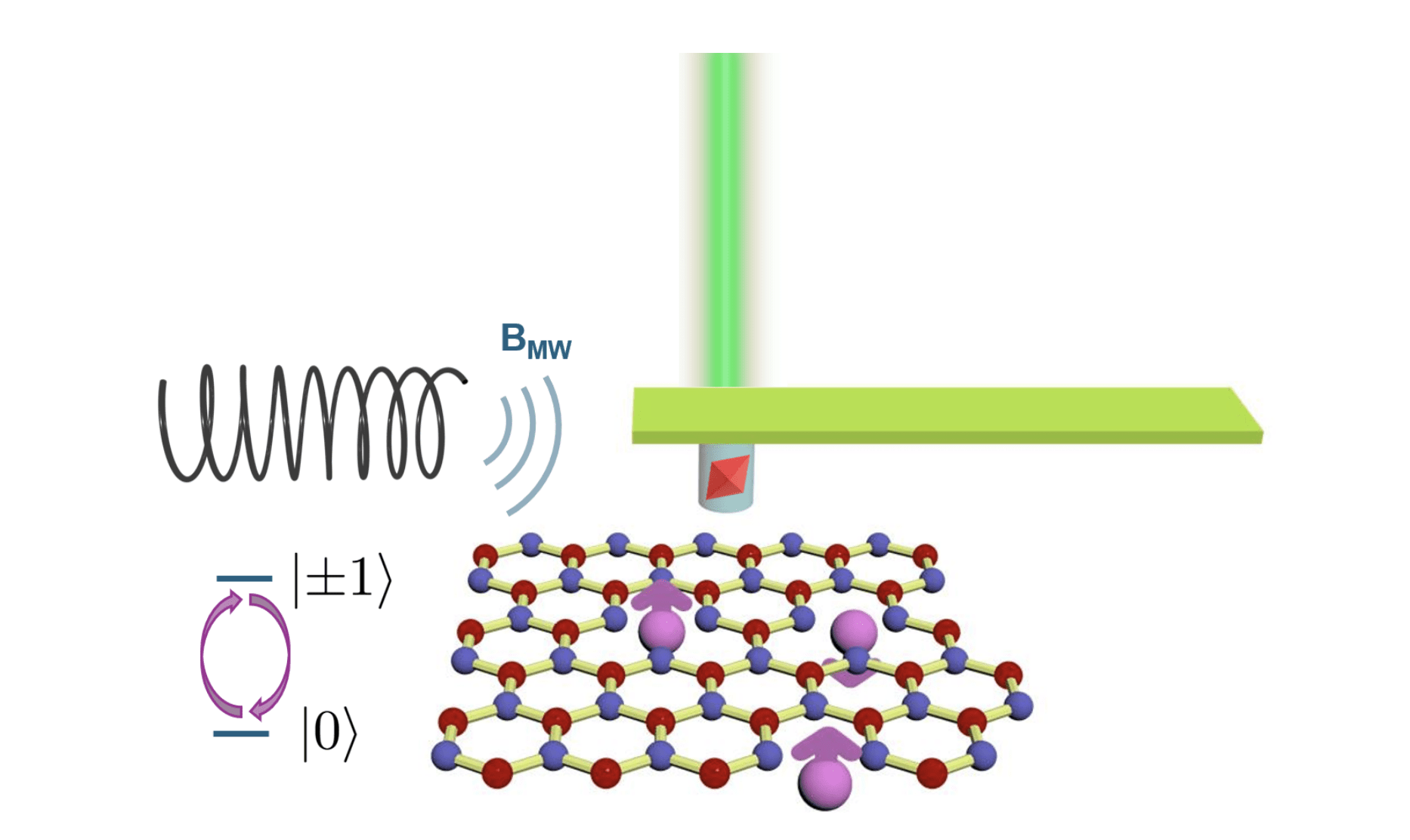
On April 13, 2025, researchers published Probing Spin Defects via Single Spin Relaxometry, detailing a novel method using nitrogen-vacancy centers and scanning probe microscopy to map spin defects at the nanoscale without direct optical excitation. This advancement enables detection beyond the optical diffraction limit, opening new possibilities for hybrid architectures in quantum sensing and networking.
Researchers integrated a nitrogen-vacancy (NV) center in diamond with scanning probe microscopy to map spin defects at the nanoscale. Using boron vacancy centers in hexagonal boron nitride as a model, they detected electron spin resonance via changes in NV spin relaxation time without optical excitation. Cross-relaxation between NV and V ensembles enabled nanoscale mapping of spin distributions beyond the optical diffraction limit. This approach demonstrates NV centers as versatile probes for characterizing spin systems, including those emitting at wavelengths undetectable by silicon-based detectors. The findings pave the way for hybrid architectures where sensing and readout qubits are decoupled, enabling discovery of previously inaccessible defects for advanced sensing and networking applications.
At the core of quantum sensor technology are defects in materials. In diamond, nitrogen-vacancy (NV) centers—where a nitrogen atom replaces a carbon atom and an adjacent lattice site is vacant—serve as highly sensitive probes. These defects possess unique electronic properties that allow interaction with external magnetic fields, enabling precise measurements at the nanoscale. Similarly, in hBN, specific vibrational modes identified through Raman spectroscopy provide insights into structural integrity and potential for hosting quantum states.
The methodology involves creating or identifying these defects within host materials and utilizing advanced optical and electronic techniques to manipulate and measure their quantum states. By applying magnetic fields or light, researchers control the spin states of these defects, which respond to external stimuli such as magnetic fields or vibrations. This interaction forms the basis for highly sensitive detection systems.
Recent studies highlight the remarkable capabilities of quantum sensors. Researchers have successfully used NV centers in diamond for proton magnetic resonance imaging (MRI) at the nanoscale, a technique that could revolutionize medical diagnostics by visualizing previously inaccessible structures. Cryogenic quantum magnetometry has enabled precise imaging of magnetic vortices, providing critical insights into superconductivity.
The use of hBN as an alternative to diamond shows promise due to its superior mechanical properties and compatibility with semiconductor manufacturing processes. By identifying specific vibrational modes through Raman spectroscopy, researchers enhance the sensitivity and reliability of quantum sensors based on hBN.
Quantum sensors represent a significant leap forward in sensing technology, offering unparalleled precision and versatility. By leveraging defects in materials like diamond and hBN, these devices pave the way for groundbreaking applications in medicine, materials science, and beyond. As research continues to uncover new possibilities, quantum sensors are poised to drive innovation across industries, from scientific exploration to practical applications.
👉 More information
🗞 Probing Spin Defects via Single Spin Relaxometry
🧠 DOI: https://doi.org/10.48550/arXiv.2504.09432


