

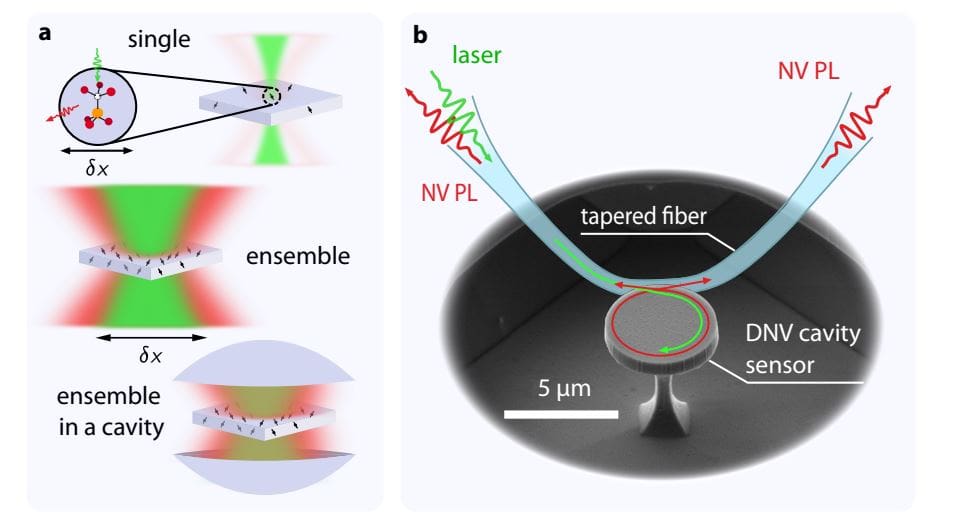
Detecting weak magnetic fields with nanoscale precision remains a significant challenge, yet holds immense potential for applications ranging from medical diagnostics to materials science. Nicholas J. Sorensen, Elham Zohari, and Joshua S. Wildeman, alongside colleagues at the University of Calgary and the National Research Council of Canada, now demonstrate a breakthrough in nanofabricated magnetometry. The team fabricates tiny, integrated cavities within diamond, leveraging the unique properties of nitrogen-vacancy centres to achieve unprecedented sensitivity and spatial resolution. This innovative platform overcomes previous limitations by combining high performance with a compact, scalable design, paving the way for advanced applications such as analysing extremely small sample volumes and developing new biosensors.
NV Centers as Quantum Sensors of Fields
This research explores the exciting potential of nitrogen-vacancy (NV) centers in diamond as remarkably sensitive quantum sensors. Scientists are investigating how these defects can detect a variety of physical properties at the nanoscale, including magnetic fields, electric fields, temperature, strain, and mechanical forces. A key focus involves understanding and controlling the properties of NV centers to optimize their performance as sensors, particularly by studying the influence of surrounding nuclear spins and improving the accuracy of detecting their quantum states using light. Extending the duration for which these quantum states remain stable, known as coherence time, is also a critical area of investigation.
This work has broad implications for diverse fields, ranging from biomedical imaging, potentially enabling magnetic resonance imaging at the single-cell level, to materials science, where it could characterize materials with unprecedented precision. Fundamental physics research also benefits, as NV centers offer a means to explore physical phenomena with high accuracy. Scientists achieve this through advanced diamond fabrication techniques, including creating high-quality diamond samples and fabricating micro- and nanostructures, alongside optical microscopy and spectroscopy to image NV centers and detect their spin states. Theoretical modeling and simulation play a crucial role in understanding spin dynamics and developing methods to control NV center spins.
Diamond Nanocavity Magnetometry with Enhanced Sensitivity
Scientists have engineered a novel platform for highly sensitive magnetometry by fabricating tiny, whispering-gallery-mode cavities within a diamond chip containing a high density of nitrogen-vacancy (NV) centers. They cleverly couple light to and from these cavities using a tapered optical fiber, overcoming a common limitation in existing systems, the trade-off between sensitivity and spatial resolution. This innovative approach enables nanoscale resolution and low-power operation, while also paving the way for scalable on-chip integration. The team achieved a photon-shot-noise-limited sensitivity of 52 nT/√Hz, the highest reported to date for a nanofabricated cavity-based magnetometer, by implementing a lock-in-amplified Ramsey magnetometry scheme.
This technique involves using frequency-modulated microwaves and extracting the signal at the modulation frequency to suppress electronic and laser noise, significantly improving magnetometer performance. Researchers enhanced conventional magnetic resonance measurements by using lock-in detection to mitigate noise and power broadening, and further refined the technique by using three-tone microwave pulses to address all three nuclear hyperfine transitions, increasing signal contrast by nearly 30%. The magnetometer’s performance is limited only by fundamental noise, not by drift, and demonstrates stable operation over extended periods, crucial for nanoscale field measurements.
Nanoscale Magnetometry With Diamond Microcavities
This research demonstrates a significant advance in nanoscale magnetometry through the creation of an integrated diamond microcavity containing nitrogen-vacancy (NV) centers. The team successfully fabricated a platform that combines high sensitivity with sub-micrometer spatial resolution, overcoming a common trade-off in existing technologies. By evanescently coupling light to and from the cavity using a tapered optical fiber, they achieved a photon-shot-noise-limited sensitivity, the highest reported to date for a nanofabricated cavity-based magnetometer. The researchers also characterized the spin-coherence of the NV centers within the microcavity, finding a slight reduction compared to bulk diamond, but significantly less degradation than observed in previous nanofabricated sensors.
Through the application of dynamical decoupling sequences, they extended the coherence time by over two orders of magnitude, approaching the limit set by longitudinal spin-relaxation. This extended coherence is crucial for enhancing the magnetometer’s sensitivity and broadening its potential applications. The authors acknowledge that the observed spin-coherence is primarily limited by dephasing caused by paramagnetic impurities, and that further improvements could be achieved through techniques like spin-bath driving. The demonstrated platform represents a versatile tool for a wide range of sensing applications, offering a pathway towards scalable on-chip integration.
👉 More information
🗞 Nanophotonic magnetometry in a spin-dense diamond cavity
🧠 ArXiv: https://arxiv.org/abs/2511.19831