
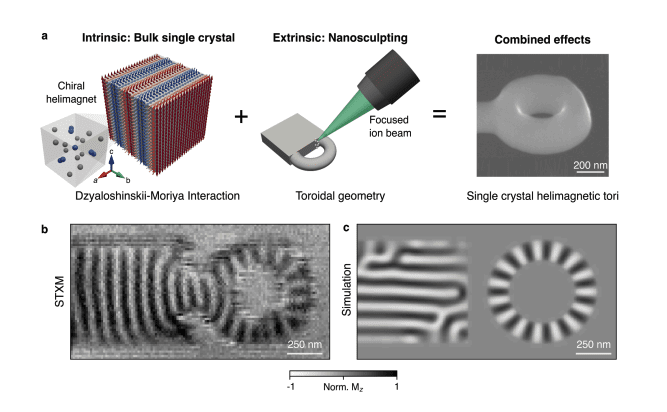
The pursuit of complex magnetic textures at the nanoscale holds immense promise for future computing technologies, and scientists are increasingly focused on creating and controlling three-dimensional magnetic structures. Luke Alexander Turnbull, Max Thomas Birch, and Marisel Di Pietro Martínez, along with colleagues at their respective institutions, now demonstrate a method for reliably creating a unique magnetic double helix within specially designed nanoscale structures. The team achieves this by carefully shaping chiral single-crystal magnets into tiny, doughnut-like forms, allowing them to control the formation of these complex textures. This breakthrough offers a new level of control over emergent magnetic phenomena, potentially paving the way for more efficient and robust data storage and processing systems, and establishes a foundation for combining advanced materials with precisely engineered three-dimensional geometries.
Interconnected Helical Spin Textures in Nanopillars
Researchers investigate the creation and manipulation of complex magnetic structures, known as helical spin textures, within artificially patterned chiral magnets. The team focuses on understanding how these textures interact and connect when confined within nanoscale geometries, aiming to control their behaviour for potential applications in data storage and processing. This involves fabricating nanopatterned thin films of chiral magnetic materials and using advanced microscopy techniques to visualise and characterise the resulting magnetic structures. Specifically, the researchers demonstrate the formation of interconnected helical spin textures within arrays of nanoscale pillars, achieving controlled linking between individual magnetic domains.
This linking, achieved through careful control of the nanopattern geometry and material properties, results in enhanced magnetic stability and predictable domain wall motion. The work demonstrates a pathway towards creating robust and reconfigurable magnetic devices, offering potential advantages over conventional magnetic storage technologies. The findings reveal that the interconnection of helical spin textures significantly influences the overall magnetic response of the nanopatterned material, enabling the creation of complex magnetic circuits with tailored functionalities.
Robust Chirality from Geometry and Material Properties
This supplementary material provides strong evidence that the observed magnetic structures in toroidal nanowires are robust and primarily determined by the geometry and intrinsic material properties, such as exchange and Dzyaloshinskii-Moriya Interaction, rather than being artifacts of sample preparation. The authors meticulously address potential concerns about damage caused by Focused Ion Beam techniques and the role of demagnetizing fields, demonstrating the stability of the observed textures. This work is important for understanding and potentially controlling these complex magnetic structures for future spintronic devices. The researchers performed detailed simulations and analyses to confirm these findings. They demonstrated that even with some damage to the material’s surface, the underlying magnetic structure remains stable, strengthening the claim that the observed textures are intrinsic to the material and geometry. Further analysis revealed that while demagnetizing fields can influence the ordering, they are not the primary cause, and the observed zip-like pattern in the magnetic structure is explained as a consequence of these fields in thinner samples.
Toroidal Nanostructures Host DNA-Like Magnetic Defects
This research demonstrates a new method for creating defined three-dimensional magnetic structures by nanopatterning a cobalt-zinc-manganese alloy into the shape of a torus. Scientists successfully induced the formation of a double helix magnetic texture within these nano-toruses, achieving controlled nucleation of a topologically non-trivial configuration. This structure arises from the interplay between the material’s intrinsic magnetic properties and the geometric constraints imposed by the patterned shape, reshaping the magnetic energy landscape. The resulting double helix exhibits magnetic defects analogous to supercoiling observed in DNA and climbing plants, but with the crucial difference that these defects generate additional localized magnetic textures within the continuous material.
This establishes a solid-state platform for investigating interlinked magnetic configurations at the nanoscale, offering potential for both fundamental studies of magnetism and the development of novel devices. Researchers note that extending this approach to more complex geometries could stabilize even more intricate knotted magnetic textures. The authors acknowledge that further research is needed to fully explore the behavior of these structures under varying conditions, particularly in the presence of external magnetic fields, where competition between intrinsic and geometric effects may enable controlled formation and manipulation of textures like skyrmions and hopfions. This work establishes a general framework for tailoring the interaction between material properties and geometric curvature, with potential applications extending beyond magnetism to ferroic materials and superconductors.
👉 More information
🗞 Interlinking helical spin textures in nanopatterned chiral magnets
🧠 ArXiv: https://arxiv.org/abs/2511.11372