Detecting and quantifying multiple substances simultaneously remains a significant challenge in fields ranging from medical diagnostics to environmental monitoring, but researchers are now exploring the potential of nanoscale drums as highly sensitive mass sensors. Adhinarayan Naembin Ashok, Sanjam Bedi, and Taha Ashraf Ali Shaikh, all from the Birla Institute of Technology and Science, Pilani, Dubai Campus, alongside their colleagues, demonstrate a computational method for ‘inertial imaging’, a technique that maps the distribution of two different masses placed on a graphene nanodrum. Their work reveals how analysing subtle shifts in the drum’s vibrational frequencies allows for the accurate determination of both the location and quantity of these masses, achieving errors as low as two percent, and offers a promising pathway towards developing highly precise, multi-target sensing devices at the nanoscale. This innovative approach, which considers optimal analyte placement and structural design, could significantly advance the field of nanomechanical mass sensing.
Graphene Nanodrums Detect Dual Mass Distributions
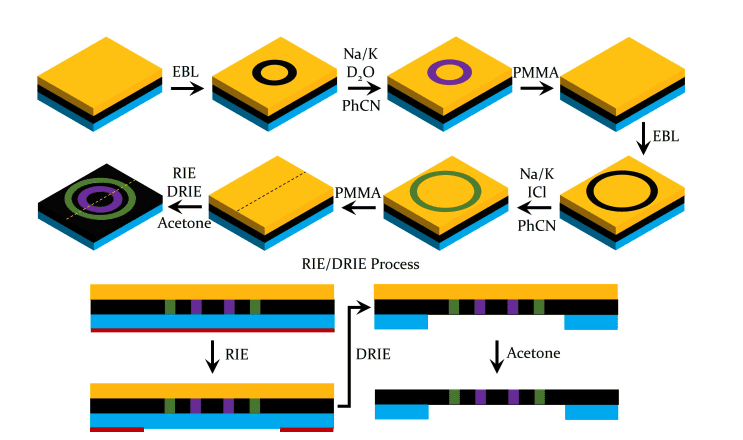
Researchers developed a novel approach to mass sensing using a circular graphene nanodrum, extending the technique of ‘inertial imaging’ to simultaneously detect two distinct mass distributions. Unlike traditional imaging methods limited by the wavelength of light, this technique relies on the precise measurement of frequency shifts in the nanodrum’s vibrational modes, offering potentially limitless resolution. The core innovation lies in strategically placing two different analytes within concentric annular rings on the graphene surface, effectively creating a spatially patterned mass distribution. This design allows researchers to exploit the unique sensitivity of each vibrational mode to the mass loading at specific locations, enabling the independent detection of each analyte.
To understand how these mass distributions affect the nanodrum’s behaviour, the team employed detailed computer simulations, modelling the frequency shifts of various vibrational modes under different configurations of annular rings. By systematically varying the position and thickness of these rings, they could map the relationship between mass distribution and resonance behaviour. The analytical framework underpinning this approach utilizes mathematical principles to relate the observed frequency shifts to the mass distributions. This allows for the reconstruction of the mass distributions from the measured frequency changes, effectively creating an ‘inertial image’ of the analytes. The accuracy of this reconstruction is enhanced by carefully considering the spatial arrangement of the masses, with thinner annular rings demonstrating improved detection precision due to reduced overlap between vibrational modes. This method offers a powerful new way to analyse nanoparticles, biomolecules, and viruses, providing information on both their shape and molecular weight.
Nanodrum Resonance Maps Mass Distributions Accurately
Researchers have developed a new method for detecting and mapping the distribution of tiny masses using a vibrating graphene nanodrum, extending a technique known as inertial imaging. This approach allows for the simultaneous detection of two distinct masses positioned in concentric rings on the surface of the nanodrum, offering a way to analyze complex samples without the limitations of traditional imaging methods. Unlike optical imaging, which is limited by the wavelength of light, inertial imaging relies on the precise measurement of changes in the nanodrum’s vibrational frequencies, enabling high-resolution mapping of mass distributions. The core of the technique involves carefully monitoring how the addition of mass to the nanodrum alters its natural frequencies of vibration.
By analyzing shifts in multiple vibrational modes, researchers can infer not only the total mass present but also its spatial distribution, effectively creating an “inertial image. ” The team systematically varied the position and thickness of the added masses, simulating different scenarios and using computer simulations to model the resulting changes in vibrational behavior. This detailed analysis revealed that the accuracy of mass estimation is significantly influenced by the placement of the masses, with optimal results achieved when analytes are positioned near specific points on the vibrating nanodrum. Importantly, the method demonstrates a high degree of precision, achieving estimation errors of only 1.
Furthermore, thinner annular rings of mass consistently yielded more accurate results, suggesting that minimizing overlap between vibrational modes enhances detection sensitivity. This advancement holds significant promise for applications in nanobiology and medical diagnostics, potentially enabling the label-free analysis of nanoparticles, biomolecules, and viruses, and providing insights into both their morphology and molecular weight. The ability to simultaneously detect and map dual mass distributions opens new avenues for studying complex biological samples and developing advanced sensing technologies.
👉 More information
🗞 Inertial Imaging of Dual Mass Distributions on a Graphene Nanodrum: A Computational Study
🧠 ArXiv: https://arxiv.org/abs/2508.02099