Researchers successfully determine the crystallographic axes and local magnetic field of individual nanodiamonds containing nitrogen-vacancy (NV) centres, utilising a minimum of four distinct bias fields. Validation occurs in bulk diamond and on individual particles, advancing potential applications including in-situ biomedical imaging and nanoscale sensing.
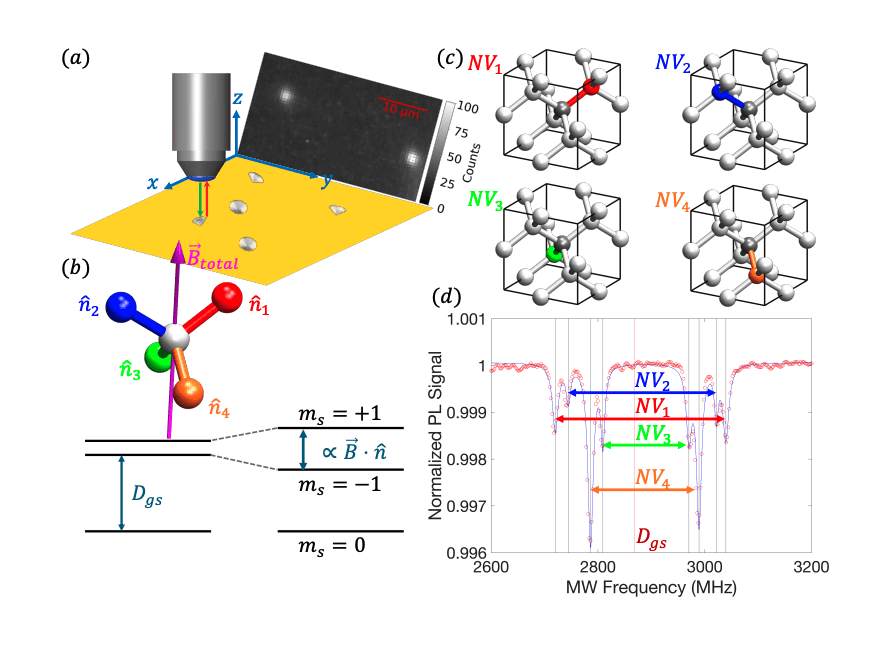
Nitrogen-vacancy (NV) centres within diamond lattices represent a developing technology for nanoscale sensing, offering potential applications in biomedical imaging and fundamental physics research. These point defects, created by nitrogen impurities substituting carbon atoms alongside an adjacent vacancy, exhibit spin-dependent fluorescence, forming the basis for optically detected magnetic resonance (ODMR). ODMR involves detecting changes in fluorescence intensity as the spin state of the NV centre is manipulated by microwave radiation in the presence of a magnetic field. The utility of NV centres stems from their sensitivity to external fields and their ability to reveal vector magnetic field information, meaning both the magnitude and direction of the field can be determined.
Deploying these sensors in situ, particularly within biological systems, presents challenges related to particle orientation, as nanodiamonds adopt random orientations when dispersed within cells or tissues. This randomness complicates data interpretation and necessitates robust methods for determining their alignment. Previous research focused on tracking these orientations using ODMR spectra, but these methods typically rely on the assumption that the external magnetic field is already known, limiting their effectiveness when investigating samples with unknown magnetic signatures.
This work addresses this limitation by demonstrating a method for simultaneously reconstructing both the local vector magnetic field and the NV centre’s orientation. The approach leverages a minimum of four independent ODMR measurements, each acquired under a different applied magnetic field configuration, allowing for accurate sensing even in scenarios where the local magnetic environment is entirely unknown.
The core of this approach relies on the sensitivity of NV centres to magnetic fields, which alters their energy levels and affects the emitted fluorescence. Accurately interpreting these signals requires thorough understanding of the NV centre’s orientation within the diamond lattice. The study demonstrates that a minimum of four non-coplanar bias fields—externally applied magnetic fields—are essential to uniquely determine both the particle’s orientation and the local magnetic field, arising from the complex interplay between the NV centre’s symmetry, the diamond lattice orientation, and the external magnetic fields.
To validate this methodology, researchers employed both a bulk diamond with a known crystal orientation and a collection of individual nanodiamonds, mimicking real-world conditions, ensuring the robustness and reliability of the technique. Numerical simulations played a vital role in confirming the accuracy and robustness of the technique, even in the presence of experimental noise.
A crucial aspect of the methodology involves careful calibration of the bias fields, ensuring accurate determination of both the nanodiamond orientation and the local magnetic field. The researchers address the complexities arising from the hyperfine structure of the NV centre, merging peaks within the ODMR spectra to improve signal clarity and analytical precision. The hyperfine structure arises from the interaction between the electron spin and the nuclear spins of nearby nitrogen atoms, resulting in subtle splittings in the ODMR spectrum.
This work establishes a significant advancement in nanodiamond magnetometry, overcoming a key limitation in utilising nanodiamonds as sensors. By enabling simultaneous determination of orientation and local magnetic field, it paves the way for in-situ biomedical imaging and nanoscale sensing in complex environments.
Numerical simulations confirm the robustness and accuracy of the reconstruction method, providing confidence in the accuracy and reliability of the results. This detailed analysis provides a strong foundation for interpreting experimental data.
Future research should focus on quantifying the impact of the hyperfine peak merging on reconstruction accuracy and exploring the limits of detection in noisy environments. Investigating the application of this method to more complex magnetic field geometries and extending the analysis to incorporate dynamic magnetic fields also presents promising directions. Furthermore, developing automated data processing pipelines will be essential for scaling up this technique for large-scale sensing applications.
👉 More information
🗞 Simultaneous Determination of Local Magnetic Fields and Sensor Orientation with Nitrogen-Vacancy Centers in Nanodiamond
🧠 DOI: https://doi.org/10.48550/arXiv.2507.05366