

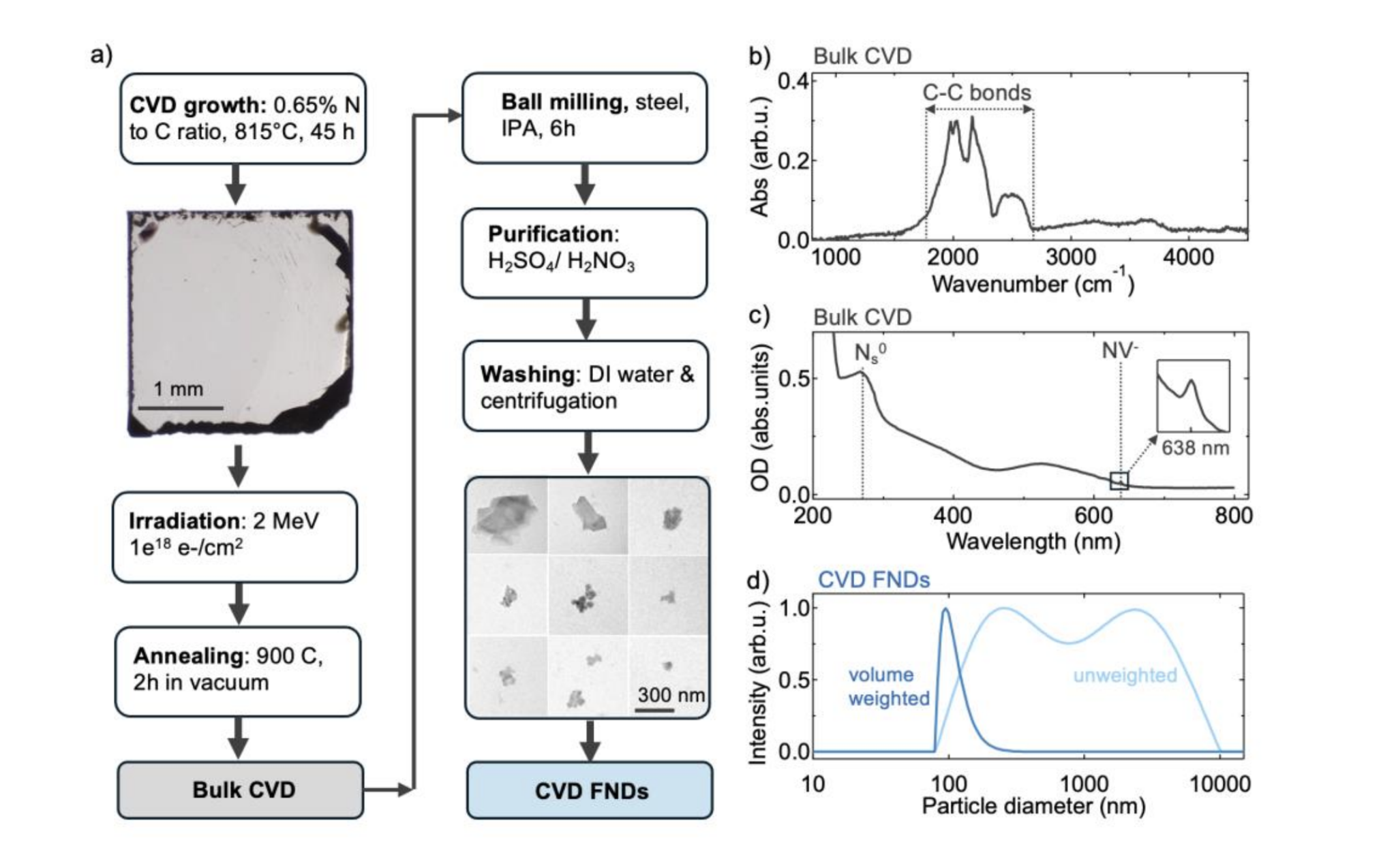
Fluorescent nanodiamonds containing nitrogen-vacancy (NV) centers hold immense promise for applications ranging from precise magnetic field sensing to detailed biological imaging, but creating these materials at scale with consistent properties has remained a significant challenge. Now, Alessandro and colleagues at [Institution name(s) not provided in source] address this issue by investigating a novel fabrication method using chemical vapor deposition diamonds subjected to ball milling. The team demonstrates that this process yields nanodiamonds hosting NV centers with remarkably similar spin coherence to bulk diamonds, a substantial improvement over existing high-pressure, high-temperature methods. This breakthrough paves the way for large-scale production of high-performance nanodiamonds, potentially unlocking widespread use of this technology in diverse fields.
Nanodiamond Fluorescence Enhancement via Nanophotonics
Fluorescent nanodiamonds (FNDs) are promising materials for quantum sensing, offering bright, stable fluorescence and long-lasting quantum properties, alongside biocompatibility. Realising their full potential, however, requires significantly enhancing their fluorescence, particularly when examining individual nanodiamonds. Recent advances in nanophotonics offer a potential solution, using nanoscale optical resonators to strongly interact with the fluorescence of individual FNDs. These resonators confine light around the nanodiamond, dramatically enhancing both the excitation and emission of light, leading to a substantial increase in fluorescence intensity.
Careful design of the resonator geometry can also suppress unwanted processes that reduce fluorescence, further boosting efficiency. This research investigates integrating FNDs with high-quality silicon nitride (SiN) photonic resonators, fabricated using electron beam lithography, aiming to achieve a ten-fold increase in FND fluorescence intensity and a measurable reduction in the spread of emitted light. Successful demonstration of these effects will pave the way for highly sensitive, nanoscale quantum sensors with applications in biomedical imaging, magnetic field detection, and temperature mapping.
Brighter Nanodiamonds Enhance Quantum Sensing Performance
Researchers have developed a new method for creating fluorescent nanodiamonds (FNDs) with significantly improved properties for quantum sensing applications. These tiny diamonds, each just a few nanometers in size, contain nitrogen-vacancy (NV) centers, defects in the diamond lattice that act as sensitive quantum sensors. The team focused on creating FNDs from chemical vapor deposition (CVD) diamonds, a process allowing precise control over the material’s composition. By milling these CVD diamonds, they produced FNDs containing a low concentration of nitrogen, approximately 2 parts per million. This is a departure from traditional methods using high-pressure, high-temperature (HPHT) diamonds, which typically contain much higher nitrogen levels.
The results demonstrate a substantial improvement in spin coherence, with CVD FNDs exhibiting T1 spin relaxation times averaging 4. 7 milliseconds, a dramatic increase compared to commercially available HPHT FNDs, which typically have T1 times of only 0. 17 milliseconds. This extended coherence allows for more precise measurements and the detection of fainter signals, and the CVD FNDs maintained a more favorable balance between the different charge states of the NV center, leading to brighter fluorescence. This breakthrough paves the way for more sensitive and reliable quantum sensors, with potential applications in detecting magnetic fields in biological samples, improving magnetic resonance imaging, and developing advanced materials characterization techniques.
Optimized Nanodiamonds Exhibit Long Spin Coherence
This research demonstrates a scalable method for fabricating fluorescent nanodiamonds (FNDs) with properties comparable to those found in bulk diamond crystals. By optimizing ball milling of chemical vapor deposition (CVD) diamonds containing nitrogen-vacancy (NV) centers, the team successfully produced FNDs exhibiting long spin coherence times, specifically a T1 relaxation time of approximately 4. 7 milliseconds. This represents a significant improvement over commercially available high-pressure, high-temperature (HPHT) FNDs, which typically exhibit much shorter coherence times. The milled CVD FNDs also showed a lower proportion of the negatively charged NV state and longer photoluminescence lifetimes, likely due to the lower concentration of nitrogen impurities in the starting material. These findings suggest that this fabrication process preserves the desirable quantum properties of the bulk diamond material, offering a pathway to produce FNDs suitable for sensitive applications such as magnetometry and biosensing. Further work is needed to optimize the stability of the NV charge state and enhance its performance without compromising coherence, potentially broadening the range of applications for these advanced materials.
🗞 The properties of the nitrogen-vacancy center in milled chemical vapor deposition nanodiamonds
🧠 ArXiv: https://arxiv.org/abs/2508.13725


