

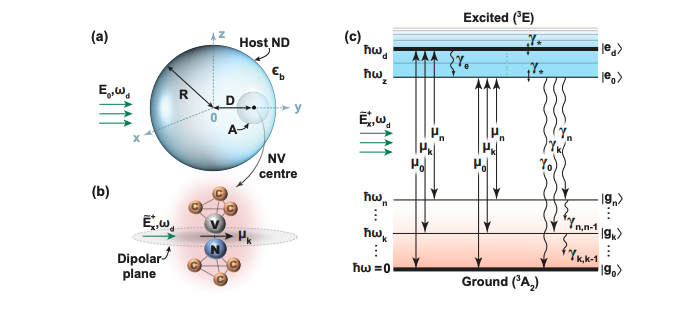
The unique light-emitting properties of nitrogen-vacancy (NV) centres in diamond hold immense promise for applications ranging from advanced sensing to biological imaging, but realising this potential requires a detailed understanding of how these centres behave when embedded within nanoscale diamonds. Harini Hapuarachchi, Francesco Campaioli, and Jared H Cole, all from RMIT University, alongside their colleagues, have developed a new model that explains how the size, depth, and surrounding environment of an NV centre within a nanodiamond dramatically affects its ability to emit light. Their research integrates rigorous electromagnetic simulations with a detailed optical model, revealing that the brightness of an NV centre is strongly influenced by these factors, explaining observations such as why shallow centres in water appear brighter than deeper ones in air. This unified framework, unlike previous approaches, predicts how emission efficiency varies with wavelength and position, offering crucial insights for designing brighter, more effective NV-based devices and furthering our understanding of light emission in nanoscale materials.
The negatively charged nitrogen-vacancy (NV) center in diamond represents a leading solid-state quantum emitter, offering unique spin and photon interfaces with applications spanning electromagnetic sensing to bioimaging. While NV centers within bulk diamond are well understood, embedding them innanodiamonds introduces complexities arising from size, geometry, and surface effects. NV centers in nanodiamonds exhibit alteredfluorescence properties, including longer lifetimes, lower quantum efficiency, and increased sensitivity to their surroundings, stemming from suppressed emission, surface-induced decay, and internal reflection.
Nanodiamond Emission Characterization of NV Centers
This research summarizes a study focused on understanding and optimizing the fluorescence emission of nitrogen-vacancy (NV) centers embedded within nanodiamonds. NV centers in diamond are promising components for quantum technologies, including sensing, imaging, and quantum computing, due to their bright fluorescence, spin-dependent emission, and coherence. Embedding NV centers in nanodiamonds allows for easier integration into diverse platforms, such as biological systems and materials. Optimizing emission efficiency is crucial for maximizing performance in these applications. The research demonstrates that the charge state of the NV center significantly impacts fluorescence intensity, influenced by surface chemistry, the surrounding environment, and external electric fields, and explores methods to stabilize the desired charge state.
Furthermore, the size of the nanodiamond plays a critical role, as smaller nanodiamonds exhibit stronger quantum confinement effects, altering the NV center’s energy levels and emission wavelength. The study investigates how nanodiamond size affects emission efficiency and spectral properties. The emission pattern of NV centers is not uniform; the nanodiamond shape and orientation influence the direction and polarization of emitted photons, crucial for efficient light collection. The surrounding dielectric medium affects the NV center’s emission rate through the Purcell effect, modifying spontaneous emission.
The research investigates how different dielectric materials can enhance or suppress emission. Theoretical models, including Mie theory and quantum master equations, help interpret experimental results and guide optimization efforts. Surface chemistry significantly impacts the NV center’s charge state and emission, and surface passivation and functionalization strategies are explored to improve performance. This research provides a comprehensive understanding of the factors governing the emission of NV centers in nanodiamonds, paving the way for advanced quantum technologies.
Nanodiamond Size Dictates NV Center Brightness
Researchers have developed a new understanding of how nitrogen-vacancy (NV) centers perform when embedded within nanodiamonds, paving the way for brighter and more efficient quantum technologies. NV centers are promising components for applications ranging from quantum computing to nanoscale sensing, but their performance changes significantly when moved from bulk diamond to the nanoscale. This work addresses the longstanding challenge of predicting how nanodiamond size, the NV center’s location within the nanodiamond, and the surrounding environment collectively influence light emission. The team created a combined theoretical model integrating the quantum behavior of the NV center with classical electromagnetic simulations, offering a comprehensive picture of light emission.
The results demonstrate that the brightness of an NV center is strongly dependent on these combined factors; for example, an NV center near the surface of a nanodiamond surrounded by water can appear significantly brighter than one deeper inside a nanodiamond in air. This research reveals that the efficiency with which light escapes the nanodiamond varies depending on the wavelength of the emitted light and the NV center’s position. The model accurately predicts how the surrounding refractive index impacts emission, explaining why embedding nanodiamonds in higher-index materials like water enhances brightness. Importantly, the model does not require assumptions about perfect quantum efficiency, instead accounting for realistic scenarios where surface effects and dielectric mismatch play a significant role. This advancement provides crucial guidelines for designing brighter and more effective NV-based devices, ultimately accelerating progress in quantum technologies and nanoscale sensing applications.
Nanodiamond Size Dictates NV Center Emission
This research presents a new theoretical framework that combines classical electromagnetic simulations with a quantum-optical model of nitrogen-vacancy (NV) centers embedded within nanodiamonds. The study investigates how the size of the nanodiamond, the NV center’s location within it, and the surrounding environment collectively influence the emission of light. By integrating these factors, the model provides a more complete understanding of NV center behaviour than previous approaches, which often addressed these aspects in isolation. The results clarify inconsistencies observed in the performance of NV centers in nanodiamonds, particularly variations in brightness and emission lifetime.
The team demonstrates that the efficiency of light emission is strongly dependent on the nanodiamond’s size and the NV center’s position, as well as the surrounding refractive index, explaining observations such as brighter emission from shallow NV centers in water compared to deeper ones in air. Future work building on this model will be crucial for the rational design of nanostructures hosting NV centers and for improving the consistency of NV-based nanodiamond applications in areas like biological imaging and sensing.
🗞 Nitrogen-Vacancy Emission from Nanodiamonds: Size, Depth, and Surroundings
🧠 ArXiv: https://arxiv.org/abs/2508.08565


