

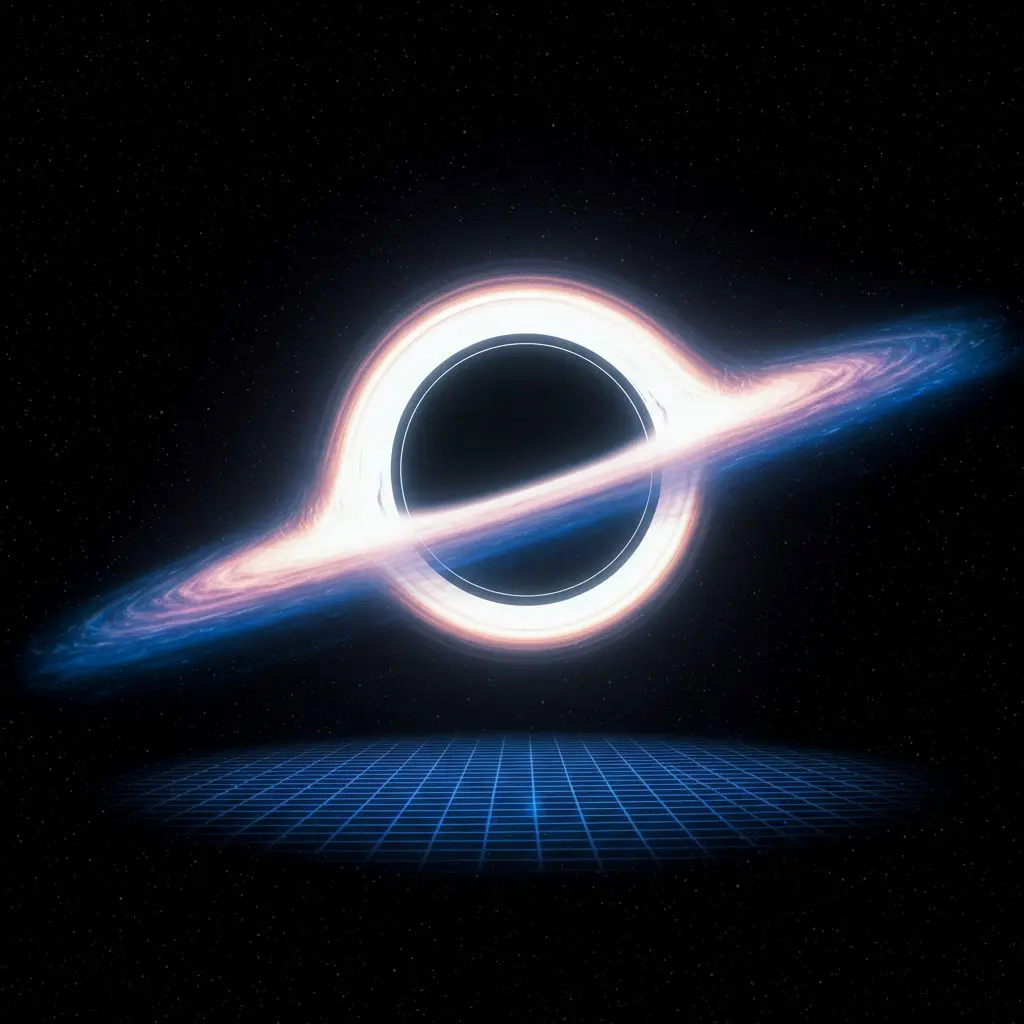
The longstanding cosmic censorship conjecture, a cornerstone of general relativity positing that singularities remain hidden from view behind event horizons, faces a compelling challenge in new research. Huang et al demonstrate, through detailed analysis of quantum-gravitational processes involving Hawking and Schwinger effects, that naked singularities – those without event horizons – can form spontaneously. Their work reveals that extreme dilatonic black holes, a theoretical type incorporating additional spatial dimensions, inevitably expose their singularities in finite time due to the convergence of Hawking radiation power and the cessation of Schwinger pair production. This research, detailed in their article “Spontaneous genesis of naked singularities through quantum-gravitational processes: conclusive evidence for violation of cosmic censorship”, originates from Yang Huang and Hongsheng Zhang at the School of Physics and Technology, University of Jinan, and presents a direct mechanism by which information escapes from a singularity, potentially reshaping our understanding of black hole physics and the fundamental limits of predictability in the universe.
Recent research challenges the cosmic censorship conjecture, a long-held tenet proposing that singularities, points where the laws of physics break down, always remain hidden within event horizons. Calculations indicate that the combined effects of Hawking radiation and the Schwinger effect inevitably lead to the spontaneous formation of naked singularities in the late-time evolution of large dilatonic black holes, fundamentally altering our understanding of these cosmic entities. This work establishes a new paradigm for black hole behaviour, revealing a mechanism where singularities actively shed information, opening avenues for exploring the extreme physics within these gravitational environments.
The study focuses on dilatonic black holes, theoretical objects differing from standard Schwarzschild black holes due to the presence of a scalar field, revealing that extreme, or near-zero temperature, versions of these objects spontaneously expose their singularities in a finite timeframe, defying previous expectations. Researchers analyse the Hawking radiation spectrum, discovering it deviates from a standard Planck distribution, a theoretical curve describing the electromagnetic radiation emitted by a black body in thermal equilibrium, due to the vast potential surrounding the black hole’s event horizon, directly influencing the rate of exposure.
The study details how the power emitted via
The study details how the power emitted via Hawking radiation converges to a finite value for extreme dilatonic black holes, circumventing the usual shielding effect and directly exposing the singularity. Researchers calculate the absorption cross-section, a crucial parameter quantifying the probability of particle absorption by the black hole, and incorporate the greybody factor, a correction accounting for the curvature of spacetime near the event horizon, to accurately model the Hawking radiation rate, providing a quantitative framework for understanding the process. This detailed analysis reveals the truncation of the Hawking radiation spectrum, a consequence of the broad potential surrounding the event horizon, and confirms the singularity’s eventual exposure within a finite timeframe.
Furthermore, the research investigates the Schwinger effect, a quantum mechanical process where particle-antiparticle pairs spontaneously appear near strong gravitational fields, and assesses its contribution to the black hole’s discharge. Calculations reveal that while the Schwinger effect does contribute to the discharge, it ultimately fails to preserve cosmic censorship for black holes exceeding solar masses within a significant range of initial charge parameters. Pair production naturally ceases for extreme dilatonic black holes above this mass threshold, meaning the Schwinger effect cannot counteract the singularity exposure driven by Hawking radiation, solidifying the dominance of Hawking radiation in driving this process.
The research presents a novel mechanism for naked singularity formation, driven solely by established physical effects, and allows for direct observation of information emanating from the singularity itself. Scientists demonstrate that the spontaneous formation of naked singularities is not merely a theoretical possibility, but a predictable outcome within the framework of general relativity and quantum field theory, given specific conditions relating to the black hole’s mass and charge. This discovery challenges the conventional understanding of black holes as information sinks and opens new avenues for exploring the fundamental nature of information in the universe.
This work represents a significant advancement by demonstrating
This work represents a significant advancement by demonstrating that naked singularities form spontaneously, driven by established physical effects, and challenges the long-held assumption that singularities always remain hidden behind event horizons. Researchers demonstrate that the resulting singularities actively shed information, offering a novel avenue for studying the physics at these extreme gravitational environments and opening new possibilities for testing fundamental theories of physics.
Looking ahead, refining the calculations of the absorption cross-section, potentially through the use of more advanced numerical techniques, would improve the accuracy of the predictions and provide a more detailed understanding of the Hawking radiation process. Scientists should also explore the potential for experimental verification of these theoretical predictions, potentially through observations of astrophysical black holes or through the creation of artificial black holes in the laboratory. Expanding the analysis to include rotating black holes and different types of black hole solutions would also be valuable, providing a more comprehensive understanding of black hole behaviour.
🗞 Spontaneous genesis of naked singularities through quantum-gravitational processes: conclusive evidence for violation of cosmic censorship
🧠 DOI: https://doi.org/10.48550/arXiv.2506.22761


