In the race to create computers that think more like human brains, scientists have found a game-changing material: MXene-Ti3C2Tx. This two-dimensional nanomaterial is revolutionizing neuromorphic computing—a field that aims to mimic the brain’s incredible efficiency in processing information while consuming minimal energy.
The Brain-Computing Connection
Traditional computers shuttle data back and forth between separate processing and memory units, creating bottlenecks that waste energy and slow performance. The human brain, by contrast, processes and stores information simultaneously in its billions of interconnected neurons and synapses. Neuromorphic devices attempt to replicate this integrated approach, and MXene-Ti3C2Tx is proving to be an ideal building block.
MXene belongs to a family of layered two-dimensional materials discovered relatively recently. What makes Ti3C2Tx special is its unique combination of properties: exceptional electrical conductivity, rich surface chemistry with functional groups like -OH, -F, and -O, and remarkable mechanical flexibility. These characteristics make it perfect for creating artificial synapses—the connections between neurons that store and process information.
Four Ways MXene Works Its Magic
Researchers have identified four key physical mechanisms that enable MXene-based devices to mimic biological neural behavior:
Electrochemical Metallization (ECM) involves the formation and breaking of conductive metal filaments within the material. When voltage is applied, metal ions migrate and form tiny conducting pathways, similar to how synapses strengthen or weaken based on neural activity.
Valence Change Memory (VCM) relies on oxygen vacancy movement. As oxygen ions migrate under electrical stimulation, they create conducting channels that can store information states—essentially creating memories at the atomic level.
Electron Tunneling allows electrons to “jump” through energy barriers in the material, with the tunneling probability varying based on the device’s history. This creates a memory effect that persists even when power is removed.
Charge Trapping captures electrons in defect sites within the material, where they remain stored until released by appropriate electrical signals. This mechanism enables both short-term and long-term memory behaviors.
Engineering Better Performance
Scientists are fine-tuning MXene devices through three main strategies. Interface engineering modifies the material’s surface properties through controlled oxidation or chemical bonding, enhancing stability and performance. Doping engineering introduces silver nanoparticles or other materials to improve electrical characteristics and reduce power consumption. Structural engineering couples MXene with dielectric layers or creates specialized geometries to optimize information storage and processing capabilities.
These enhancements have produced remarkable results. Some MXene devices operate at ultra-low voltages and consume only femtojoules of energy per operation—approaching the efficiency of biological synapses.
Beyond Traditional Computing
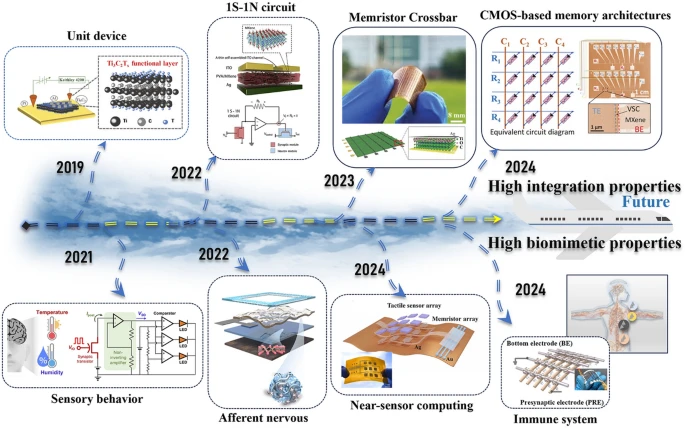
The most exciting applications involve integrating sensing and computing functions directly into single devices. In “near-sensor computing,” MXene-based processors are placed close to sensors to minimize data transmission delays. “In-sensor computing” goes further, embedding processing capabilities directly within the sensors themselves.
These approaches enable remarkable applications: artificial skin that can recognize different materials by touch, visual systems that adapt to changing light conditions, and even devices that simulate circadian rhythms for more natural human-computer interactions. Researchers have demonstrated MXene devices that can learn and remember tactile patterns, recognize handwritten digits with over 90% accuracy, and even model complex behaviors like Pavlovian conditioning.
The Road Ahead
Despite these advances, significant challenges remain. Scaling up from individual devices to large integrated systems requires solving problems of manufacturing uniformity and preventing interference between neighboring components. For biomedical applications, ensuring long-term biocompatibility and developing proper encapsulation methods are crucial.
The research community is particularly focused on two goals: achieving high-integration capabilities for practical computing systems and developing highly biomimetic properties for medical implants and brain-computer interfaces.
MXene-Ti3C2Tx represents more than just a new material—it’s a pathway toward computing systems that blur the boundaries between artificial and biological intelligence. As researchers continue refining these technologies, we’re moving closer to computers that don’t just process information, but truly learn and adapt like living brains.
This breakthrough could ultimately lead to more efficient artificial intelligence systems, revolutionary medical devices, and entirely new paradigms for human-computer interaction.
More information
External Link: Click Here For More