The behaviour of quantum ‘magic’, a resource for computation distinct from entanglement, remains a key question in quantum information theory, and recent work by Hari Timsina from the International School for Advanced Studies (SISSA), Yi-Ming Ding from Fudan University, and Emanuele Tirrito from the Abdus Salam International Centre for Theoretical Physics (ICTP), alongside colleagues, sheds new light on its properties. The team investigates how this ‘magic’ manifests in a common quantum system, the Ising chain, and importantly, how it responds to increasing temperature. Their research introduces a novel computational technique combining Monte Carlo simulations with advanced statistical estimators to rigorously quantify ‘magic’ even in complex, mixed quantum states, allowing them to study systems up to eight quantum bits in size. The results demonstrate a surprising resilience of ‘magic’ to temperature increases, suggesting it may not diminish as quickly as entanglement, and offering a potentially valuable resource for future quantum technologies.
Quantifying Magic in Quantum States
Researchers are increasingly focused on understanding the complexity of quantum states, driven by the need to build practical quantum computers. A key challenge lies in quantifying the resources required to create and manipulate these states, particularly those beyond the capabilities of simple, easily controlled systems. This research centers on a property called “magic,” which represents how difficult it is to create a quantum state using standard quantum operations. States with high magic are more complex and require more sophisticated control, impacting the feasibility of building large-scale quantum computers.
Currently, much of the work on quantum complexity focuses on pure states, where the quantum system is in a single, well-defined configuration. However, real-world quantum systems are often “mixed,” existing as a probabilistic combination of multiple states. Quantifying magic in these mixed states is significantly more challenging, as existing methods for pure states don’t readily apply. Researchers have developed measures like “robustness of magic,” but calculating these for complex systems remains computationally expensive and limited in scope. This hinders a complete understanding of how magic manifests in realistic quantum scenarios.
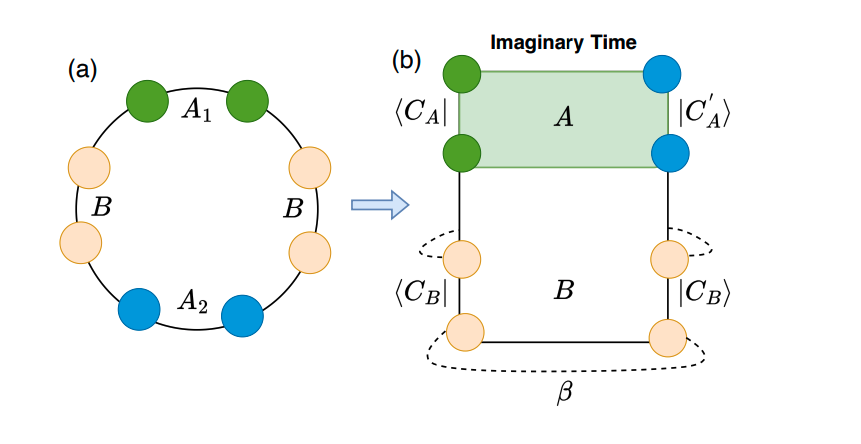
To address this, scientists have developed a novel computational approach combining quantum Monte Carlo simulations with advanced statistical techniques. This hybrid method allows for a more accurate and efficient calculation of the robustness of magic in larger, more complex systems, specifically within the quantum Ising model, a widely studied system in condensed matter physics. By focusing on “mutual” robustness of magic, how magic is distributed between different parts of a system, researchers aim to uncover deeper connections between magic and the critical behavior of quantum materials, the points at which materials undergo dramatic changes in their properties. The results demonstrate that mutual magic exhibits characteristics of a system just before it undergoes a phase transition, and that the system decays as the system increases. This suggests a connection between the distribution of magic within a quantum system and its susceptibility to change, potentially offering insights into the behavior of complex quantum materials.
🗞 Robustness of Magic in the quantum Ising chain via Quantum Monte Carlo tomography
🧠 DOI: https://doi.org/10.48550/arXiv.2507.12902