The search for dark matter constitutes one of the most pressing challenges in modern physics, and scientists are increasingly exploring novel methods to detect these elusive particles. Feng Fang, Kim Siang Khaw, and Ce Zhang, along with colleagues from Advanced Energy Science and Technology Guangdong and other institutions, propose a groundbreaking experiment utilising muonium, an exotic atom resembling hydrogen, to search for ultralight axions, a leading dark matter candidate. Their work demonstrates that a carefully designed muonium-based spectroscopy experiment, currently under construction, promises to improve existing limits on the interaction between axions and ordinary matter by up to seven orders of magnitude, opening a new and powerful pathway to unravel the mysteries of the dark universe and probe physics beyond our current understanding. This innovative approach establishes muonium spectroscopy as a highly sensitive quantum sensor with the potential to significantly advance the search for dark matter.
This research exploits the exceptional precision achievable in muonium spectroscopy to detect subtle effects caused by interactions with these hypothetical particles, motivated by discrepancies observed in measurements of the muon’s magnetic moment. The work represents a significant step towards exploring new physics and understanding the universe’s fundamental constituents. Muonium serves as a sensitive probe because its energy levels are well-defined and can be measured with remarkable accuracy.
Researchers utilize extensive computer simulations to model the muon beamline, muonium formation, and detector response, ensuring a thorough understanding of the experimental setup and accurate interpretation of results. Current and future experiments rely on high-intensity muon beams available at facilities such as PSI, J-PARC, and the proposed HIMB. The experimental approach involves creating muonium by stopping muons in materials and allowing them to capture electrons. A key measurement focuses on the Lamb shift, a small energy difference between closely spaced energy levels, which would be affected by interactions with ALPs.
Ongoing research and facility development aim to improve sensitivity and refine theoretical models. This research has implications for dark matter detection, confirming the existence of physics beyond the Standard Model, and precisely measuring fundamental constants. By improving our understanding of muonium and its interactions, scientists hope to revolutionize our understanding of dark matter and the laws of physics. The work represents a cutting-edge effort to explore the fundamental nature of the universe using a unique and sensitive probe.
Muonium Spectroscopy Constrains Axion Dark Matter
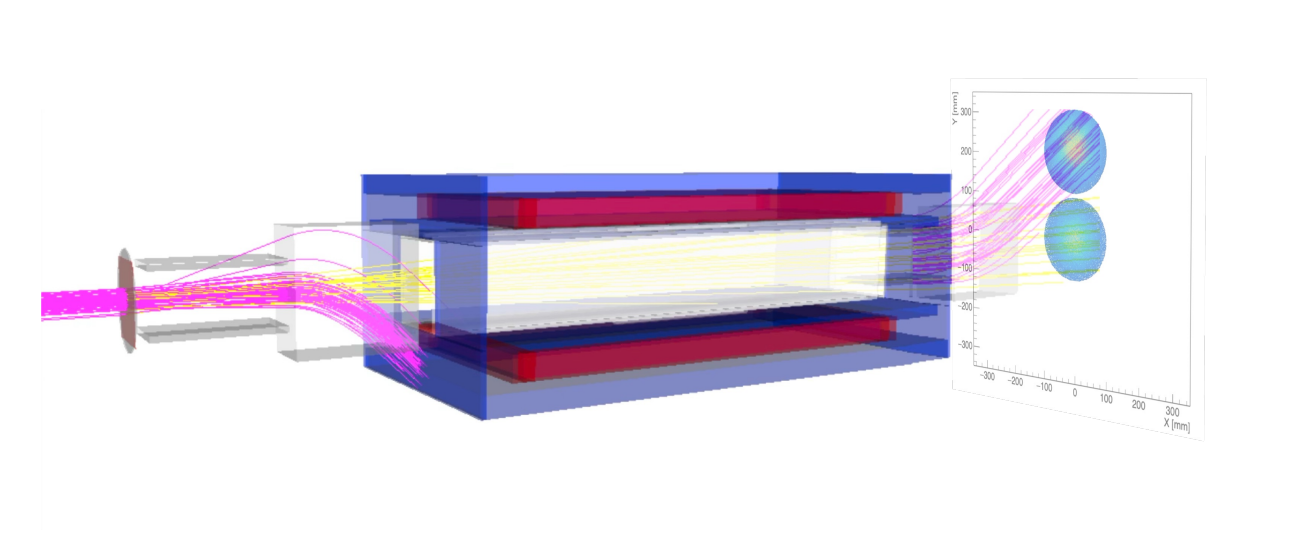
Scientists are pioneering a new method for detecting dark matter axions by harnessing the unique properties of muonium, an exotic atom consisting of an electron and a positive muon. This research proposes an experiment that utilizes intense muon beams to search for these axions through resonant transitions between hyperfine states within the muonium atom, establishing muonium spectroscopy as a powerful new technique for exploring physics beyond the Standard Model. The experimental approach involves slowing down surface muons generated at high-intensity facilities using cryogenic targets, then initiating muonium formation as they pass through a thin foil. Detectors are strategically positioned to monitor muon and muonium behavior throughout the process.
Following formation, muonium atoms enter a multipass cavity where a specific quantum state is selectively excited to a Rydberg state, enhancing sensitivity to axion interactions. A region of deflection electrodes ionizes the Rydberg atoms, while other muonium atoms continue forward, allowing for clear differentiation. A high-vacuum scan magnet precisely controls the energy splitting between hyperfine states, enabling resonant transitions when the splitting matches the axion energy. The expected event rate for a resonant transition is calculated based on the number of muonium atoms in the magnetic field, setting a limit on the strength of the interaction between axions and muons. Future facilities are expected to deliver even more intense muon beams, significantly enhancing the potential for detecting these elusive dark matter particles.
Muonium Spectroscopy Constrains Ultralight Axion Interactions
Scientists are employing high-intensity muon beams and muonium, an exotic atom composed of a muon and an electron, to search for ultralight axions, a leading dark matter candidate. This work proposes a method to search for these particles by observing resonant transitions between hyperfine states within the muonium atom, demonstrating that a muon beam with a realistic intensity can significantly improve constraints on the interaction between axions and muons. Specifically, the team’s calculations show the potential to improve current limits on the axion-muon coupling by up to seven orders of magnitude, over an axion mass range of interest. This breakthrough stems from the unique properties of muonium, which provides a clean, purely leptonic system for precision measurements, avoiding complications from strong interactions present in other systems.
The study details how dark matter axions can be treated as an effective oscillating background field, inducing transitions between muonium spin states when the energy gap matches the axion mass. The predicted event rate for detecting these transitions is directly related to the axion mass, muon beam intensity, and the axion decay constant, with calculations showing a rate proportional to the square of the axion velocity and the muon beam intensity. Researchers estimate that an experiment scanning a relevant frequency bandwidth could achieve unprecedented sensitivity, establishing muonium spectroscopy as a powerful new tool for probing physics beyond the Standard Model and potentially revealing the nature of dark matter. The method does not rely on the coherence of the dark matter field, offering a distinct advantage over other search strategies.
Muonium Probes Ultralight Dark Matter Candidates
This research presents a novel approach to searching for ultralight axion-like particles (ALPs), hypothetical components of dark matter, using muonium, an exotic atom consisting of a muon and an electron. Scientists have demonstrated, through detailed simulations, the feasibility of a muonium-based experiment capable of detecting these particles via precise measurements of quantum transitions within the atom, potentially improving current limits on the strength of couplings between ALPs and muons by up to seven orders of magnitude over a specific mass range. The team validated the experimental design using sophisticated computational modelling, effectively suppressing background noise and optimising beam and magnetic field parameters. Simulations indicate that, with realistic muon beam intensities, the setup could achieve a significant event rate, with peak performance at specific energy levels and detector lengths.
This work opens a new avenue for investigating ALP interactions, a sector previously inaccessible to conventional collider experiments and precision muon studies due to the nature of the interaction. The authors acknowledge that the sensitivity of the experiment is dependent on the intensity of available muon beams and the precision of magnetic field control. Future research will focus on optimising these parameters and refining the experimental setup with the advent of next-generation high-intensity muon sources. This work establishes muonium spectroscopy as a promising technique for exploring physics beyond the Standard Model and furthering our understanding of dark matter.
🗞 Muonium Spectroscopy as a Quantum Sensor for Ultralight Axion Dark Matter
🧠 ArXiv: https://arxiv.org/abs/2509.20862