

Understanding how complex fluids begin to flow is a long-standing challenge in physics and engineering, and new research sheds light on the behaviour of fluids containing tiny, asymmetrical particles. Kesavan Sekar, Viney Ghai, and Reza Ghanbari, alongside Marko Bek, Marianne Liebi, Aleksandar Matic, and colleagues at Chalmers University of Technology and other institutions, investigate the transition from smooth to turbulent flow in suspensions of anisotropic nanoparticles. They demonstrate, using a novel combination of advanced microscopy techniques, that the movement of these particles does not simply mirror the overall fluid flow, but exhibits complex, scale-dependent behaviour. This discovery is significant because it reveals previously hidden dynamics governing flow stability and offers crucial insights into how particle shape influences the transport, processing, and ultimate structure of these complex materials.
Cellulose Nanofibrils Reveal Flow Transition Mechanisms
Complex fluids transition from smooth to chaotic behaviour as external forces increase, similar to how crystalline materials change phases. Understanding the microscopic origins of these transitions is challenging, particularly in systems influenced by both entropic and enthalpic forces. This research investigates the flow behaviour of cellulose nanofibrils, a model complex fluid, using small-angle X-ray scattering and rheometry. The team focused on how interactions between nanofibrils and the overall network structure influence the shift from viscous to elasto-viscous behaviour, and ultimately, network changes caused by flow.
The approach systematically varied flow rates and concentrations of cellulose nanofibrils in water, while simultaneously monitoring structural changes using X-ray scattering. Rheological measurements provided complementary information about macroscopic flow properties, such as viscosity and elasticity, as a function of shear rate and concentration. By combining these techniques, the researchers established a direct link between the microscopic structure of the nanofibril network and macroscopic flow behaviour. The study employed a custom-built rheometer coupled with a high-brilliance synchrotron X-ray source, allowing simultaneous measurements of structure and flow at unprecedented resolution.
This work demonstrates that the transition to elasto-viscous behaviour occurs through alignment of nanofibrils along the direction of flow. At low shear rates, the network exhibited random orientation of nanofibrils. As shear rate increased, the nanofibrils progressively aligned, increasing the elastic modulus and transitioning to elasto-viscous flow. The team identified a critical shear rate above which the aligned network underwent structural rearrangements, decreasing viscosity and returning to more viscous behaviour. These findings provide new insights into the rheology of complex fluids and have implications for materials science, food processing, and biopharmaceutical engineering.
Nanoparticle Alignment Under Vortical Flow
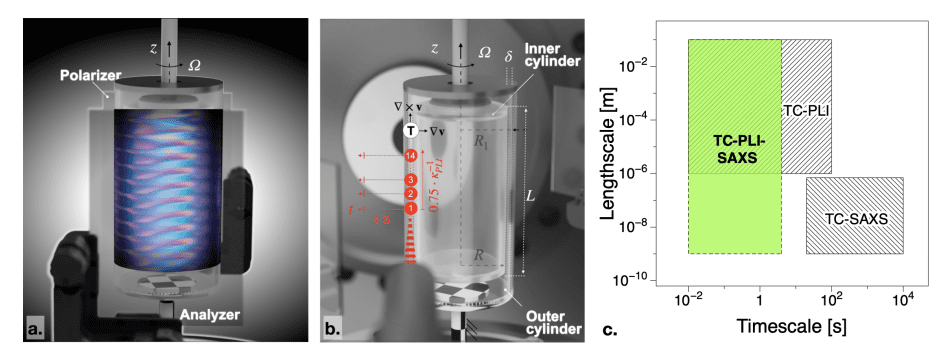
This research investigates the flow behaviour of graphene oxide (GO) and cellulose nanocrystal (CNC) suspensions under Taylor-Couette flow, employing planar laser imaging (PLI) and small-angle X-ray scattering (SAXS). The goal is to understand how nanoparticle alignment and dynamics evolve across different flow regimes, from laminar to turbulent, bridging the gap between macroscopic flow structures and nanoscale particle behaviour. The researchers combined PLI, which visualizes macroscopic flow patterns like vortices, with SAXS, which probes nanoscale particle orientation and dynamics, simultaneously to correlate macroscopic flow features with microscopic particle alignment. They studied five distinct flow regimes: laminar Couette flow, Taylor vortex flow, wavy vortex flow, modulated wavy vortex flow, and turbulent wavy vortex flow.
The SAXS data revealed characteristic frequencies of particle alignment that correlated with the macroscopic flow frequencies observed via PLI. GO exhibited slower dynamics and a different frequency response compared to CNC, likely due to differences in particle shape, aspect ratio, and surface chemistry. They performed Fourier analysis of both PLI and SAXS data to extract characteristic spatial and temporal frequencies, providing a quantitative understanding of the flow dynamics at different length scales. Specific observations include the correlation between macro- and nanoscale frequencies, where the characteristic frequencies observed in the SAXS data matched the frequencies of the macroscopic flow structures observed via PLI.
Modulated wavy vortex flow showed particularly interesting behaviour, with complex spatiotemporal patterns observed at both macroscopic and nanoscale levels. CNC exhibited faster and more pronounced dynamics compared to GO, suggesting a stronger coupling between the flow and particle alignment. This research demonstrates that combining PLI and SAXS provides a powerful tool for understanding the complex interplay between fluid dynamics and nanoparticle behaviour in complex fluids, contributing to a deeper understanding of how to control and manipulate nanoparticle suspensions for various applications, such as materials processing, drug delivery, and energy storage.
Multiscale Fluid Dynamics of Anisotropic Nanoparticles
Scientists have developed a novel experimental setup combining polarized light imaging and small-angle x-ray scatter microscopy with millisecond temporal resolution, enabling observation of fluid dynamics across seven orders of magnitude in lengthscale. This breakthrough allows researchers to investigate the relationship between macroscopic flow patterns and the behaviour of individual anisotropic nanoparticles within complex fluids. The work focuses on two distinct nanoparticle suspensions, platelet-like graphene oxide and rod-like cellulose nanocrystals, subjected to Taylor-Couette flow, a classical stability problem used to study the transition from laminar to turbulent flow. Experiments reveal markedly different multiscale dynamics depending on nanoparticle morphology.
Platelet-like graphene oxide particles followed the wavy motion characteristic of the macroscopic secondary flow field, aligning with the overall fluid movement. In contrast, rod-like cellulose nanocrystals exhibited high-frequency motion uncorrelated with the vortex instabilities, indicating a distinct response to the flow. Static nanoscale structure analysis, conducted under laminar Couette flow, demonstrates that the graphene oxide suspension exhibits no liquid crystalline ordering, confirming the study focuses on individual nanoparticles. Conversely, cellulose nanocrystals display local ordering at approximately 40 nanometer interparticle distance, as evidenced by distinct maxima in the structure factor at a scattering vector modulus of 0.
16 nanometers inverse. The team probed the scattering vector range of q = 0. 13 to 0. 20 nanometers inverse, allowing detailed characterization of nanoparticle behaviour. Measurements confirm that the combined polarized light imaging and small-angle x-ray scatter microscopy setup is critical for addressing transitional flow across multiple lengthscales. This innovative approach allows scientists to observe instability modes where transitional flow effects at the nanoparticle level coexist with molecular motion effects, dependent on particle morphology and aspect ratio. The results demonstrate a fundamental difference in how anisotropic nanoparticles respond to complex flows, challenging the assumption that they simply follow the motion of the macroscopic fluid elements.
Nanoparticle Dynamics Reveal Fluid Complexity
This research demonstrates a novel approach to understanding the behaviour of complex fluids by directly observing particle dynamics at multiple length scales. Scientists developed a combined microscopy technique, bridging a gap of seven orders of magnitude in scale, to investigate how anisotropic nanoparticles, platelet-like and rod-like, respond to fluid flow. Through observations of Taylor-Couette flow, the team revealed distinct behaviours between the two particle types; platelet-like particles followed the macroscopic secondary flow field, aligning with the overall fluid movement.
👉 More information
🗞 Multiscale transitional flow in anisotropic nanoparticle suspensions revealed by time-resolved x-ray scatter microscopy
🧠 ArXiv: https://arxiv.org/abs/2510.18444


