The increasing demand for data transmission speeds drives researchers to explore innovative methods of sending information, and a new approach utilising the untapped potential of light within fibre optic cables promises a significant leap forward. Mario Zitelli from Sapienza University of Rome, and colleagues, demonstrate an efficient method of space-division multiplexing, a technique that increases capacity by sending data through multiple channels simultaneously within a single fibre. Their work achieves the transmission of multiple quantum bits per second over an eight-kilometre few-mode fibre, crucially overcoming a common limitation of single-photon detectors by cleverly utilising detector ‘dead time’ to eliminate interference between channels, and paving the way for substantially faster and more reliable quantum communication networks. This advancement represents a key step towards realising the full potential of fibre optic technology for future data transmission needs.
Quantum Key Distribution (QKD) aims to enable the transmission of cryptographic keys with absolute security, ensuring no computational power can reveal their contents. Recent advances demonstrate secure quantum communication over distances up to 600 km with key rates exceeding Mbps, and even gigabit bandwidth over shorter links. This research utilizes multimode fiber to overcome the limitations of traditional single-mode fibers, effectively harnessing the normally unused dead time of single-photon detectors to eliminate interference between quantum channels and improve transmission efficiency.
Multimode Fiber Enables Long-Distance Quantum Transmission
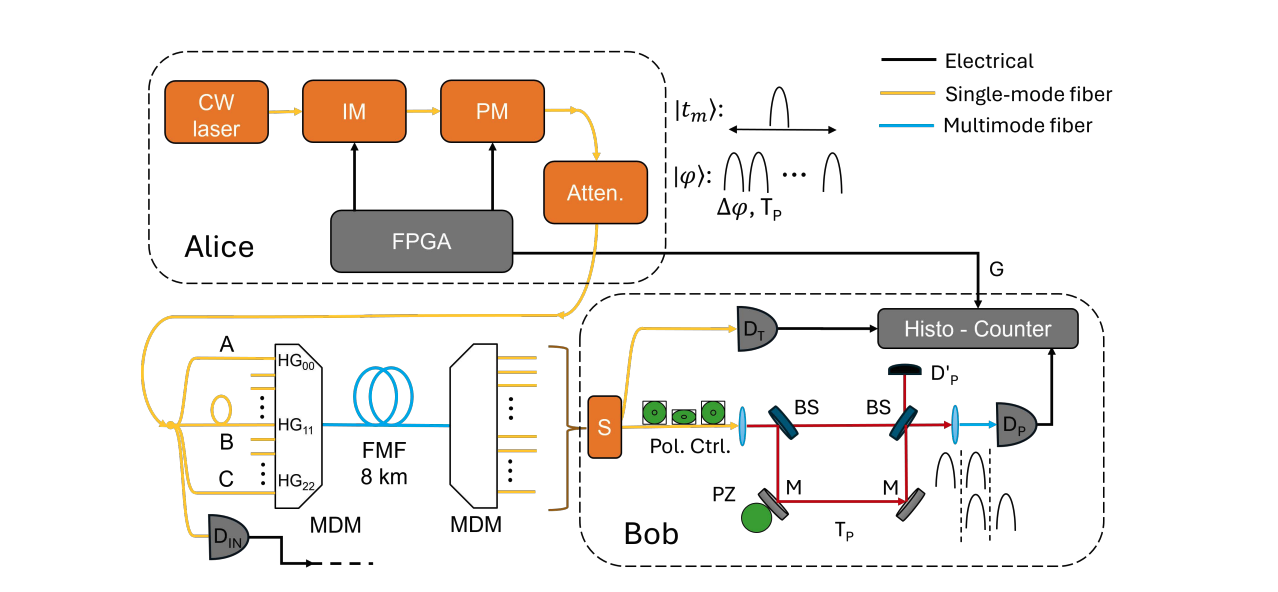
Scientists engineered a space-division multiplexing system to transmit quantum signals through multimode fiber, achieving a data rate of 1. 22 Mqubits per second over an 8 kilometer link. The approach leverages the unique properties of few-mode fiber and strategically utilizes the dead time of single-photon detectors to eliminate unwanted interference between communication channels. This innovative technique addresses a key bottleneck in long-distance quantum communication by mitigating modal cross-talk, a common source of signal degradation. The experimental setup incorporates a transmitter and a corresponding receiver connected by the 8 kilometer multimode fiber equipped with modal multiplexers.
Pulses are created using optical modulators controlled by a high-bandwidth programmable processor, allowing for precise control over the signal’s characteristics. Signals are carefully attenuated to balance signal strength and minimize detection errors. To further enhance performance, the team developed a custom-designed modal multiplexer/demultiplexer based on multi-plane light conversion technology. This device couples 15 spatial modes into the fiber and separates them at the receiving end, enabling parallel transmission of data through different channels. The device operates passively, preserving the quantum state of the transmitted information, and extensive characterization confirms the feasibility of using space-division multiplexing to significantly increase the capacity and reliability of long-distance quantum communication networks.
Quantum Key Distribution and Optical Fiber Security
A significant body of research explores quantum key distribution (QKD), mode-division multiplexing (MDM) in optical fibers, and related topics in optical communication. These studies aim to develop secure communication methods using quantum mechanics, allowing two parties to generate a shared secret key unbreakable by conventional or quantum computing. Mode-division multiplexing increases fiber capacity by transmitting multiple signals simultaneously on different spatial modes. A key challenge is mitigating cross-talk, which degrades signal quality. Researchers are increasingly combining QKD and MDM to achieve both secure and high-capacity communication.
This requires careful consideration of how the characteristics of MDM fibers affect QKD performance. Studies explore various QKD protocols, including time-bin encoding and the use of qudits, which offer potential improvements in key rate and security. Fiber design plays a crucial role, with researchers focusing on multimode fibers that support a large number of spatial modes with low loss and low cross-talk. Ultimately, this research seeks to overcome the limitations of current quantum communication systems and pave the way for practical, secure, and high-capacity quantum networks.
Few-Mode Fiber Achieves Megabit Quantum Rates
This research demonstrates a space-division multiplexing system capable of transmitting 1. 22 Mqubits per second over 8km of few-mode fiber. The system encodes information using both time-bin and phase encoding, effectively utilising the dead time of single-photon detectors to minimise interference between different signal channels. By carefully assigning signal collection to specific spatial modes within the fiber, the team achieved transmission rates closely matching theoretical predictions. The system’s performance relies on balancing several factors, including detector efficiency, frame rate, and insertion loss.
While the current setup achieves a quantum bit error rate of 0. 018, residual crosstalk from fiber imperfections contributes to errors. Future improvements could involve employing fibers with reduced imperfections, utilising more advanced time-windowing techniques, and increasing the number of modes within the fiber to further enhance transmission capacity. The method allows for the extraction of information about both time and phase states, providing a basis for secure communication protocols.
🗞 Efficient Quantum Space-Division Multiplexing Using Time-Bin and Phase Encoding in Few-Mode Fibers
🧠 ArXiv: https://arxiv.org/abs/2509.05123